‘A political decision’: FIU law school community uneasy over new dean with Trump ties
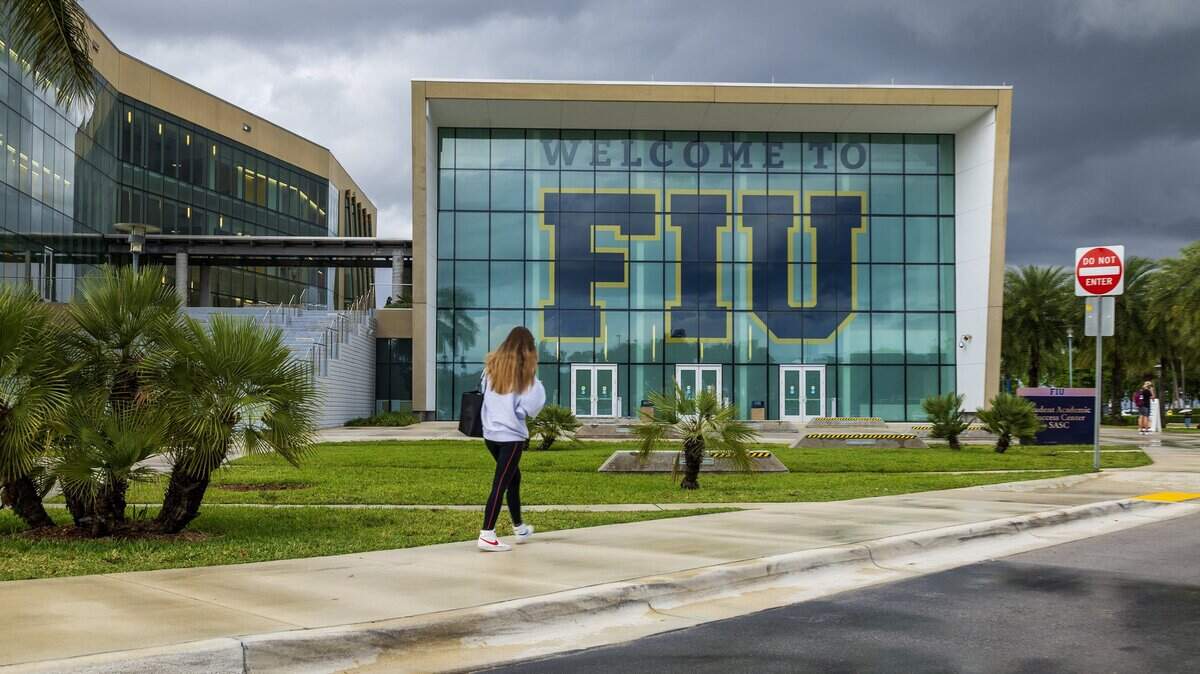
Several of Florida International University’s College of Law faculty members raised questions about how their new interim dean’s politics could change the school at a Monday meeting held to announce the hiring of Daniel Epstein, a conservative legal activist and personal attorney to President Donald Trump, as the new interim dean.
Read more Two men fatally stabbed in Lauderhill. Suspect in custody, police say
They pointed to Epstein’s cover letter, which he submitted when he initially applied for the opening.
Obtained by the Miami Herald, the document lays out Epstein’s early vision of leveraging South Florida’s economic and cultural power — and leaning into conservative politics — to position FIU for success.
Epstein wrote that Ivy League schools are “scrambling” to come across as viewpoint diverse, but are “stuck with the faculty they have, who will block necessary reforms.” He said FIU could offer a contrast.
“The law schools that can build and maintain ties with the conservative parts of the country, intelligentsia, and federal government are poised to benefit, in terms of clerkships, placement in prestigious government positions, faculty and student recruitment, fundraising, and overall prestige. FIU must present itself credibly and be open to different approaches and ideas,” Epstein wrote.
Epstein also wrote that he’d focus on placing students in clerkships with conservative judges, tapping conservative megadonors like Charles Koch and Leonard Leo, hiring more conservative faculty and recruiting students from conservative-aligned undergraduate schools.
When asked about the ideological bent of the cover letter in the Monday meeting, FIU Provost Elizabeth Béjar indicated that thinking had “evolved” since he initially applied for the dean position.
“I see it more as an outline in my conversations, that outline has been revised, has been polished, has evolved, and many months have passed since that outline was submitted,” Béjar said.
She also suggested that faculty members read through his scholarship.
Still, members of the FIU law school community expressed skepticism about what they’ve read from him thus far and expressed confusion as to how he was named interim dean when the search committee hadn’t selected him as a finalist.
FIU leadership decided not to move forward with any of the committee’s three finalists after interviewing them.
“At the end of the day, when the President and I met with each of the finalists, perhaps we hadn’t articulated the appropriate vision moving forward for the College of Law. So, that’s not on the search committee, it’s not on the search firm, that’s on the administration,” Béjar said.
Epstein starts his new role in August.
Epstein did not respond to requests from the Herald for comment on the faculty reactions as of Tuesday afternoon.
As to questions about whether Epstein might transition into full-time dean, Béjar said he was joining “as an interim dean on a tenure-track line,” and that the administration would “cross that bridge in the fall semester.”
Epstein has a long record in the upper echelons of conservative legal circles.
He’s represented Trump in high-profile lawsuits against government agencies and worked for the White House in the president’s first term. Epstein is vice president of America First Legal, the conservative litigation group founded by key Trump advisor Stephen Miller. He also founded a public interest law firm that represented plaintiffs in a landmark Supreme Court of the United States case that curtailed federal agencies’ regulatory power, a ruling cheered by anti-regulation conservatives.
Epstein’s hiring didn’t just raise alarm bells among current faculty. The law school’s founding dean, Leonard Strickman, told the Herald he was concerned about how the search played out.
“Clearly this was a political decision, and it’s extremely regrettable when an academic decision for academic leadership in a law school is made on a political basis without meaningful participation by the faculty,” Strickman said.
“That is an extremely difficult thing for a law school — to be told who’s their dean rather than participating in the process by which a dean is appointed,” he added.
What’s in Epstein’s cover letter?
Much of Epstein’s cover letter for the role is devoted to growing FIU’s prestige and bringing in more donations to the school.
“UF and FSU are fundraising and getting students from Miami, where schools like FIU should have a natural advantage. Students from Miami go to UF’s law school to train, then go back to Miami to work at firms. There’s a huge opportunity here to cut out the middleman by making FIU the best law school in the state,” Epstein wrote.
Read more A conservative court’s rebuke to Trump ends his attacks on Miami families | Opinion
He suggests selling Miami as a higher quality of life destination for students who would otherwise go to those schools or out of state – “the vision should be Ann Arbor (in Michigan) on the beach,” he wrote.
Epstein wrote that he would look to boost FIU’s status in national rankings, fundraising, elite job placement, faculty prestige, social media visibility and student recruitment.
He said he would seek to “leapfrog” traditional law firm recruiting departments and strengthen relationships with higher-ups at some of the country’s leading law firms. He also said he’d build a personal relationship with “every federal and state appellate judge in Florida.”
In one section of the document, Epstein suggested that the college should recruit 40% of its students from “high network-density colleges,” listing off both elite private colleges and “conservative colleges” like Hillsdale College in Michigan.
Then, Epstein suggested recruiting students with “personal networks in high-legal talent communities,” producing a laundry list of thriving cities and affluent suburbs in populous states.
The three Florida communities mentioned in the list are Miami Beach, Boca Raton and Palm Beach; Epstein listed 39 California communities and 11 New York communities.
Epstein mentioned a handful of potential areas of scholarly focus that would fit the Miami area: Latin America, cryptocurrency, private equity and real estate.
Other parts of the letter were more explicitly conservative.
In speaking of his goal to raise at least $5 million a year to support hiring, scholarships and programming, Epstein’s “initial targets” were all conservative megadonors. In addition to Leo and Koch, he mentioned billionaire hedge fund manager Paul Singer, a “conservative political network” including Commerce Secretary Howard Lutnick, the Searle Foundation and the Hertog Foundation.
In laying out a vision for student recruitment, Epstein said he would focus his efforts on high-performers as well as conservatives.
“Massive merit scholarships for LSATs over 170. Focus on getting the top students clerkships, especially with conservative judges, where FIU will have a natural advantage. Once it starts placing clerks on the Supreme Court, the top students will fall in line every year,” Epstein wrote.
Epstein also said he’d recommend making three to five “major senior” faculty hires “targeting mainly, though not exclusively, conservatives.”
Scott Norberg, who was a founding associate dean when the school started 25 years ago, spoke at the faculty meeting and later told the Herald the letter didn’t align with what he saw as the school’s initial ideal.
“I would say that politicizing the program poses a lot of risks and no clear upside,” Norberg said.
Strickman said if he were to offer advice to Epstein, it would be to cut politics out of the picture.
“I would advise him to drop politics and political ideology as a theme of his deanship, and to try to make academic excellence the guiding light. Academic excellence is above ideology,” Strickman said.
In addressing a faculty question Monday, Béjar indicated that she’s seen a shift in his vision.
“In my conversations with him over the last two months, it is a much more polished vision of really ensuring that legal issues, challenges, problems can have multiple perspectives – all perspectives… I think it’s a fair question that you can ask him,” Béjar said.
Read more A conservative court’s rebuke to Trump ends his attacks on Miami families | Opinion









Post Comment