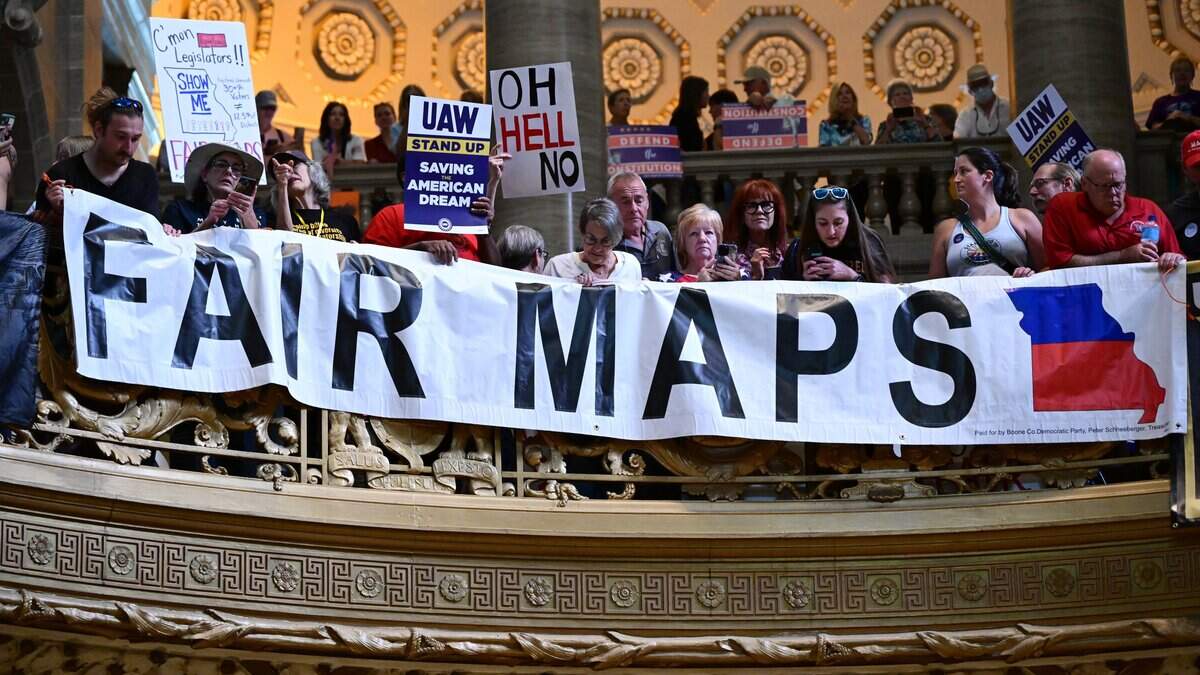
What does the Missouri Supreme Court’s gerrymandered map ruling really mean?
When the Missouri Supreme Court blocked the state’s gerrymandered congressional map on Thursday, the decision sent shockwaves across the country.
Read more Kalshi is betting that an app in Spanish connects with users
The court, in a unanimous decision, barred Republican Secretary of State Denny Hoskins and “all of those acting in concert with him” from conducting the Nov. 3 election using the map.
The seismic ruling marked the culmination of a months-long redistricting fight in Missouri spearheaded by the Trump administration. Lawmakers drew the map in the hopes of ousting U.S. Rep. Emanuel Cleaver, Kansas City’s longtime congressman.
But the ruling also left a series of unanswered questions that still loom over the upcoming election.
In the wake of Thursday’s order, The Star examined what the court did and did not decide — and what you should know ahead of the election.
What, exactly, did the court decide?
The court ordered Republican Secretary of State Denny Hoskins to place a referendum seeking to strike down the map on the Nov. 3 ballot.
The decision found that the referendum was legal and Hoskins was wrong to reject the campaign from the ballot last month. Missouri law allows citizens to hold a referendum on redistricting, the court said.
A campaign called People Not Politicians used a referendum, a mechanism for direct democracy that allows citizens to challenge laws, and collected more than 305,000 signatures to force a statewide vote on the map.
That order also barred Hoskins from conducting the Nov. 3 election using the new map.
Why is the map blocked?
That decision builds on a court ruling from May, which said that if Hoskins certified the referendum for the ballot, then the map never would have gone into effect until voters approved it at the ballot box.
The court emphasized that decision on Thursday. The map, the ruling said, is not in effect unless voters approve it on Nov. 3.
If voters approve the map at the ballot box, it would take effect 30 days after the election.
So, which map is in effect for the Nov. 3 election?
As of Thursday’s ruling, the congressional map lawmakers approved in 2022 based on 2020 U.S. Census data is in effect.
“(The) 2022 map is the only map in effect,” Judge Ginger K. Gooch wrote in a footnote in the ruling.
Read more Former Kentucky Gov. Matt Bevin’s arrest: Here’s what we know
Will that decision stand?
Republican Attorney General Catherine Hanaway said she will ask the U.S. Supreme Court to overturn the decision.
But any challenge to the state Supreme Court’s ruling would have to be lightning fast. State law bars judges from adding items to the ballot after Tuesday, a tight deadline that could scramble Hanaway’s efforts to overturn the ruling.
The state Supreme Court on Friday rejected Hanaway’s request for a stay on the ruling pending her emergency appeal.
What happens now?
Good question. The decision has sparked a series of unanswered questions about how Missouri will handle the upcoming elections. The state already held primary elections using the new map.
The directors of the Jackson County Election Board on Friday made clear that they were equipped to change the map for the November election, a statement that undercut claims from President Donald Trump and others that it was too late.
The state Supreme Court also ruled that the map never went into effect. But the court did not weigh in directly on the legality of the August primary, potentially opening the door for candidates to file lawsuits against the results of that election.
How did we get here?
Hoskins and other Missouri Republicans have attacked the ruling, alleging that the decision created chaos for the state’s elections. Some have attacked the court as too liberal and called for changes to how the state picks judges.
But the decision came after Hoskins repeatedly used the powers of his office to block — or at least delay — the referendum from appearing on the ballot.
He previously tossed out nearly 90,000 of the campaign’s signatures. He waited until the day of the Aug. 4 primary election to reject the referendum for the ballot. And he pressed forward with the new map despite legal questions about whether it was in effect or not.
The court, in the unanimous decision, placed the blame for the chaos directly at Hoskins.
“Regardless of any confusion, expense, or practical difficulties caused by the secretary’s delay and incorrect assumption about whether the referendum petition would be deemed sufficient,” Gooch wrote, “simply continuing to utilize the congressional redistricting in HB 1 does not comport with the Missouri Constitution because the 2022 map is the only map in effect.”
Five of the court’s seven judges were appointed by Republican governors. Gooch was appointed to the court by Republican Gov. Mike Parson.
This story was originally published September 4, 2026 at 2:38 PM with the headline “What does the Missouri Supreme Court’s gerrymandered map ruling really mean?.”
Read more Overhaul Florida’s ‘failing’ Department of Children and Families, senators say








Post Comment