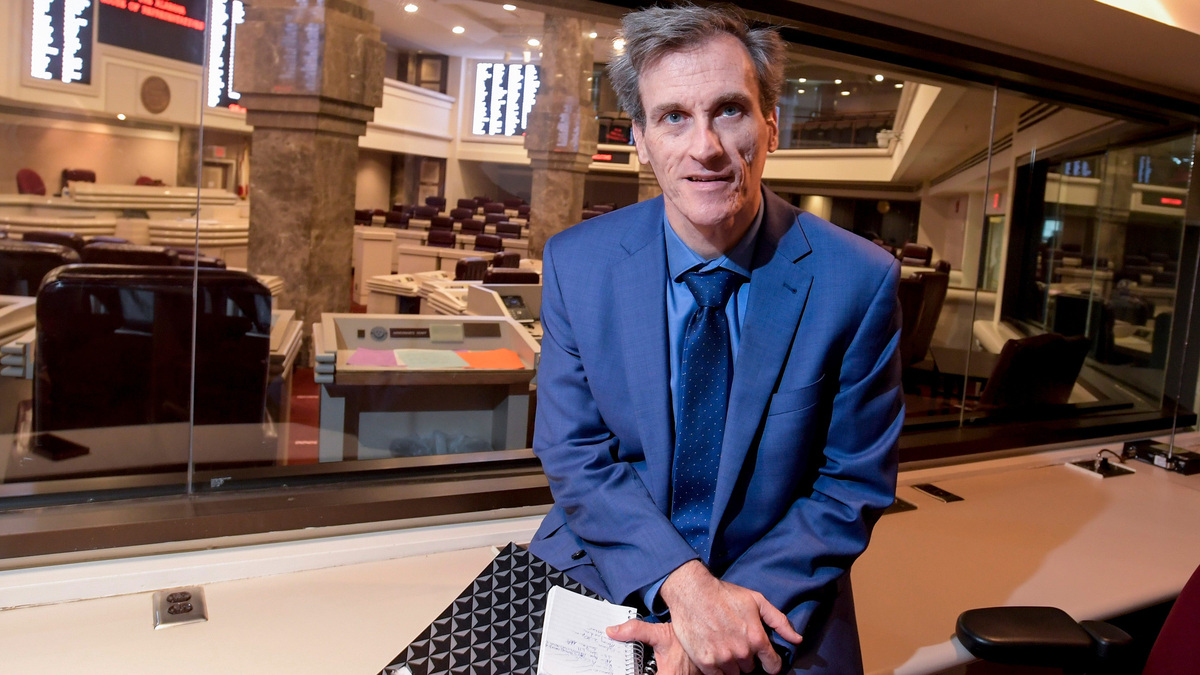
Tuberville’s plan on data centers has good ideas, flaws | BRIAN LYMAN
Tommy Tuberville’s data center plan has some good ideas. The problem is that they’re good ideas for long-term constitutional reform, not the pressing challenges these large-scale facilities pose.
Read more Companies left China to dodge tariffs. Now some are heading back
And even if he’s serious about giving communities the power to say no to data centers, his proposal lacks a key requirement to make those objections meaningful.
But I will give Tuberville (or his handlers) credit. After weeks of belittling data center opponents and treating the facilities as inevitabilities, he has – for now – stopped mouthing the triumphalist rhetoric to hear what people are saying.
Data centers are about as popular as Tennessee in Tuscaloosa on the third Saturday in October. They’re loud, they consume a ton of electricity, and they threaten water supplies. In a state that already has some of the South’s highest residential electricity rates, you shake the pom-poms for data centers at your peril.
So at first glance, the approach Tuberville outlined in Alabama Political Reporter makes sense. Tuberville proposes letting communities decide whether they want a data center. He would extend an Alabama Power rate freeze past 2029 to prevent customers from subsidizing the facilities’ power consumption.
Tuberville also says that he wants data centers to pay full price for water and electric infrastructure, and to “replace the power and water capacity they take.” And he wants to place data centers “in Alabama’s highest property tax bracket, where they should be.”
This is all reasonable, though it’s less about addressing impacts than trying to make data centers more attractive. The Alabama Power rate freeze is fine, though extending it beyond 2029 would depend on a Gov. Tuberville appointing an energy secretary who does not uncritically accept everything the utility says.
Data centers should pay for water and electric infrastructure, but it’s not clear how the state could force that outside a law or by leveraging economic incentives. The former couldn’t pass before next February at the earliest. Negotiations for the latter are opaque and usually revealed after the fact.
But two other points in the plan that cause problems.
Who resides in Alabama’s highest property tax bracket? Utilities providing utility services. Under that delightfully ruinous 1978 constitutional amendment known as the lid bill, the state taxes utility property at 30% of its assessed value.
Putting data centers in this bracket could be politically and constitutionally tricky. But let’s assume you could.
Take the $1.5 billion project Red Clay proposed in Lowndes County. (Tuberville in his op-ed wants you to imagine a $12 billion data center bringing in $150 million in revenue. There are no projects of that scale currently planned here.) Assuming the fair market value of Red Clay is $1.5 billion, Lowndes County would get about $17.3 million a year in property taxes under Tuberville’s plan.
I’m sure that money would be welcomed. Would the noise? Or the electricity and water consumption? Tuberville does not propose any regulation to mitigate the impact of data centers after they’re built. The Red Clay developers say they will pay for water infrastructure improvements, but I’m not sure how far that will go in the Black Belt, long plagued by problems with water supply.
Read more Chevron eyes Argentina, Mediterranean for global LNG growth, deal with India
And if you multiplied that by eight, to a $12 billion facility? Well, $150 million might not be enough. Amazon, which is building a $12 billion data center in Louisiana, is putting $400 million into local water infrastructure there.
Fine. A community could look at the proposal and say no under Tuberville’s plan.
Except Tuberville doesn’t say how he would do this. Alabama’s constitution severely limits county government powers. The Legislature might grant zoning powers to local counties, or you could get a constitutional amendment.
And that loud, angry gurgling you hear from Goat Hill is the custodians of Alabama’s top-down government contemptuously spitting out the phrase “home rule.” The Alabama Farmers Federation, arguably the most powerful interest group in the Republican coalition, has traditionally opposed anything moving powers from state government.
So you’d have to overcome their likely opposition. You’d have to marshal the votes in the Legislature. If you got an amendment, you’d have to send it out for a vote, a vote unlikely to occur before 2028. (Also, the governor has no direct role in this process.)
That’s a lot of time for data centers to sink roots into communities as the process grinds on. And it assumes the Big Mules wouldn’t suffocate the proposal first.
To make community input mean something, you have to pause development long enough for local governments to get the power to decide. Democratic gubernatorial nominee Doug Jones has proposed a one-year moratorium on new data center construction. Tuberville blasted Jones for the proposal in his op-ed. But practically speaking, local empowerment means nothing if developers build their facilities before a county commission can say no.
It’s good to see Tuberville taking this issue seriously. But intentionally or not, his plan won’t let Alabamians decide whether a data center is a good fit. In fact, it could give developers a window to make local opinion meaningless.
If Tuberville is talking about constitutional reform, I’ll be there with him. But if he’s serious about addressing data center concerns, his plan needs more details, more safeguards and a lot more urgency.
Brian Lyman is the editor of Alabama Reflector. He has covered Alabama politics since 2006, and worked at the Montgomery Advertiser, the Press-Register and The Anniston Star. A 2024 Pulitzer finalist for Commentary, his work has also won awards from the Associated Press Managing Editors, the Alabama Press Association and Robert F. Kennedy Center for Human Rights. He lives in Auburn with his wife, Julie, and their three children.
Alabama Reflector is part of States Newsroom, the nation’s largest state-focused nonprofit news organization.
This article originally appeared on Montgomery Advertiser: Tuberville’s plan on data centers has good ideas, flaws | BRIAN LYMAN
Read more Pratt voters could play pivotal role in deciding LA’s next mayor
Reporting by Brian Lyman, Alabama Reflector / Montgomery Advertiser
USA TODAY Network via Reuters Connect
Copyright Reuters or USA Today via Reuters Connect
This story was originally published September 14, 2026 at 4:47 AM.










Post Comment