Stores sometimes play ‘confuse the consumer’ to sell pricier goods, professor says
Time is money. The simple phrase generally means time is a valuable resource and wasting it is like throwing away money.
Read more Fate of killer who suffocated his wife, her young girls is in hands of the jury
But in this time of high prices for everything from groceries to gasoline, let’s take it as meaning something else: Taking time to make smart choices as a consumer will save money.
That means shop the circulars before you shop the stores. Use apps and customer loyalty reward programs. Make a list, both to ensure nothing is forgotten and to avoid impulse purchases. It means look not just at the price of a food product but its price per ounce. Compare prices of major-brand vs. store-brand products
Consumers are really “getting hammered” by high prices at every turn, Stanislaus State University’s Foster Farms Endowed Professor of Business Economics Gökçe Soydemir told The Modesto Bee in a recent interview. Stanislaus State University is in California’s Central Valley, south of Sacramento.
Consumers have to fight back, he said, “and one way to do that is to shop at different places and find out what’s cheaper in one store and cheaper at another store. I know it’s more cumbersome to do it, but the feeling that high costs are being passed onto you as a consumer is terrible.”
Soydemir leads the San Joaquin Valley Business Forecast, a regional economic outlook that tracks and forecasts key economic trends across the San Joaquin Valley.
He noted that the Consumer Confidence Index, a monthly survey of US consumer attitudes, spending plans and expectations for inflation, stock prices and interest rates, fell from 88.6 in August to 81.9 in September. That is the lowest level since 2014.
“There’s a very well-defined gradual, slowly evolving decline in consumer confidence that we’re tracking very closely, and it’s quite concerning,” Soydemir said. “… When it dips down to 70, that’s when recessions occur, and we’re not too far from it.”
It’s always important for consumers to look out for themselves, the professor said, and he shared with The Bee some ways to do just that.
Plan your trips
We all have a favorite couple of stores, but shopping them blindly can mean you’re missing bargains.
Decades ago, before the internet, “Let Your Fingers Do the Walking” was the slogan for the yellow pages business telephone directories. Now, our fingers walk across our phone screens to compare prices through Google Shopping and other tools.
Sodemir said he frequently uses AI to quickly hunt for best buys.
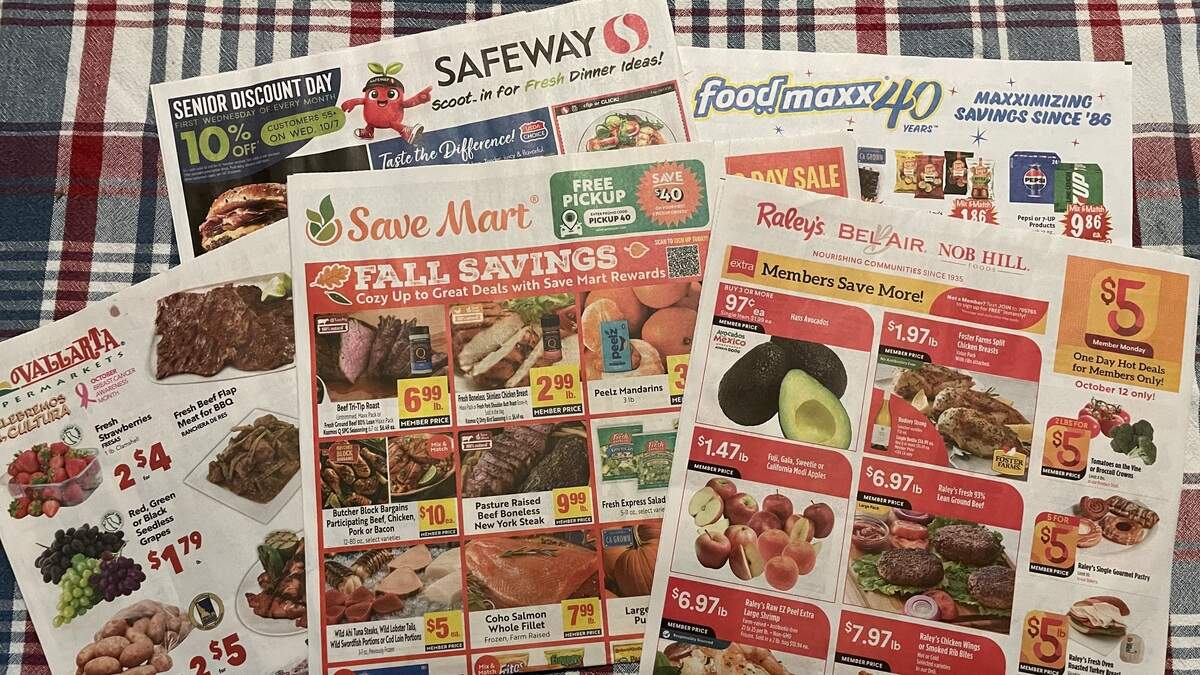
The old-school version of online searching remains the weekly circulars now found in mailboxes instead of tucked into newspapers.
One week this month, it was easy to compare prices of “fresh boneless, skinless chicken breast” and “beef boneless New York steak” at Save Mart and Food Maxx. The chicken was $2.99 a pound at Save Mart and $1.99 a pound at Food Maxx if purchased in a “Maxx Pack.” The steak was $9.99 a pound at Save Mart and $8.86 a pound at Food Maxx — again if bought in a Maxx Pack.
Stay focused, but don’t wear blinders
Make a shopping list and try to stick to it. But don’t be so laser focused on buying Brand X when Brand Y of essentially the same product may be on sale right next to it.
Stores want you to buy more than you came for. That’s one of the reasons they change things up, occasionally moving products among aisles. Having to hunt for what you’re looking for means you’re more likely to stumble across something not on your list.
“Stores also strategically place the dairy department at the back of the store so we’ll have to wander past lots of other potential purchases on our way to grab milk or eggs,” says a story on HuffPost.com. “And they stock candy and soda by the checkout lanes, where we might be inspired to make one last inexpensive impulse buy.”
Read more Florida Bar looking into racist DMs from employee’s account to Canes lineman
Stores sometimes play “confuse the consumer” as a way to sell higher-priced goods, Soydemir said. There may be a very cheap deal offered, “but it’s gonna be in a tiny, tiny, small corner, and then you won’t notice it, right?” And if you can’t quickly find a store employee, you buy something else.
One reason a sale item is tucked away is that it may be low in inventory, the professor said. And when the shopper can’t find it, or it sells out, “you’re gonna say, ‘OK, I can’t look for it anymore. I’ll just get this higher-priced frozen pizza,’ for example.”
Rules of thumb — and exceptions to them
Shoppers learn to believe certain rules of thumb: House brands are cheaper than name brands. Buying the larger package — “family size,” or “giant size” — means the product’s per-ounce price is lower. Clearance items are deeply discounted.
For the most part, these things are true.
Take over-the-counter medicines, for instance. If a doctor says, “Just take Tylenol as needed,” some patients will swing by the pain-relief aisle to buy exactly that. But the active ingredient in Tylenol is acetaminophen, which is available much cheaper in house brands.
So when Sodemir finds a generic product with a label that invites the buyer to “compare to the active ingredient” in a more expensive version, he doesn’t hesitate. “I wouldn’t even look at the ingredients,” he said. “If it says substitute, and it’s cheaper, I get it immediately. Because there has to be truth in advertising, particularly in medicine and over-the-counter drugs. Going with those options saves you a lot of money for sure.”
Sometimes, though, a brand name on sale will be less expensive than the house brand. Or the larger container is not cheaper by the ounce. It’s a good habit to look closely at the price on the shelf, though you can’t always trust even that.
For instance, at the Walmart on McHenry Avenue in Modesto (and online), State Fair 100% beef corn dogs sell in a five pack for $4.84 (the sticker says 36.4 cents per ounce) or in a 16 pack for $13.62 (sticker says 56.8 cents per ounce). That indicates the larger pack is more expensive per ounce, but the math is wrong. The cost per corn dog is about 96 cents by the five pack and about 85 cents by the 16 pack.
As for clearance items, look for the sticker that states the original and discounted prices. Then pull out your phone to comparison shop. Perhaps the clearance price still remains higher than what other stores are asking. Or the discount is not much — if anything at all.
A few years ago, a customer could not find the lower price on an item in a Modesto store’s clearance section and asked a store employee to price-check it. The price had not been lowered, the employee said, because “clearance” sometimes means only that the product won’t be restocked on the regular shelves.
Don’t get caught short
When you see you’re running low on an item, find the best buy before you’re in a pinch, Soydemir advised, It’s especially important when the product is a lot pricier than a loaf of bread or a gallon of milk.
The professor offered his purchase of pool shock as an example.
He did an AI search to find the lowest price, which was at The Home Depot. The exact product he wanted was out of stock at local stores, but he was able to order it online from the store.
“Plan ahead, you know? Do not leave it to the last day, where you have no option but buy it at a higher-priced option,” he advised. “Plan ahead so you can order through like Walmart or Amazon or Home Depot so that you get that lower price.”
The power consumers hold
Consumers are basically the biggest economic group in the U.S. and any country, Soydemir said, but they don’t pull together like a special-interest group. “Because they’re so big, it’s very hard for them to organize and vectorize themselves,” he said.
When faced with higher costs themselves, Soydemir said, stores will absorb what they must and pass on to shoppers what they can. “If all the consumers got together and curb their spending in certain items,” he said, “then you’ll see how fast the those prices come down.”
This story was originally published October 19, 2026 at 5:45 PM with the headline “Stores sometimes play ‘confuse the consumer’ to sell pricier goods, professor says.”
Read more Fate of killer who suffocated his wife, her young girls is in hands of the jury












Post Comment