From Fleetwood Mac to Future: Why your favorite song may come from North Miami
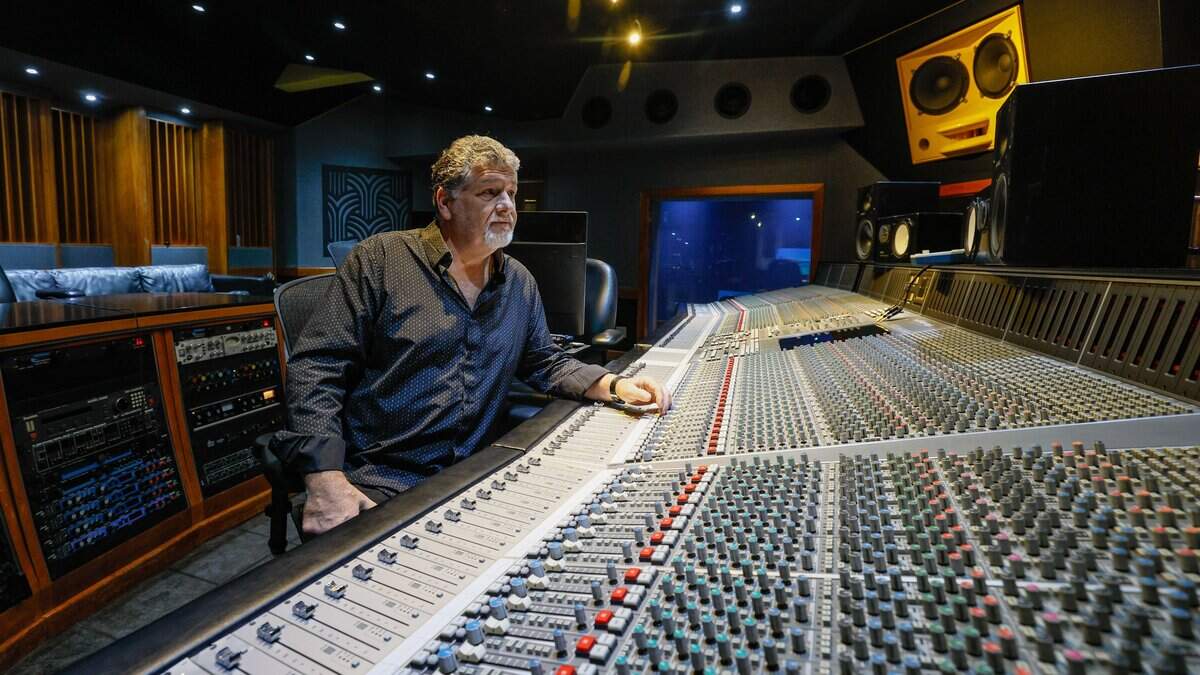
At North Miami’s Criteria Studios, artists as disparate as Latin pop queen Gloria Estefan and British heavy metal headbangers Judas Priest have crossed paths as they recorded in adjacent studio rooms.
Read more The Underline’s bike and walk trail is complete. It’s named after a billionaire
In front of the studio’s wrought-iron gate, Justin Bieber lured throngs of teenaged fans to the business warehouse corridor while recording his “Believe” album in 2012.
In Studio A, sound engineers dropped four- and five-pound phone books, miking and mixing them just so, to help achieve an explosive closing sound for the Bee Gees’ 1979 smash hit “Tragedy.”
Criteria’s Studio C is where the Eagles opened the doors to “Hotel California.” Where Black Sabbath delivered “Heaven and Hell.” And it’s where Jimmy Buffett lost his shaker of salt in “Margaritaville.”
This is the universe of Criteria Studios, an unassuming two-story building where, since 1958, everyone from James Brown to Aretha Franklin and Lil Wayne to Lynyrd Skynyrd has recorded music. If you think you haven’t heard something recorded at Criteria, you have — songs tracked there include Eric Clapton’s “Layla,” Britney Spears’ “Hot as Ice” and James Brown’s “I Got You (I Feel Good).”
This year marks the 50th anniversary of some of its greatest contributions to the American recording canon, including parts of the Fleetwood Mac album “Rumours,” the Bee Gees’ hit “You Should Be Dancing,” the Eagles’ “Hotel California” album, and Buffett’s “Changes in Latitudes, Changes in Attitudes” album and its breakout single “Margaritaville.”
“That matters from a historical perspective,” says studio vice president Trevor Fletcher.
As Fletcher led guests on a tour of the building recently, he casually pointed to an unlikely spot where another piece of music history was made. It was in a small hallway bathroom that Bob Seger recorded vocals for his “Like a Rock” title track in 1985. While the adjacent Studio C was good enough to record hundreds of legendary recordings, for his lead vocal, he insisted the bathroom had better acoustics.
Criteria’s still open 24/7, says Fletcher. The 61-year-old has run the studio since 1983.
His mom got a job answering phones there in 1969. He still remembers being 5, asleep in a room at Criteria, when the sounds of Duane Allman’s electric guitars, Jim Gordon and Bobby Whitlock’s chunky grand piano and Eric Clapton’s anguished vocals came leaking through the walls from a dubbing session. The clatter caught the kid’s ears. It was Derek and the Dominos’ “Layla,” he recalled.
Fletcher’s favorite only-at-Criteria moment? Well, that actually happened in the parking lot.
He was in his second-floor office, “and I hear an automotive honking horn and it’s going on and on and on. I’m like, ‘Good Lord, what’s going on in this studio that somebody’s honking that excessively in the parking lot?’”
It was punk rocker Iggy Pop.
“He’s got a, I don’t know, an early-‘70s Cadillac convertible with the hood up. There’s all kinds of cables and microphones and stuff stuffed in the hood of the car. And he’s honking away. I figure, OK, there’s probably a good reason for this. ‘Iggy, what’s going on, dude?’” Fletcher asked.
“I’m doing horn overdubs,” he responded.
You can hear Iggy Pop’s resulting “horn section” at the three-minute mark on the abrasive track “Ugliness” from his “Beat ‘Em Up” album released in 2001.
Founder Mack Emerman opened Criteria as a one-room studio with his pioneering mixing consoles and soundboard equipment in 1958. He expanded in 1966, and it has grown and been remodeled frequently over the decades.
In 1999, New York’s Hit Factory bought Criteria but kept its original name attached. It’s been back to just Criteria Studios since 2017.
READ MORE: This studio is the birthplace of the Miami sound. Here’s how the music started
Criteria remains viable in its 68th year even as Miami has grown up and around it, and there’s a roster of current acts to attest to the neighborhood studio’s resilience. Megan Thee Stallion, Young Thug and Future just wrapped projects at Criteria. Bruno Mars, who was in town in September for two packed concerts at Hard Rock Stadium, popped over to Criteria to cut a track, Fletcher said.
Pitbull, as well as Timbaland, Missy Elliott, Michael Jackson, R.E.M. and Mariah Carey have all tracked here over the last half-century, even as the music industry has shifted in countless directions.
Songs tracked here account for more than 507 billion streams between 2006 and 2017 — and that’s not counting Apple Music or Pandora streams, or the billions in the last decade, said Fletcher, who’s still tabulating.
The trend today leans on artists recording from home and using audio “plugins” and producer-crafted “presets” — digital tools and custom settings that can add effects, emulate vintage gear or pitch-correct a singer’s voice. Often purchased outright, the software helps musicians achieve commercial-quality sound or capture a trending sound while bypassing expensive studio rates that can run in the thousands per day.
But Criteria’s managed to remain competitive.
This, despite the closure of other famed studios, including Los Angeles’ Record Plant, where Fleetwood Mac recorded the bulk of “Rumours” and Beyoncé cut “Lemonade.” It closed in 2024. Chung King Studios in New York, which pioneered hip-hop productions and trailblazing rap acts like the Beastie Boys and Run-D.M.C., shuttered in 2015.
But there’s a sound to be had here. A Miami sound. A history.
Sometimes, it’s about using the same mic that your favorite singer used for inspiration.
“Some people enjoy the opportunity to stand in the footsteps of legends and perform in the same environment, the same space, breathe the same air. That motivates people,” Fletcher said. “If you are an artist and someone gives you a full palette of colors to use in the creation of your art, you’re going to do better art than if you’re confined to blue or green or yellow only.”
As far as the difference between 1976 and 2026?
“That would be most things — and not just the shag carpet,” Fletcher quips. “From production, distribution and consumption methods, to musicianship, the idea of one producer for an entire album, the level of knowledge and expectations of the artist, as well as the record labels — it goes on and on.”
Artists recording at home “is certainly a major factor in why so many large-format studios have closed down worldwide,” Fletcher continues. “Musical tastes have changed as well. There are fewer instances of live bands recording together in the same room.”
Today, Fletcher motivates his staff of engineers and other technicians by telling them that although these are “the dark ages of the craft of audio recording, we’re a monastery.”
“We’re keeping the craft of recording acoustic instruments with microphones in live, viable recording spaces. I think that’s incredibly important for the next generation of music makers, of creators, of producers, of artists, to have access to classic techniques and vintage microphones and very well-built rooms and staff that’s highly trained. All of those things put an artist or creator in a position to do their best work — to do groundbreaking, history-making music,” he said.
Here’s more of the story of Criteria Studios, as told through seven of the most famous artists to ever record there.
Read more This potluck wants to bridge Miami’s faith divides over food
Gloria Estefan
Since 1990, Gloria and Emilio Estefan have run their own Crescent Moon Studios on Bird Road in Southwest Miami. It’s a world-class recording studio in its own right. Estefan and others — including Shakira, Jennifer Lopez, Ricky Martin and Juanes — have tracked projects there. But all of them headed 25 miles north to Criteria, too, to capture specific sounds.
Estefan, for instance, utilized both studios for her first all-Spanish-language album in nearly 20 years, “Raíces,” recording parts of it at Criteria in 2025.
“Although I absolutely LOVE my studio and it’s my happy place and has been since we opened it … there are some size limitations when we want to record the whole band live, or even record a live piano,” she said.
Since early on in her career, Estefan said just pulling into the parking lot at Criteria has “made me feel like we were a part of something very special.”
She recalls recording the 1987 “Let It Loose” album at Criteria, the first to put her name on LP covers ahead of the previous Miami Sound Machine band title. The first single, ”Rhythm Is Gonna Get You,” was added to the National Recording Registry in 2018. Judas Priest was mixing its thunderous “Priest…Live!” album in a room next door.
In the mid-1980s, before the advent of computerized boards, a handful of engineers alongside the performers would hover over the soundboard, fingers ready to mute or turn on tracks on the count of three. Then they would splice together, literally, the pieces of tape the musicians, singers and studio technicians had created.
“I have memories of our editor, the one doing the physical splicing, with the pieces of tape hanging around his neck in the order they were supposed to be put together,” Estefan said. “So at one 3 a.m. session, with a giant Big Gulp sitting next to him on the floor, all of the pieces slipped to the floor, and it took quite a bit of time for us to run those pieces through the tape machine and sort out the jigsaw puzzle of sound we had created to be able to piece them back together.”
Eric Clapton
Eric Clapton put the address “461 Ocean Boulevard” in everyone’s Rolodex after renting a nearby Golden Beach home as his base while recording that career-rejuvenating album at Criteria in 1974. He scored his first U.S. No. 1 with its single “I Shot the Sheriff,” a cover of a Bob Marley tune.
At that time, Clapton told the floundering Barry, Robin and Maurice Gibb of the Bee Gees that a change in scenery from a cold, damp and dark England winter to sunny South Florida could inspire them again.
The move worked. The brothers settled in Miami Beach more than 50 years ago with their growing families.
Bee Gees
The Bee Gees’ first South Florida effort was the “Main Course” album, recorded at Criteria in 1975. The first single, “Jive Talkin’” and its distinctive “chunka-chunka-chunka” rhythm track, was inspired by the sound of their “drive talking” as the wheels of their car rolled over a drawbridge that took them from their Miami Beach homes to Criteria.
That offhand “Listen, it’s our drive talking” comment from Linda Gibb to her husband Barry gave birth to an R&B-pop classic when savvy producer Arif Mardin tipped the Australian and British ex-patriots to the American urban slang of the ‘70s — “jive talking.”
The Bee Gees’ Criteria-built follow-ups included “You Should Be Dancing” from the 1976 “Children of the World” album that was remastered and reissued on Oct. 30 as a 50th anniversary audiophile “Vinylphile” vinyl record edition. The release was restored from master tapes originally cut at Criteria.
“How Deep Is Your Love,” “Stayin’ Alive,” “Night Fever,” “Love You Inside Out” and “Spirits Having Flown” also emanated from this studio. So did three consecutive No. 1 hits in 1977 and 1978 from youngest brother Andy Gibb: “I Just Want to Be Your Everything,” “(Love Is) Thicker Than Water” and “Shadow Dancing.”
READ MORE: Barry Gibb joins country partners to bring his songs alive again. ‘I just want my brothers’
Barbra Streisand
By 1980, Barry Gibb began writing songs for Barbra Streisand’s “Guilty” album with his brothers and co-producer Albhy Galuten while simultaneously building and opening their own Middle Ear Studio that, for 25 years, was tucked just off Miami Beach’s Venetian Causeway on Bay Road close to their homes. Still, as producer and songwriter, Barry Gibb recorded his “Guilty” demos at Criteria as a vocal guide for Streisand.
The rhythm tracks for the album’s Top 10 singles “Woman in Love,” “Guilty” and “What Kind of Fool” were also recorded at Criteria by its engineers, including Dennis Hetzendorfer, who had a long history recording the Bee Gees, Andy Gibb, and pop-rock acts America and Grace Slick at Criteria in the 1980s.
Fittingly, the final project recorded at Middle Ear, with parts also cut at Criteria and on Streisand’s scoring stage in Los Angeles, was her 2005 sequel album, “Guilty Pleasures,” which reunited Barry Gibb and Streisand.
ABBA
Even global superstars ABBA cut one — and only one — song outside its Sweden home base in its entire career. They chose Criteria for a rhythm track for their dance floor staple “Voulez-Vous” in February 1979. ABBA’s four members said they wanted to record in the same studio where the Bee Gees recorded hits like “Jive Talkin’” and “You Should Be Dancing.”
South Florida disco act Foxy (“Get Off”), with percussionist Joe Galdo, played on ABBA’s track to give it that era’s Miami sound. Producer-engineer Tom Dowd, who was hot from producing Rod Stewart, Clapton and the Allman Brothers at Criteria, ran the soundboard.
A few months earlier, in 1978, ABBA had released the single “Summer Night City,” consciously echoing the disco-era Criteria sound of the Bee Gees. Unbeknownst to the Swedes, the Bee Gees had also composed the “Saturday Night Fever” hit “If I Can’t Have You” with ABBA in mind.
“What we used to do as kids is write songs for artists that we adored and idolized, and we’d imagine, ‘What would their next record be?’ And then we’d sing it, and it would be a Bee Gees record,” Maurice Gibb told the Herald in 2002.
Fleetwood Mac
Criteria Studio’s Studio C room, one of its more historic studios, is where Fleetwood Mac started the process of spreading “Rumours” in 1976 before returning to its L.A. base.
Lindsey Buckingham cut several of his lead guitar parts for “Go Your Own Way” at Criteria. That stinging sound propelled the lead single from “Rumours” to become the group’s first Top 10 hit and his signature song. Buckingham and Stevie Nicks’ rage-baiting soundtrack of songs like “Silver Springs,” “Dreams” and “Go Your Own Way” began in Miami — who knew?
Soon, millions more will get hip to that local history. Apple Original Films will premiere director Frank Marshall’s fully authorized documentary “Fleetwood Mac: The Chain” on Apple TV on Jan. 29, 2027 — almost 50 years to the day “Rumours” was released on Feb. 4, 1977.
Tom Petty
Gainesville’s Tom Petty, before forming the Heartbreakers from members of his earliest band Mudcrutch, drove to Criteria’s studio in North Miami for a whirlwind September 1971 session to record a track that he could not afford.
A former bandmate, drummer Randall Marsh, helped cobble together $800 to pay Criteria’s booking fee — more than $6,000 in today’s money — to work with the studio’s top in-house producer Ron Albert.
The resulting Criteria song, then 20-year-old Petty’s rare “Up in Mississippi Tonight,” received some AM radio play in Gainesville at the time. It’s the oldest track issued on the “No Sleep Til L.A.” disc, the opening centerpiece of Universal’s just-released boxed set “Origins: 1971-1978,” which was posthumously released on Nov. 6.
Read more Why a South Carolina oysterman is planting 4,000 wooden stakes in the mud
This story was originally published November 13, 2026 at 5:00 AM.






Post Comment