Fewer lives lost: Miami-Dade hits lowest murder count in nearly 60 years
Miami-Dade County has come a long way from its place in popular culture as an area where murders are rampant.
Read more This Arctic plant has a bad rep. Florida scientists are trying to exonerate it
Last year, the county marked its lowest recorded homicide count in 58 years, a 30% drop from 2023, data show.
Through open records requests and year-end reports, the Miami Herald obtained records showing there were 184 people who were victims of homicides in 2023. There were 161 homicides in 2024. Last year, the count dropped to 128.
“It’s a dramatic drop,” Steadman Stahl, the president of the South Florida Police Benevolent Association, said, adding he “would definitely say the county is getting safer.”
It’s a significant change from decades ago when the county was dubbed the “murder capital of the nation” in 1981, when a record 622 people were killed, according to Orlando Sentinel archives.
Since that infamous year, homicide deaths, for the most part, have slowly decreased, according to Centers for Disease Control and Prevention WONDER data. Miami-Dade recorded its lowest tally last year in at least 58 years, falling below the around 166 killings recorded by the CDC in 1968.
The Miami-Dade’s Sheriff’s Office investigates the lion’s share of the murders, conducting investigations in 27 of the county’s 34 municipalities. The Miami-Dade County Sheriff’s Office, the agency overseeing the majority of those murder cases, declined to offer a reporter an interview for this story.
The remaining spots: Aventura, Hialeah, Miami, Miami Beach, Miami Gardens, North Miami and North Miami Beach investigate their own cases.
During the three-year span, 293 of the 473 killings happened throughout Miami-Dade County, according to sheriff’s office data. Miami, the largest city, was home to the next-highest number at 86. Miami Gardens, the third-largest city, was third at 51.
The tinier cities reported similarly tiny numbers. Aventura, Hialeah, Miami Beach, North Miami and North Miami Beach all saw dozens fewer with Aventura having the least — just one in three years, records show.
With an estimated population of around 2.8 million, according to U.S. Census data, there were around 4.57 homicides per 100,000 people last year in Miami-Dade. Chicago had a similar population of around 2.73 million. There were around 416 recorded homicides in 2025, according to the Chicago Police Department year-end report, resulting in a rate of approximately 15.3 homicides per 100,000 residents, which is more than three times greater than Miami-Dade County.
The type of homicides that people fear the most and make a community unsafe are random ones like a drive-by shooting at a park, Stahl said. Those appear to be declining in Miami-Dade along with murders between people who know each other.
Why the dramatic drop?
When it comes to what’s causing the drop in murders in Miami-Dade, experts have a familiar message: it’s complicated.
In this regard, Miami-Dade is actually not special, according to Ernesto Lopez, Senior Research Specialist for the Council on Criminal Justice.
“Crime rates in large American cities continued to fall in the first half of 2026, with homicides down 18% from the same period in 2025 and 51% since the most recent peak in 2022, likely pushing the national homicide rate to a new historic low,” an analysis released on July 23 by the CCJ says.
Lopez said there are largely “three different buckets” people can examine for potential causes — demographic social changes, improvements in law enforcement and investment in community programs.
Mateus Santos, an assistant professor in the Department of Criminology at the University of South Florida, points to social changes. The population is aging, and there are fewer juveniles, he said. The existing youths are committing fewer crimes and engaging in less risk taking behaviors.
“They use less drugs,” Santos said. “They drink less. They have less sex. They don’t hang out by themselves as much anymore.”
Social media has made people more cognizant of their actions in public and their image, he said. It’s also become more profitable to engage in cyber crimes than street crimes. For the first time, people have widespread access to shows and documentaries about how horrible prison is, and it may work as some form of deterrence, he said. There’s a laundry list of possible changes that have impacted homicide rates.
Read more How Florida is challenging climate change in textbooks, changing science standards
It’s not the most satisfying answer, but “society is too complex” to provide one conclusive reason, he said.
Lower numbers mean fewer victims
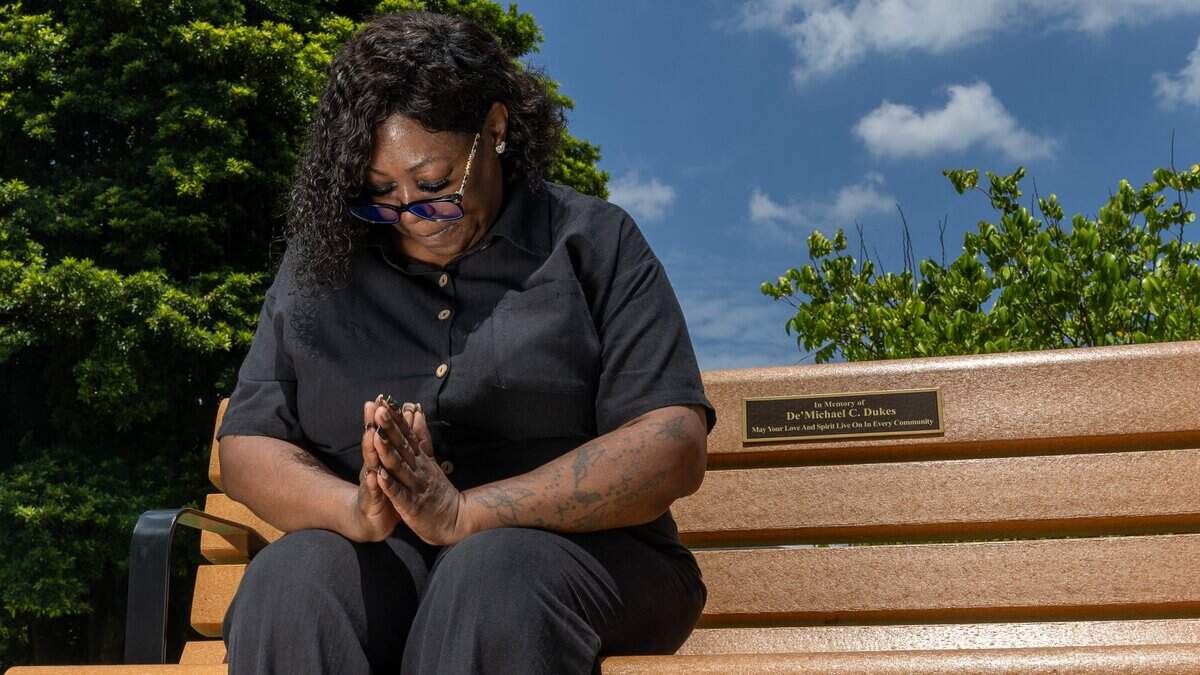
By far, the best outcome of a lower number of murders is fewer people left with the kind of lifelong pain that Romania Dukes carries with her.
Her son, De’Michael Dukes, was shot and killed on July 21, 2014, at Cutler Manor Apartments in Goulds. They were visiting her cousin when her 18-year-old son was shot in the chest by a stray bullet, she said.
“My son died in my arms like I gave birth to him,” Dukes said.
De’Michael would help an old lady across the street or carry in someone’s groceries, she said. He’d always say I love you. He was so special, she said. De’Michael was my “dancing, fun kid.”
Her son’s killer has never faced justice, she said. She noticed that much of the violence in her community was over something meaningless such as failed romantic relationships or being born in different zip codes.
In her devastation, she founded Mothers Fighting for Justice, she said. Dukes holds a memorial in South Miami-Dade to honor victims of violence, the Annual Walk for Justice. She’s previously hosted turkey and toy drives, a free snack program and other community efforts.
But despite the lower numbers on paper, people don’t necessarily feel safer from violence because there are fewer deaths, she said, adding “we always hear gunshots” in South Miami-Dade.
It can be difficult to “give back to the same community that took away our kids,” but every action brings people one step closer to lasting change.
“Every child deserves the opportunity to grow up safely, and every family deserves peace,” Dukes said.
Local law enforcement
Another factor that could have helped eat away at the total number of slayings is more effective prosecution, argues the Miami-Dade State Attorney’s Office. Research shows that a small group of repeat violent offenders drive the majority of non-fatal shootings, which are directly connected to potential homicides, said Ed Griffith, a spokesperson for the state attorney’s office, in an email response to Herald questions.
The “difference between a non-fatal shooting and a homicide is often a matter of just a few inches,” Griffith wrote.
And then there’s the science. Medicine has gotten a lot better at saving lives, and physicians can more often save a stabbing or a shooting from becoming fatal. Griffith gave a nod to “the availability of world-class trauma-care” at Jackson Memorial Hospital in particular.
Despite the drop, law enforcement officials still say every homicide is one too many.
The decrease is “certainly encouraging, but it does not change our mindset,” Major Michael Chinchilla, of the North Miami Beach Police Department, said.
North Miami Beach experienced a reduction from eight murders in 2023 to four in 2024 and then two in 2025, representing a 75% decrease, Chinchilla said. It’s difficult to attribute this reduction to any single factor, but the department believes it’s a result of a combination of proactive policing strategies.
The department has seen a mix of domestic issues, disputes between individuals who know one another and other isolated acts of violence, Chinchilla said. One outside factor that has played an important role is community engagement and residents’ willingness to provide information about cases.
That said, crime trends are influenced by many factors that extend beyond law enforcement, he said.
“Our goal is to sustain the reduction, but there are no guarantees,” Chinchilla said.
Read more Mike Caruso has assault rifles, too dangerous for release, prosecutors say










Post Comment