This Arctic plant has a bad rep. Florida scientists are trying to exonerate it
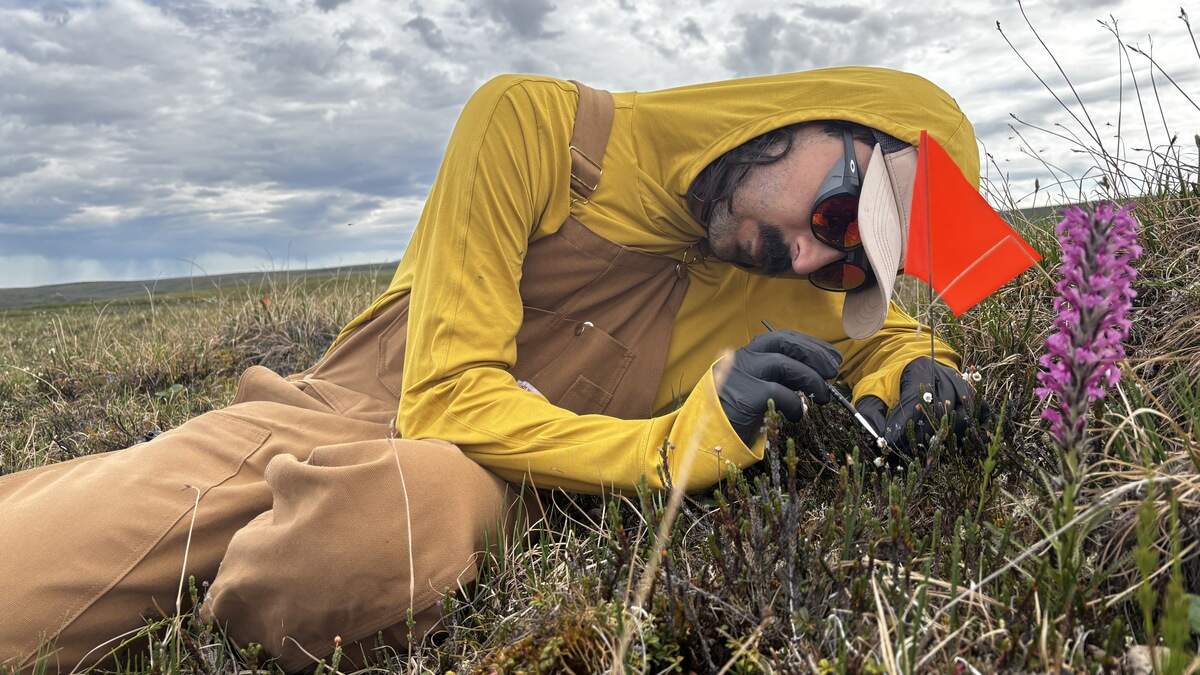
Jonathan Carcache likes to pretend he’s a bee.
Just a few hours from the Arctic Ocean, the exercise helps the Miami native narrow his view to suit a world stunted by extreme cold. At that scale, Pedicularis lanata, a plant that grows hardly larger than a hand, can become a magnetic giant.
Read more How Florida is challenging climate change in textbooks, changing science standards
Better known as woolly lousewort, it is also a textbook parasite, and Carcache’s main subject for his PhD at Florida Atlantic University. Pedicularis will extend its roots into other plants’ vascular systems, he explains, and siphon precious nutrients and water to fuel its own flamboyant pink and purple flowers.
Ecologists generally view it as a bad neighbor, its presence detrimental to its host. “But that might not be true,” Carcache said. With his team, he hypothesizes that ecologists may have wrongly accused Pedicularis of simple nutrient theft, and that the plant might actually benefit its neighbors. Perhaps, he said, it’s even a welcome guest.
To exonerate and maybe even vindicate this tiny but hardy plant, the FAU team has traveled to Toolik Field Station in northern Alaska, a two-day journey that includes a 12-hour ride through the Arctic wilderness. If they’re right, the implications can go far beyond the Arctic. Even all the way down in South Florida, plants long dismissed as parasites could turn out to offer benefits to their hosts, and prompt parks and gardeners to rethink when to reach for pruning shears and weedkillers.
Barter, Not Theft?
“This is them,” Carcache said as he stopped in a patch of tussocks one day last June.
Only days earlier, snow had covered the ground. Now Pedicularis had emerged as one of the first heralds of the Arctic summer, its stems wrapped in grayish, silky hairs that protect it like a warm winter coat.
“And right up in the heather,” said Jake Francis, who heads the Francis Lab for Pollination Ecology at FAU, pointing to the tiny, bell-shaped flowers of Cassiope tetragona. So small and white, they could be mistaken for a cluster of snowflakes.
Within a six-inch radius, chances are that Pedicularis has tapped into the roots of Cassiope, drawing resources vital to the plant’s growth and survival.
In theory, that theft should leave the heather worse off — the reason ecologists have long classified Pedicularis as a parasite. But the resources it loses might not be what most limits Cassiope’s ability to produce seeds, the plant’s offspring.
Like many flowering plants, Cassiope needs help moving pollen — the male reproductive cells — to the female parts of another flower. Pollinating insects like bees that are capable of doing that work are scarce and in high demand in the Arctic. All too easily, they can overlook Cassiope’s whimsical white bells.
That is where Pedicularis’ large, ostentatious flowers, easily spotted from afar, may help. Pedicularis may act like a billboard for the neighborhood: Once a bee has flown to one of its flowers, it stands to reason that it might also visit the nearby Cassiope.
Or, as Francis put it, it is “like a Buc-ee’s opening in a dying town that makes everybody get off at the exit.” Even if Buc-ee’s fudge or brisket is the main attraction, the local restaurants can still profit from the influx.
In exchange for luring in insects, Cassiope might happily provide some of its resources to Pedicularis. What looks like theft might, in fact, be barter.
Worth More Than Gold
On a mildly warm morning in late June, Carcache and his field tech Adam Bloom gathered in their lab at Toolik to inspect wild Cassiope pollen they had collected in a vial, a smidgen so tiny it could have been mistaken for randomly accumulated dust. Given how many hours it took Bloom to extract it from Cassiope plants, it was “definitely more valuable than gold,” he said.
To find out whether a lack of pollen is what limits Cassiope’s seed production, the team decided to give some of the flowers extra help.
In about half of the more than a dozen plots of tundra they selected, they carefully snipped away the Pedicularis. In the others, they left the plants untouched. Then, within every plot, they manually added extra pollen to half of the Cassiope flowers, leaving the others to rely on whatever pollinators the tundra provided.
The design allowed the researchers to ask two questions at once: Does Pedicularis increase Cassiope’s chances of attracting pollinators? And if so, is pollination more important to the heather’s reproductive success than the resources it loses to its parasitic neighbor?
In the field, that meant pollinating an estimated 600 flowers by hand — a tedious task that Carcache couldn’t have envisioned enjoying just three years ago.
An Explosion of Life
A Cuban-American who grew up in Hialeah, he’d tracked down elusive ghost orchids in the Everglades and interned at Fairchild Tropical Botanic Garden with its giant Victoria water lilies and scarlet lipstick palms. In comparison, he believed the Arctic to be “barren and lifeless.”
Read more Mike Caruso has assault rifles, too dangerous for release, prosecutors say
But after moving into a heavy-duty, cold-resistant tent at Toolik for a job as a field technician in 2023, Carcache was struck by what he describes as “an explosion of life” in the Arctic tundra.
Located some 4 hours south of the Arctic Ocean, he watched Caribou and shaggy muskoxen graze on tufts of grass and delicate sedges that rise from the soggy ground. Mosses and lichens filled the hollows, while yellowish dead man’s fingers — a spooky and thus aptly named fungus — curled among low-growing rhododendrons that perfumed the air with warm, woody notes.
The experience was “overwhelming,” he said. It hooked him so completely that he and his assistants secured funding from the Organization of Biological Field Stations and FAU’s WLW-ECOS scholarship, and this summer found themselves lying in the tundra to pollinate hundreds of Cassiopes by hand.
For most of their month-long research, they dipped tiny brushes more commonly used to paint Warhammer figurines into the pollen, then brushed it onto the stigma, the female part of the flower.
Their 12-hour work days, facilitated by a sun that never sets, gave them ample time to marvel at the fact that Cassiope and Pedicularis exist here at all.
Not a marathon, but a sprint
In places such as Florida, where the sun shines for most of the year and soils are rich in nutrients, size and beauty come easily. Not in the Arctic.
By mid-October, Toolik Lake will be frozen again, and snow and ice will begin to blanket the landscape. Between mid-November and mid-January, the sun will not rise at all. True summer lasts only about three months, giving plants a narrow window to grow leaves, produce flowers, get pollinated, and make seeds capable of producing the next generation.
It is like having to run a marathon while being given only the time of a sprint.
For decades, ecologists assumed that species were largely competing with one another in that race. Winners thrived. Losers perished.
But scientists now know the picture is more complicated. Species once seen primarily as competitors or antagonists have turned out to be mutualists, with both parties benefiting.
In Central America, for example, ants feed on acacia trees, a relationship that, at first glance, appeared purely antagonistic. Look closer, though, and it becomes apparent that the ants defend the trees from herbivores and help keep them free of intrusive vines.
Carcache believes similar research could also reveal more about plants closer to home.
“Just getting started”
In South Florida, Cassytha filiformis, known as love vine, is generally cut back because it can overtake trees, draping them as though a massive pot of spaghetti had been dumped over their branches. But Carcache wonders whether the vine might also deter herbivores, offering some protection to its host.
If future research can prove that, “maybe we could manage it less aggressively,” he said. “Instead of removing every last bit of it, maybe we leave a little bit. Maybe we could form new strategies.”
For Francis, Carcache’s PhD advisor, the research is part of a larger effort to understand how best to protect native species, especially as they face growing threats from development and extreme weather. Better science could help local governments manage native plants and the pollinators they depend on.
“Understanding when and how these parasites might act as mutualists, I could see someone spending their lives answering that question,” Francis said.
Carcache agrees.
Having just turned 27, he plans to do this kind of work for the rest of his life. “I’m just getting started.”
This climate report is funded by Florida International University and the John S. and James L. Knight Foundation, in partnership with Journalism Funding Partners. The Miami Herald retains editorial control of all content.
Read more How Jackson, Homeless Trust paid millions to woman whose ALFs state punished











Post Comment