Proposed rule change would let Miami-Dade invest more tax dollars in Israel
Miami-Dade could invest millions more dollars in the government of Israel under a proposed change in the rules on how the county invests its cash, thrusting an obscure corner of municipal finance into the controversy over military action in Gaza.
Read more Donalds says he will remove local officials who refuse to work with ICE
The are up for a vote Tuesday by the County Commission and would allow Miami-Dade to invest up to 5% of its roughly $9 billion portfolio in debt issued by Israel. The current rules cap that investment at 3%.
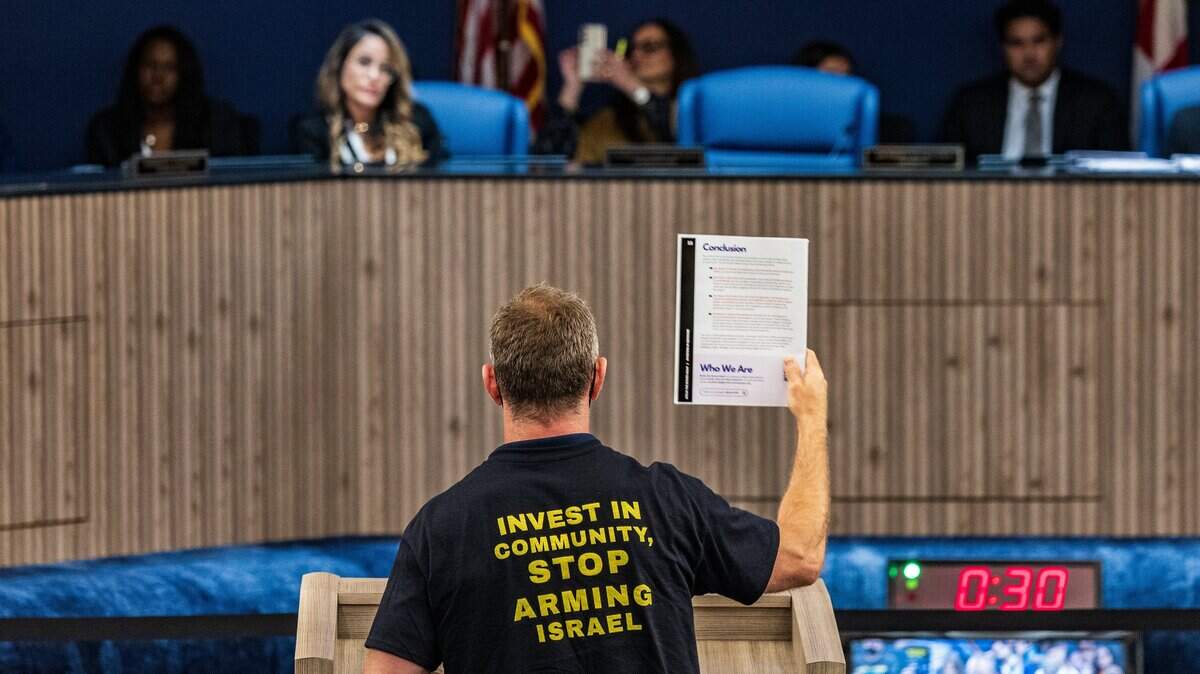
Local critics of Israel’s conduct of the Gaza military operation say they’ve been flooding commission offices with objections to the proposal, which is sponsored by Commissioner René Garcia.
“Miami-Dade is not allowed to invest in any foreign governments but has an exception for Israel,” said Govind Srivastav, a community activist who is helping lead the opposition to Miami-Dade purchasing Israeli bonds. “That money should be directed into the United States.”
The proposed change appears to be mostly symbolic, at least in the short term. Miami-Dade’s shows Israel bonds make up just under 1.5% of the county’s investments, well below the current 3% cap.
Like almost every government, Israel raises cash by selling bonds to investors. Those bonds are the equivalent of loans, with Israel paying back the money with interest to the people and institutions that purchase them — a group known as the bondholders.
Miami-Dade’s Israel bonds are worth about $130 million, according to the portfolio report.
In 2023, Mayor Daniella Levine Cava used her authority over the county’s investment portfolio to triple Miami-Dade’s holdings in Israeli bonds — from $25 million to $76 million. She linked the move to the Oct. 7 terrorist attacks that year against Israel by Hamas. “Today, I am proud to make this additional investment in Israel bonds, as we send a clear message that Miami-Dade stands together with Israel and all nations that champion democracy,” she said in a press release then.
In the years since, activists have urged Levine Cava, the county’s first Jewish mayor, to reverse course and support Miami-Dade divesting from Israeli bonds, citing widespread civilian deaths during the country’s military response in Gaza. Last year, Levine Cava’s son joined the public calls for Miami-Dade to stop investing in Israel.
Read more A three-hour standoff at a Miami high-rise has ended, police say
Levine Cava herself has condemned the humanitarian crisis in Gaza. “We must speak out against the horror of starvation in Gaza,” she wrote in a social media post last year. “No child, no human, should ever spend days without access to food.”
But she has declined to weigh in on whether Miami-Dade should divest itself of Israeli bonds. Levine Cava also has not said whether she supports the proposed policy change, and her office on Monday referred questions to Garcia and the independent clerk’s office, which implements the county’s investment policy.
While the mayor used to have ultimate control over Miami-Dade’s finances, that power shifted to the county’s elected clerk early last year. In a statement, Clerk and Comptroller Juan Fernandez-Barquin’s office described the changes proposed by Garcia as bringing Miami-Dade into agreement with state law on Israel investments and giving the county’s portfolio managers more leeway. “Overall, the proposed changes provide the County with greater investment flexibility while maintaining appropriate risk parameters and compliance with applicable Florida law,” the clerk’s office said.
Last year, the Florida Legislature changed state rules on local investment portfolios to allow for the purchase of unrated bonds from Israel. The prior state rules only mentioned rated Israeli bonds as allowed.
Garcia’s legislation also inserts unrated bonds as allowable investments by Miami-Dade. “We are following a state statute that was passed last year,” Garcia told the Miami Herald.
Private rating agencies like Standard & Poor’s and Fitch grade bonds in the private and public sector based on the likelihood that the issuer will default and not pay back bondholders. The higher the rating, the safer the investment is supposed to be. Bond issuers pay for the ratings reports, and declining to have debt rated can be a red flag for investors, said Samuel Bonsall, an accounting professor at Pennsylvania State University who specializes in the study of credit-rating agencies.
For Israel, Bonsall said the distinction of rated versus unrated bonds doesn’t amount to much in practice because Standard & Poor’s and their competitors issue umbrella ratings for a country’s creditworthiness. So investors see those ratings as applying to all of that country’s bonds. “Because the state of Israel is rated, [Israeli] bonds are rated,” he said.
Read more See which Miami-Dade public schools are in U.S. News & World Report’s ‘Top 100’












Post Comment