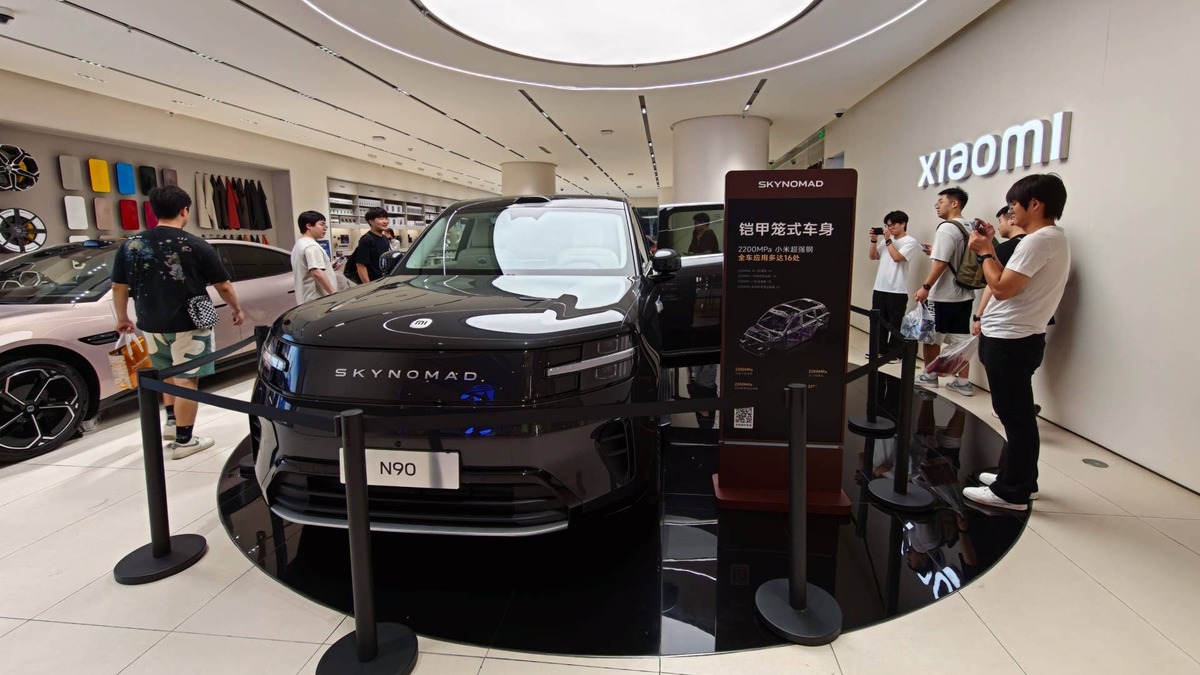
Xiaomi begins delivering an SUV U.S. buyers cannot legally get
Most car shopping involves a budget problem. but every so often, it turns out to be a permission problem.
Read more As the Senate returns, questions remain about Mitch McConnell
Americans have spent four years watching the family hauler drift out of reach and filing it under inflation. The average new vehicle sold for $50,089 in August, and the midsize SUV that most households actually cross-shop averaged $50,315, according to Kelley Blue Book.
Financial strain is “steering more shoppers toward lower price points,” said Erin Keating, executive analyst at Cox Automotive, in comments published by Kelley Blue Book.
Meanwhile, the vehicle a lot of families describe when you ask them what they want, a three-row that runs on electricity all week and burns gasoline on the holiday drive, does not exist here at a family price.
The closest American answers are full-size pickups averaging $67,446 and electric SUVs that ask you to plan Thanksgiving around a charging stop.
So the compromise stays theoretical. You buy the gas SUV, you keep the payment, and you wait for somebody to build the other thing.
Somebody did. On Sept. 13, it started arriving in driveways on the other side of the Pacific.
Xiaomi (XIACY) began deliveries of its Skynomad extended-range SUV lineup across 75 Chinese cities, with CEO Lei Jun handing keys to owners at events in Shanghai and Xuzhou, according to CarNewsChina.
Prices start at 209,900 yuan, about $31,300.
What $31,300 buys in a Chinese showroom
The Skynomad line covers four trims across two sizes, the five-seat N70 and the larger N90, which comes in a seven-seat layout and a camping-focused Explorer Edition.
Every trim runs a 1.5-liter turbocharged range extender rated at 150 horsepower, supplied by Changan subsidiary Harbin Dongan, that charges the battery rather than driving the wheels. Combined range on a full tank and a full pack runs from 1,351 to 1,705 kilometers, roughly 840 to 1,060 miles.
Standard equipment is the part that stopped me. I went through the trim sheet expecting the lidar and the driver-assistance silicon to sit behind an options wall, the way they do in the U.S.
They do not. Every trim carries a roof-mounted lidar unit and Nvidia’s (NVDA) Thor-U chip rated at 700 trillion operations per second, running assisted driving on highways and city streets, CarNewsChina reported.
Air suspension is standard on all but the base car. The front seats swivel 180 degrees. The top N90 folds an electric tent out of its roof. Xiaomi calls the result an “SUV shape with an MPV cabin.”
Here is the ladder as it stands:
- Skynomad N70 Pro, China: 209,900 yuan, about $31,300, CarNewsChina confirmed.
- Skynomad N90 Max seven-seater, China: 299,900 yuan, about $44,100, according to CarNewsChina.
- Average new midsize SUV, U.S.: $50,315 in August, according to Kelley Blue Book.
- Average new electric vehicle, U.S.: $54,813 in August, Kelley Blue Book noted.
picture alliance / Getty Images
Why the Skynomad never reaches a U.S. driveway
The tariff math is the part everyone reaches for first, and on this car it is less decisive than it looks.
A China-built passenger vehicle already faces the 2.5% base duty plus the 25% Section 232 tariff on imported cars. The 100% Section 301 rate finalized in 2024 targets Chinese electric vehicles, and the Skynomad burns gasoline, so its classification would at least get litigated.
Read more Anthropic CEO sounds the alarm on AI risks
That fight never happens. A rule finalized in January 2025 bars manufacturers owned by or subject to the direction of China from selling connected vehicles here, starting with the 2027 model year and covering vehicles under 10,001 pounds.
Related: Xiaomi issues surprising words on Ford merger
The software and hardware at issue pose an “undue and unacceptable risk to national security,” the Commerce Department said, according to the Bureau of Industry and Security.
Ownership, not the factory address, decides it, which is why the same rule reaches cars assembled on American soil. It is the wall that pushed Waymo into buying Chinese vehicles for its own fleet, and the one I walked through last week on a $19,170 Geely sedan.
What Xiaomi’s EV losses say about the sticker
The price is not a manufacturing miracle. Xiaomi’s smart EV, AI, and other new initiatives segment posted an operating loss of 2.6 billion yuan in the second quarter, with gross margin sliding to 19.2% from 26.4% a year earlier and average selling price down 9.6%, according to electrive.
Deliveries rose 28.2% to 104,199 vehicles over the same three months, so the red ink is not a demand problem.
More Automotive:
- Audi isn’t fighting China with a bigger car
- Musk just turned the Cybercab into a gaming console
- VW’s CEO just survived the fight that sank his predecessors
Then Xiaomi cut deeper. Skynomad launch prices landed 20,000 to 30,000 yuan below the July pre-sale figures, reductions of about 7.7% and 10%, and the lineup locked in more than 10,000 orders within four minutes, according to CnEVPost.
Xiaomi is also late to this segment, which is already crowded with Li Auto (LI) and Huawei-backed models, and where extended-range share of the Chinese market has been shrinking.
My read is that $31,300 is a customer-acquisition number rather than a margin number, and that reframes what the trade wall is protecting. Detroit is being shielded from a rival that treats losing money per vehicle as tuition.
That rival is funding the effort from a phone business under real strain, which is where the arithmetic gets uncomfortable.
What a $44,100 seven-seater means for your next SUV
No American family is trading a Highlander for a Skynomad. The pressure still lands on the Highlander.
Ford (F) has spent the past year designing a lower-cost electric vehicle against Chinese cost structures rather than against Tesla (TSLA), and the specification floor keeps moving underneath everyone. Lidar and 700-TOPS compute as standard kit on a $31,300 family car resets what “loaded” means, even in a market that will never sell one.
The useful number here is not the sticker. It is five years, which is how long Xiaomi has been building cars at all.
Watch the segment gross margin in Xiaomi’s third-quarter report. If it holds near 19% while Skynomad volume scales, the pricing was strategy rather than a stunt, and the argument for the wall stops being about quality and starts being about time.
Related: Xiaomi’s profit just took a memory-fueled hit
The Arena Media Brands, LLC THESTREET is a registered trademark of TheStreet, Inc.
Read more Sydney Sweeney in new controversial commercial. Does she live in Florida?
This story was originally published September 14, 2026 at 9:37 AM.








Post Comment