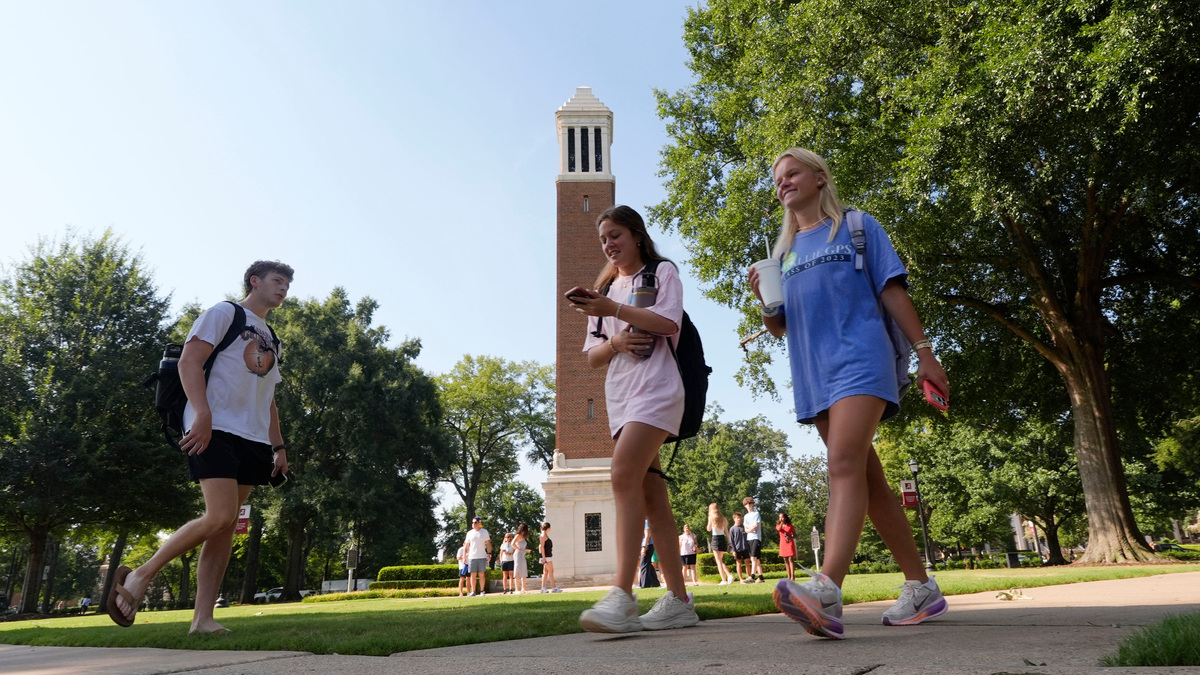
Why a UA grad documented the iconic Denny Chimes
Most University of Alabama students are familiar with Denny Chimes, often hearing its bells ring as they walk to class.
Read more White Mouse and Mickee Faust create new home for Tallahassee writers
For Luke Turner, a recent UA graduate, those chimes sparked a question: What is the story behind them?
Standing 115 feet tall on the Quad, Denny Chimes is one of the university’s most recognizable landmarks. The freestanding campanile was dedicated May 27, 1929, and was conceived and funded by students as a tribute to then-University President George H. “Mike” Denny, who presided over a period of significant growth at the Tuscaloosa campus.
When students began planning Denny Chimes, they intentionally chose a site across from the President’s Mansion so Denny would see the tower each day.
The tower was constructed by Skinner, Maxwell and Co. for $40,000 (about $800,000 in today’s dollars) and was dedicated the same year Denny Stadium, now Bryant-Denny Stadium, opened.
Denny Chimes was built of Alabama limestone and Virginia red brick, a combination that reflected Denny’s role at UA and his home state.
Today, Denny Chimes houses a 25-bell carillon of cast bronze bells. The tower marks time throughout the day, plays the university’s alma mater at noon and serves as both a memorial and a working musical instrument. The carillon is performed by university carillonneur Amir Zaheri.
Yet despite its prominent place on campus and its nearly century-long history, Turner discovered there was no single source that fully documented the tower’s story.
Turner, a classical pianist, said his interest in Denny Chimes began during his time as a student, when he became curious about its mechanics as a music major.
“As a student, everyone walks past Denny Chimes quite a few times each day, so I was always intrigued by it,” Turner said. “As a music major, I knew it was some sort of musical instrument, but I didn’t know who got to play it, what it looked like inside or how it worked.”
As he researched Denny Chimes, Turner found little information about its history and decided to change that.
During his senior year, Turner chose the campus landmark as the focus of his student project for the Randall Research Scholars Program.
“As part of that program, we’re asked to do a passion presentation on something we’re interested in and want to research,” Turner said. “I decided to give my passion talk during my senior year on Denny Chimes.”
What began as a single presentation grew into a deeper exploration of one of the campus’ most recognizable landmarks.
“So I went to the special collections library and did some initial research and gave that presentation for the program,” Turner said. “But then I realized there was so much more that I wanted to learn about Denny Chimes, and that’s really when the main project started.”
Read more Downtown Daytona Beach welcomes new ‘Italian fusion’ restaurant
Turner decided to continue investigating the history of Denny Chimes and develop a centralized website dedicated to the landmark.
“If you Google Denny Chimes, a few pictures and maybe one or two articles come up, but there was no centralized place where all the information was,” Turner said. “That really led me to want to make a website where all this information could be in one place.”
The project allowed Turner to combine his skills in coding, musical performance and historical research. He completed the research and development process in about five months before graduation.
To complete the project, Turner used the university’s special collections library to study historical blueprints, letters and dedication programs. He also interviewed community members and traveled throughout the Southeast during spring break to visit seven carillons and compare them with Denny Chimes.
As part of his research, Turner also had the opportunity to perform a concert inside Denny Chimes.
“It was super exciting,” Turner said. “It was definitely the most unique concert I’ve ever given. As a pianist and cellist, typically when I give a concert, the only people who can hear it are the people in the room with you. Even if you’re giving a recital with lots of people, the music stays in that concert hall. What’s really cool about Denny Chimes is that it can be heard for several miles.”
“So when I got to give that concert at Denny Chimes, pretty much the entire city of Tuscaloosa got to hear whatever I was playing,” he said.
Turner graduated in May 2026 with bachelor’s degrees in management information systems and music, as well as a master’s degree in management information systems.
He said he hopes the website will serve as a lasting resource for future generations of students.
The website also includes a forum where students can share stories, memories and experiences related to Denny Chimes.
“It’s really cool because I feel like every student knows what Denny Chimes is, but most people I’ve talked to have never seen what the inside looks like, and most people don’t even know it can be played manually,” Turner said.
“Many people think the only thing it can do is chime every 15 minutes. It’s really exciting for me to think people can now access the story of Denny Chimes, and my hope is that the website will continue to expand,” he said.
Turner’s website is available at dennychimes.ua.edu.
Reach Jasmine Hollie at [email protected]. To support her work, please subscribe to The Tuscaloosa News.
This article originally appeared on The Tuscaloosa News: Why a UA grad documented the iconic Denny Chimes
Read more Leon County’s volunteer fire departments need your skills | Opinion
Reporting by Jasmine Hollie, Tuscaloosa News / The Tuscaloosa News
USA TODAY Network via Reuters Connect
Copyright Reuters or USA Today via Reuters Connect
This story was originally published September 14, 2026 at 4:56 AM.










Post Comment