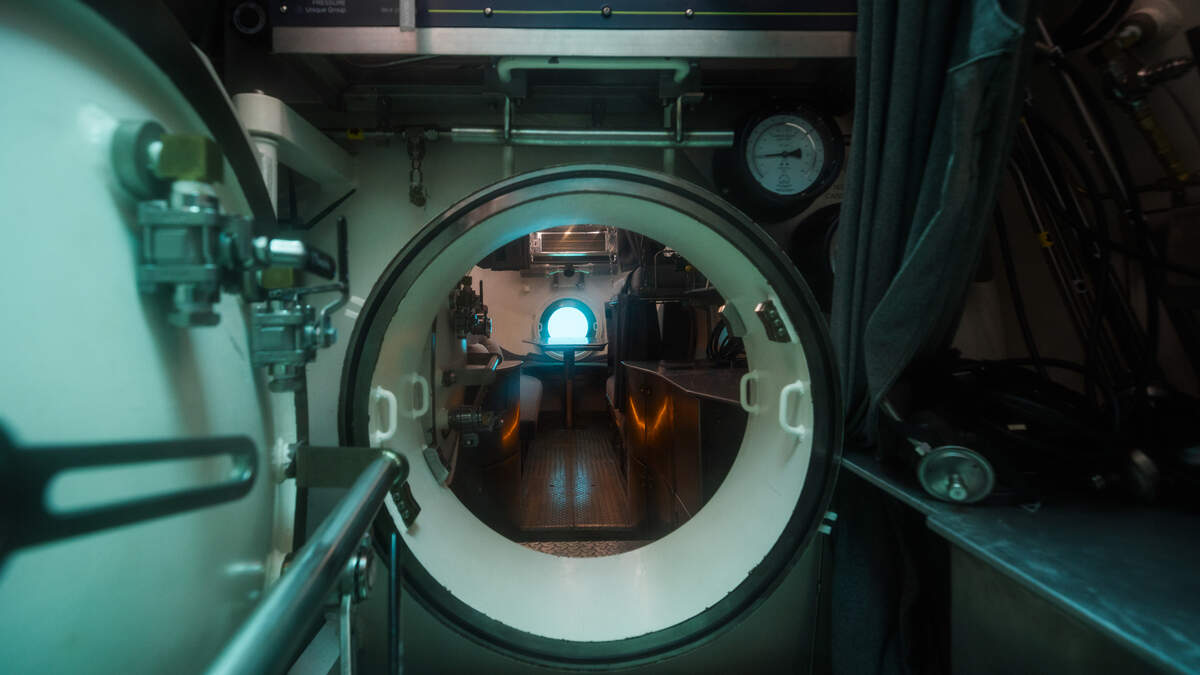
Take a look at this new private undersea habitat in the Florida Keys
The Florida Keys just got its second undersea habitat, where researchers can spend days working and living without breaking the water’s surface. But unlike the first, a government and university-funded project first built in the 1980s, this one is privately funded. And it’s brand new.
Read more South Florida has nation’s biggest price gap between luxury and non-luxury homes
It’s called Vanguard, the first product from undersea habitat company DEEP. The company says it’s step one toward its mission of a network of undersea habitats.
“It’s been over 40 years since we’ve had an undersea habitat built for humans and launched,” said Dawn Kernagis, DEEP’s director of scientific research. “We’re really building on the shoulders of giants who’ve done this research.”
The benefit of an underwater home for researchers is that their bodies can reach a state where they are safe to stay underwater for days at a time, breathing in air from the surface, without worrying about developing any of the depth-based illnesses that plague SCUBA divers.
Instead of hitting the limit of one to two hours of a traditional SCUBA dive, underwater divers can “really go out for hours and hours and hours at a time.”
Plus, the overnight experience allows researchers to behave more like Jane Goodall with her chimpanzees, Kernagis said, instead of a fly-by expedition.
“Instead of getting a snapshot of what that environment looks like for an hour at most, you’re getting a really good picture over 24 hours,” she said.
History underwater
In the heyday of the 1960s and ‘70s, the world’s oceans were sprinkled with hundreds of undersea habitats.
Famous ocean explorer Jacques Cousteau and his crew played chess, smoked cigarettes and drank wine between missions in the “Starfish House,” as memorialized in his Oscar-winning documentary “World Without Sun.” They even brought a parrot down in a pressure cooker and introduced it to the reef’s parrotfish through the window.
But the incredible expense of maintaining these habitats — and a series of horrible accidents resulting in a few deaths — led to a pullback in federal funding for the undersea habitat industry. Until Vanguard was installed in the Keys last month, the only other underwater research lab in the continental U.S. was the Aquarius Reef Base near Key Largo.
Read more An AI school with $65K tuition is the latest sign of billionaires reshaping Miami
Aquarius was first sunk in the Keys in 1993 by the National Oceanic Atmospheric Administration and passed into the hands of Florida International University in 2013. But it was originally constructed in 1986, making it a 40-year-old facility. The decades have come with some wear and tear.
This year, its program got from the state of Florida to install new life support buoys in the aging reef base, with “significant” contributions from private donors as well for other upgrades, said Michael Heithaus, executive dean of the college of arts, sciences and education at FIU.
“This is not just a piece of equipment for FIU. FIU is maintaining and operating something that’s a resource for the state, the country and the world,” he said. “The life support buoy is already underway. We’ll be starting the upgrades to the habitat soon.
We’re super excited.”
Aquarius has played host to researchers observing the marine life around them, studying the effects of long term pressure on the human body, learning best practices for remote robotic surgery and even growing food and fungi underwater.
NASA has also, famously, crewed many missions to Aquarius to help inform its space program. One of those underwater researchers, also known as aquanauts, was Kernagis.
She spent eight days underwater on a NASA mission in 2016 focused on molecular changes associated with living in saturation, data that helped the space program and Navy interests.
She said she expects similar sorts of research to be conducted in Vanguard, which is 17 meters below the surface at Tennessee Reef in the Keys. Only in this habitat, she said, there will be a few more creature comforts for crew bunking inside the facility.
There’s bunk beds, a bathroom and shower, a kitchen with a dining nook near a window and a separate dive center so researchers can keep the saltwater on their suits away from the living quarters. There’s also a laboratory bench where scientists can examine their samples immediately, instead of waiting to return to shore.
Kernagis has toured the facility while it was on land, but hasn’t set foot in it since Vanguard was sunk in the Keys last month.
Read more Dadeland expands with new stores, including a hot eyewear company. See the list
“I just really can’t wait to get in the water,” she said.
This story was originally published July 15, 2026 at 4:30 AM.



Post Comment