South Florida’s lizard problem keeps growing. Meet the invaders in your backyard
South Florida is literally crawling with lizards. They’re skittering through parks and yards, scampering into homes and reproducing like there’s no tomorrow.
Read more This famous bagel shop from Washington, D.C., is coming to Coral Gables
And new species join the party regularly, as bad pet owners release their charges into the wild or stowaways sneak in from far-off countries. At this point, researchers say, invasives outnumber the natives.
There are dozens of introduced lizard species in South Florida, more than any other region on Earth, but an exact count is tough to come by, said Mario Zuliani, a post-doctoral associate at the University of Florida studying invasive reptiles.
“It almost seems like every time we think we know, there’s another one or two that pop up,” he said. “The state is just very good for many reptiles and snakes.”
However, Zuliani stressed that just because a non-native species has proliferated in Florida, that doesn’t necessarily mean it’s an issue. The tiny brown lizards that are everywhere in South Florida, brown anoles, were introduced from Cuba. But they don’t outcompete any native species or harm anything. If anything, recent research suggests, they may be soaking up mosquito bites and protecting humans from itchy bumps — and diseases.
“If they’re here it doesn’t necessarily mean they’re bad, but if they’re doing something bad they’re probably not supposed to be here,” Zuliani said.
Take, for instance, the colorful Rock Agama or rainbow lizard. The Florida newcomer is scarfing up both the brown anoles and the native green ones. They also burrow under concrete, ruining sidewalks and other infrastructure.
“In their native range, agamas have been shown to carry helminths (parasitic worms) which are potentially pathogenic in humans,” said wildlife biologist Natalie Claunch of the U.S. Department of Agriculture in a written statement.
Claunch and other researchers recently studied the most effective was to get rid of the orange and blue lizard. In a paper published in Frontiers in Amphibian and Reptile Science, they compared traps baited with crickets, “lizard fishing” and a good ‘ol fashioned gun. Well, an air rifle.
Trapping and lizard fishing, which is exactly what it sounds like — baiting a line on a stick and catching a lizard when it chomps down on the unlucky bug, were not very effective. The air rifle method, or in academic paper speak, “simultaneous euthanasia via projectile” excelled.
The person hired to shoot the lizards managed to bag 27 of them over the course of the study, compared to the six caught via trap and four caught via lizard fishing. It was also a far cheaper method, at a mere $36 per lizard versus the $111 per lizard cost of using a pole and bait.
The researchers acknowledged that this wasn’t very helpful to the average homeowner, who may not be able to hire a professional air rifle marksman to deal with their lizard issue. But Claunch said the team is working on follow-ups and trying to figure out a cost-effective and easy method to help Floridians deal with the reptilian invasion.
While routing out invasives is usually a fool’s errand in Florida (see: Burmese python), scientists like Zuliani still want to know what these critters are up to. In June, he and other researchers published a paper in the Royal Society Open Science journal that showed how helpful various citizen science apps were in tracking the spread of invasive reptiles in Florida.
In particular, they found that users of the app iNaturalist were contributing to one of the greatest bodies of scientific data of invasive species in Florida. Zuliani called it a gold mine for researchers and encouraged anyone in Florida to join the app and log their lizards.
“It’s probably the way of the future because there’s millions of users on this app providing millions of observations,” he said. “We can probably use a lot of these observations to drive policy.”
While the iNaturalist app is a popular way to identify an unknown species, here’s a breakdown of the most common invasive lizards you might spy in South Florida:
Rock Agama
These might be the most striking lizards dashing around South Florida. Peter’s Rock Agama are originally from West Africa and were introduced to Miami in the 1990s, said the University of Miami’s Christopher Searcy.
Searcy, an associate professor of biology, found that the rainbow lizards were the fastest spreading reptile species in Miami-Dade and saw a 36-fold population increase between 2017 and 2022 alone.
Read more 3 famed Florida Keys resorts change hands in $500M buying spree. What’s next?
They’re not always dressed in the colors of the University of Florida, however. Outside of breeding season they can be found in more muted brown and gray tones.
Curly-tailed Lizard
This is a fun species to identify when your friends ask. Is it a lizard with a curling tail? It’s probably the Northern curly-tailed lizard.
According to UM’s Searcy, the Bahamian lizard was introduced in Palm Beach in the 1950s and has been creeping southward ever since. His lab found they were the second-fastest-spreading non-native reptile species with a 22-fold increase between 2017 and 2022.
Tegu
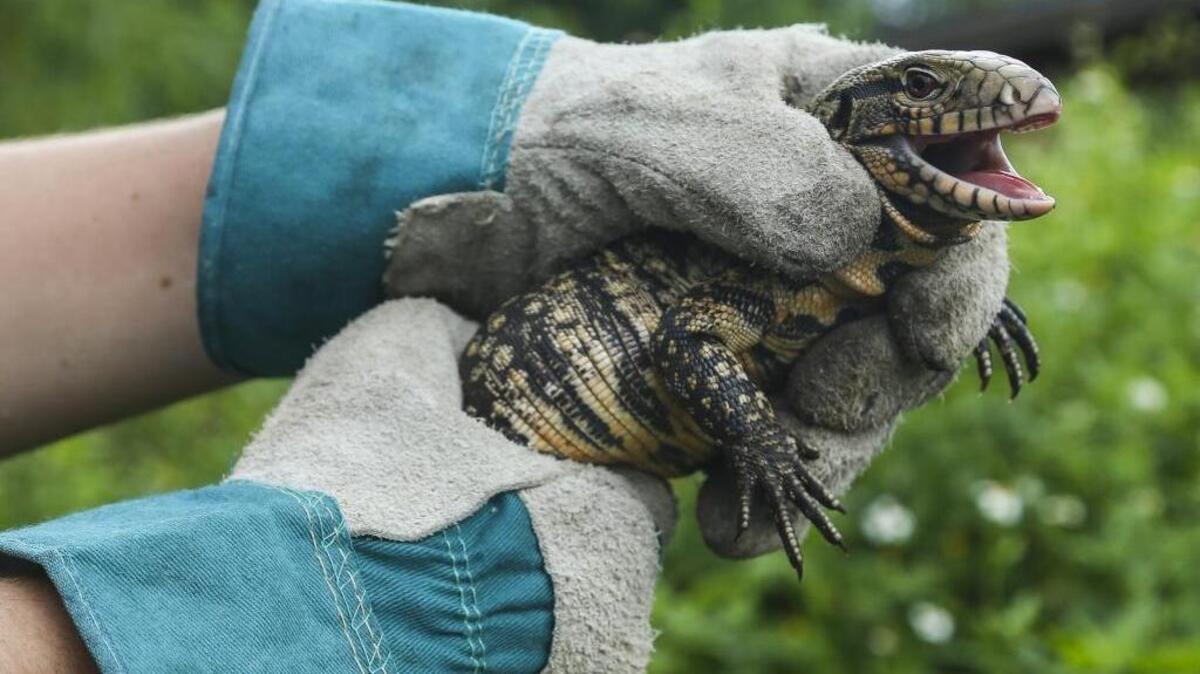
These fat, speckled lizards hail from Argentina and arrived in Florida with a hunger for eggs— alligator, turtle, tortoise and bird alike.
They arrived in South Florida around 2009 and can grow up to four feet long. Red and gold varieties have also made their way to Miami-Dade. Scientists have been fighting a losing battle to eradicate them from sensitive ecosystems in South Florida.
Nile Monitor
These sub-Saharan African lizards can grow as big as alligators at five to eight feet long. They have sharp teeth and blue tongues, and state officials encourage Floridians to steer clear.
They gained a toehold in South Florida via the pet trade about 40 years ago, and although they’re more established in Southwest Florida they have been spotted in Broward and Miami-Dade County. In fact, there’s a federal removal program at a hotspot in South Dade, the Homestead Air Reserve Base.
Basilisk
Brown basilisks were first spotted in Florida in the 1960s and cluster in South Florida, although they could be establishing a new population in Central Florida, according to UF researchers.
These dark brown lizards have a distinctive crest and a yellow running stripe. But they’re perhaps best known for their ability to run over the surface of water, earning them the nickname Jesus Lizards.
Brown Anole
These little guys are everywhere. They have flourished in South Florida for so long that most people think they’re natives. But these tiny brown lizards are actually expats from Cuba and the Bahamas.
UF calls them the first documented reptile introduced to Florida, likely via a cargo ship from Cuba in the late 1800s.
They’re well known for doing pushups and flaring that red neck pouch — known as a dewlap — to flex on other lizards and attract mates. If you grew up in Florida, you may have attached one to your earlobe as a kid as a stylish earring.
Cuban Knight Anole
Cuban knight anoles are the bigger, greener cousins to a brown anole. While brown anoles can get about 9 inches long at most, Cuban knights can get nearly 20 inches long. They have a yellow stripe near their face and have been skittering around Florida for decades.
House Gecko
Most commonly spotted inside a home, the house gecko is one of a handful of non-native geckos that have fanned out across Florida over the last century. They love to hang out in the AC and eat bugs, so consider them a friend, not a foe.
Unlike most of the lizards on this list, they have sticky little toe pads instead of the claws. That helps them make their way up walls and across ceilings — an unlikely spot to see anoles or other lizards.
Iguana
South Florida’s most famous invasive lizard is, of course, the iguana. These pests munch gardens, poop in pools, snap at pets and occasionally knock down power lines.
They also provide plenty of comic relief when they freeze during increasingly rare cold snaps.
Read more ‘Costs almost doubled’: Longstanding Black film festival leaves Miami Beach











Post Comment