South Florida botánicas face gentrification, rising costs — and old religious stigma
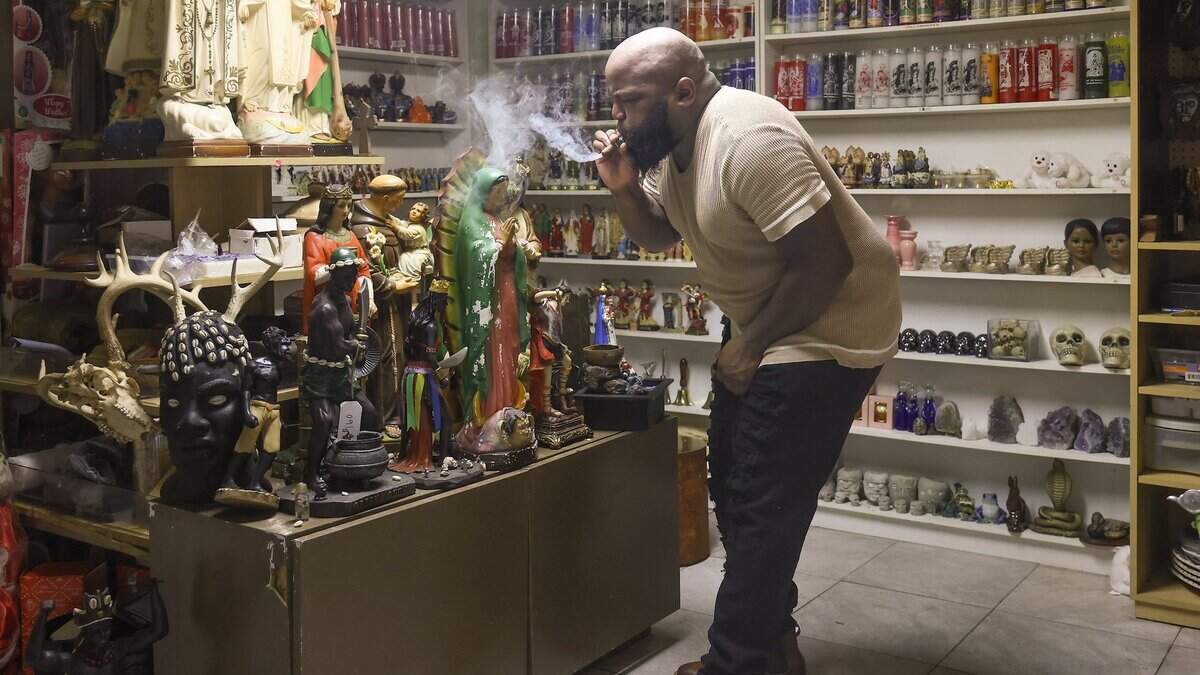
Inside Botánica Santo Tomas in Wilton Manors, store owner Héctor Giovanni Pizarro Santana sweeps the floor as his tiny Chihuahua, Bella, scurries behind him. The shop, no more than 700-square-feet, is a picture of organized chaos.
Read more Man’s death on Brightline tracks in Orlando is a first
Sacred altars display various statues of orishas, or divine spirits, alongside offerings in the form of money, water, food and tobacco. Walls are lined from floor to ceiling with shelves of spiritual goods, from herb bundles to Catholic prayer books. Every object has meaning rooted in hundreds of years of Afro-Caribbean religious tradition.
But Botánica Santo Tomas hasn’t seen any customers for almost a year.
Pizarro-Santana has been dealing with myriad issues at his store: Water damage from last hurricane season, disagreements with his landlord and a steady increase in rent has caused the shop owner stress and a significant loss in business.
“I don’t want to go without a fight, and I’m struggling, but I’m still there because I want to show that you fight for what you want,” said Pizarro Santana, 37.
Throughout Miami-Dade and parts of Broward County, “botánicas” — or stores that sell the religious goods like candles, oils and statues of saints used in Afro-Caribbean religions like Santería — are hard to miss. Woven into the cultural fabric of South Florida, botánicas serve as spaces of community, connection and commerce for the spiritual. But as the old Miami continues to cede to the inevitable march of increased development, skyrocketing rent, gentrification, cost of living and changing demographics, botánica owners are finding themselves being forced to adapt to the new landscape in different ways.
Rather than disappearing, many of South Florida’s botánicas are reinventing themselves to survive a changing city. Some owners have expanded beyond their traditional clientele by embracing tourism and technology, while others say rising rents, inflation and difficulty finding willing landlords have made keeping their doors open a growing challenge.
Financial woes
Pizarro Santana started his botánica business out of a flea market in Miami in 2013 after moving to the United States from Puerto Rico. After two years, he moved to Wilton Manors, opened up his own store and started building a community of clients.
Pizarro Santana is practitioner of Santería, also known as Regla de Ocha or Lucumí, which has roots in the Yoruba religion of West Africa and was brought to Cuba during the transatlantic slave trade. Santería, the colloquial name used mostly in the U.S., came about after the enslaved Africans were forced to mask their traditional Yoruba faith with Catholic practices, symbols and saints after it was imposed upon them by the Spanish. In South Florida, the practice is so widespread that even some major supermarket and pharmacy chains carry products normally sold in botánicas.
The faith is based in the worship of orishas, which can be described as saints or mediators of humanity’s relationship with the sacred, with similar roles to saints in the Catholic religion. Those who turn to orishas often seek different forms of spiritual, financial, emotional or physical protection. In his shop, Pizarro Santana supplies the items needed to practice traditional rituals.
Botánica Santo Tomas has always been a self-funded project for Pizarro-Santana, who said he’s never taken out a loan and supplements his store with his other career in social work and mental health counseling.
“I was doing conversations and seminars on spirituality and mental health, spirituality and the LGBT community, spirituality in the Hispanic cultures … my botánica is the only one that has the blend of that,” he said.
Inside Pizarro Santana’s botánica, the walls, floor and ceiling still have water damage from last summer’s hurricane season. On top of the repairs needed, Pizarro-Santana said his rent keeps increasing, making staying in his shop increasingly unaffordable. He says he’s not making a profit and is taking extra shifts at his other job just to keep up.
Pizarro-Santana is not the only owner facing financial challenges.
Nelson Hernández has owned and operated El Viejo Lazaro, a botánica on West Flagler Street, for 23 years. He relies on a mix of loyal in-person customers, spiritual consultations and online orders to help keep the family-owned business alive.
Hernández sells bunches of medicinal herbs — his most popular online item — and ships them all over the country. A bundle of Abre Camino herbs, for example, sells for $7.99 and is believed to clear paths, remove spiritual blocks and invite good fortune.
Hernandez said his issue isn’t increases in rent — he’s owned the property since 2014 — but rather the belt-tightening due to the cost of living increases in South Florida affecting his clientele.
“Right now I sell half of what I used to sell,” he said. “Things are more expensive — the products, the rent, everything.”
More than half of all Miami-Dade County households are living paycheck to paycheck, according to reporting from the Miami Herald. That’s 563,947 households that make just enough money to survive — often too much to qualify for government assistance — but not enough to save any money.
As rents spike, increasing costs can drive away the usual clientele of botánicas, said Edwin Aponte, professor of religion and culture at Drew University in New Jersey.
“Properties that were once inexpensive, they go through the roof in terms of rentals … and so the clientele of the botánicas get pushed out of the neighborhood as the neighborhood changes,” Aponte said.
Botánicas have to move and adapt
Down the road in Hialeah, Hernández’s friends, Raul and Rosa Villamia, who own Botánica Yemaya & Chango, recently closed their store after the plaza where the store was located changed owners.
Many who spoke with the Herald mentioned Botánica Yemaya & Chango as an example of a long-time business that was forced out of a neighborhood that’s rapidly gentrifying.
“She had to move, and she had been there for 40 years,” Hernández said, referring to Rosa Villamia.
Read more With a $93M bid, group wins auction for former Spirit headquarters in Broward
The owners announced their store’s closure on Instagram and Facebook, where long-time customers flooded the comment section with sad face emojis and memories of the store.
“For four decades, this place was much more than a business. It was a refuge for many. A space where friendships were made, stories were shared and generations of customers became family,” the store wrote on their social media accounts on April 11.
“Wow I’m in shock. A true staple. I remember being a little girl and walking in there with my father and looking at all the soperas,” wrote one commenter who mentioned she drove from West Kendall to frequent the botánica. Soperas are sacred containers believed to represent or house African Orishas.
Last month, the owners announced that they were able to relocate to a spot near Westchester, a move that shows that survival increasingly requires flexibility, whether that means relocating or reaching customers in new ways.
As Miami-Dade County changes, botánicas are finding ways to appeal to a changing demographic, which can include focusing on online storefronts and using social media to attract new customers.
Hernández, of El Viejo Lazaro botánica, said he relies on an online social media presence — TikTok, Instagram, Facebook and Google — to attract new and sometimes younger customers. He’s noticed that many young people seem to be showing an interest in Santería. One Pew Research Center survey shows that younger Americans increasingly identify as “spiritual but not religious.”
A botánica is one of the few places where someone who is interested in spirituality can cater to their beliefs without attending a place of organized religion. It allows for what Aponte calls an “optional spirituality.”
“Even if people are saying they don’t have any particular religious convictions, they are still drawn to the botánicas because it helps them in their moving through everyday life, their everyday spirituality,” Aponte said.
Many botánica owners are very protective of their spiritual business. The Miami Herald spoke with several shop owners who expressed concern about rising costs but refused to go on the record, many citing the stigma surrounding the religion and misconceptions about practitioners. This has created another issue for store owners when their buildings are sold to new landlords who could object to their religious practices.
“Some people see this type of related spirituality, religiosity, as somehow evil, then they want to cut any connection with it, and they lose their lease,” Aponte said.
Religious practices like Santería and Haitian Vodou are often stigmatized as “demonic” religions that dabble in destructive, evil practices, said Michelle Gonzalez Maldonado, professor of religious studies and assistant provost of undergraduate education at the University of Miami College of Arts and Sciences.
“I think the stigma at its root is racism,” Maldonado said. “The fact is that at its core [Santería] still remains an African religion and has its roots in Black religious practices both in Cuba and abroad.”
More than a business
For Pizarro Santana, the religion isn’t just his livelihood, it’s his community.
Since he is also an ordained priest in a variety of denominations, he offers spiritual consultations to customers in order to help them figure out what religious objects or practices they may need. His clientele is a mix of all ages, and he used to get a lot of young professionals coming into the store seeking help, he said.
Caught in a cycle where rising rent and repair costs are making it nearly impossible to run his business, Pizarro Santana said closing the shop is taking a toll on him mentally and financially.
“To be honest with you, I was depressed, because I missed it. I have over 100 clients texting me constantly, and it hurts me because I’m like, damn, the store looks crazy. I’m not able to do that,” he said.
Pizarro-Santana also identifies as gay and his store had become something of a safe haven for members of the LGBTQ+ community in Wilton Manor — a well-known gay enclave in Broward.
“For me, it’s my safe haven. For me, it is my sense of peace,” Pizarro-Santana said
The store had served as a place where those on the fringes — the Santeros, the LGBTQ+, those struggling to figure out their own practice — could go to feel at home.
“It’s the place that I only feel loved, accepted, understood, acknowledged, seen for the first time ever,” he said. “And that’s what I want everybody else to get as well. That’s why I don’t want to leave.”
This story was produced with financial support from Trish and Dan Bell and donors in South Florida’s Jewish and Muslim communities, including Khalid and Diana Mirza and the Mohsin and Fauzia Jaffer Foundation, in partnership with Journalism Funding Partners. The Miami Herald maintains full editorial control of this work.
Read more Miami woman faces denaturalization after jury says she lied about her criminal past










Post Comment