Miami-Dade’s next schools superintendent on closures, teacher pay, AI and more
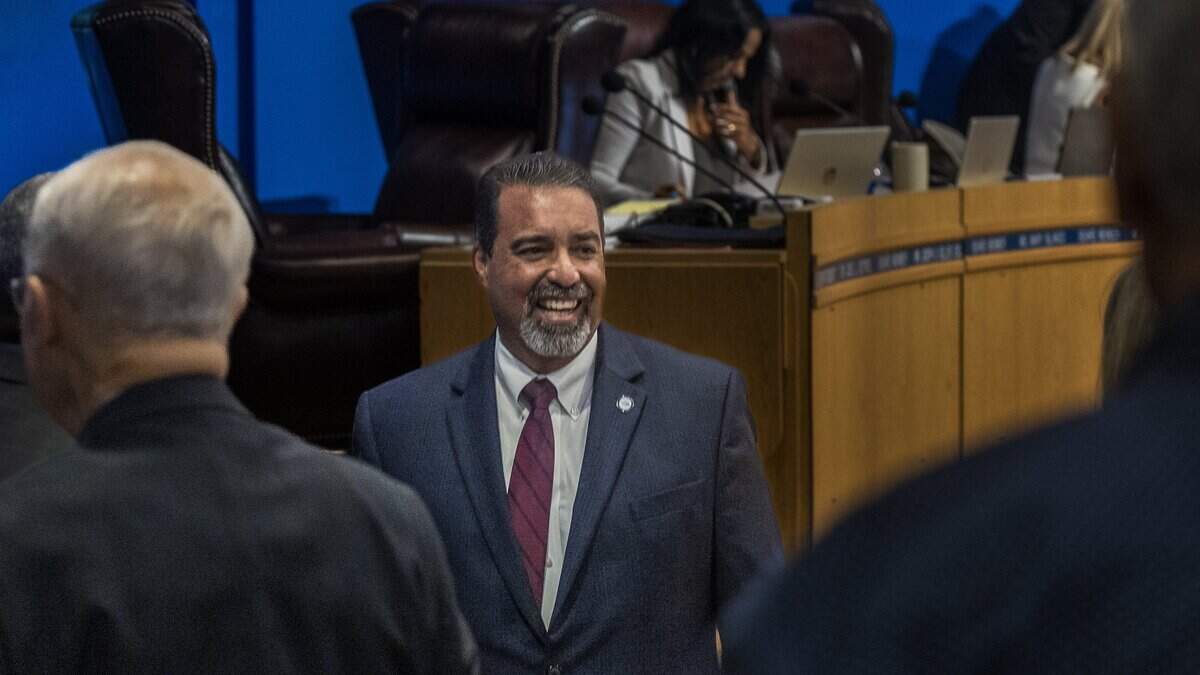
Rafael Villalobos has yet to start his new job, but the South Region Superintendent, who was recently picked to succeed Jose Dotres as superintendent of Miami-Dade County Public Schools, has some ideas on where the district will head once he takes the reins.
Read more South Florida botánicas face gentrification, rising costs — and old religious stigma
In an interview with the Miami Herald this week, Villalobos weighed in on some of the most pressing issues facing the district: school closures, teacher pay, land deals, AI in schools and more.
Details on the longtime administrator’s contract and official start date as the new superintendent are expected to be hashed out later this month. In the meantime, he continues as South Region Superintendent, which covers about one third of the county.
Here’s what Villalobos said over the course of a 30-minute interview with the Herald:
Answers edited for length and clarity.
Miami Herald: At a recent press conference, you said you’d fight for teachers to make “top dollar.” Where can that salary number go, realistically?
Rafael Villalobos: We know the impact that teachers make on a daily basis, and I don’t think that they get enough credit. We need to really thank them for the work that they do, because whether you go on to become a police officer, a lawyer, a doctor or anything it started with a teacher making sure that they got you to that point, and academically got you ready.
I’d like us to be as competitive as possible. A report that came out not too long ago spoke about how the city of Miami is more expensive to live in than New York City. So, when you look at the teachers in New York City, I believe that their base salary is somewhere around $70,000 or above. So I’d like us, at some point or another, to be as competitive.
That’s number one. Number two is: It’s extremely, extremely important—and the voters know it because they voted on it twice already—(to pass) the referendum. Whether you have a child in school or you don’t have a child in school, you’re impacted by that student that’s going to graduate and is going to go into the community and is going to be a part of that community one way or the other.
MH: Enrollment has been a big theme of late, and we’ve seen the recent closures, consolidations. Both you and Superintendent Dotres have said plainly that more of these things are coming down the pike. For you, what are the guiding factors going forward?
RV: It’s never easy because, at the end of the day, these are schools that have been in our communities for years and years and years. So, that’s never an easy feat to tell somebody, “Hey, we may need to close this school, because you’re at 150 students or 200 students, and when you look at the fiscal responsibility that we have and the programmatic responsibility that we have to students, we need to make sure that we do this, and consolidate those students at another school so that they can have more personnel at their disposal to help them and assist them to have better programs.” Whether it’s that PE teacher that’s there full-time, that music teacher that’s there full-time, that art teacher that’s there full time – those resources are also important to students.
I’m a big proponent of you know teaching the whole child, and if that whole child is missing something beyond the academics, that’s going to help them socially, emotionally, and actually, you know, grow as a human being… Most of my greatest memories are those right beyond academics.
MH: Looking at the numbers of the schools that closed this past summer, the majority of them have been majority Black schools. At the same time, majority Black schools also tend to be more under enrolled. Just looking at the data, is that a factor in your decision-making going forward?
RV: I think that what we did was we prioritized, right? So we looked at those schools that were at 200 students or less, and, unfortunately, they fell in many of those neighborhoods. But I like to call those the tier three enrollment gaps that were happening. We’re going to get to a point that we’re going to get to that tier two, and that tier two is those schools that may be at 250 to 350 that have a capacity of 1,000 or 1,500. Those schools are not being efficient fiscally, so we’ve got to make sure we combine them.
If you’ve got three schools in a neighborhood in a one-, two-, three-mile radius, and those three schools have the capacity for 1,000 each, but they’re at 300, we’re not being efficient. We’re not having all the programmatic impact to students that we should have. So we’ve got to look at consolidating those schools. So fiscally, we’re responsible, and I understand that. But the most important thing — and it’s what I continue to harp on — is that students receive the best programmatic impact for their academic careers, and that they have the best ability to learn not only academically, but also in the electives and also in activities.
MH: What’s your philosophy on the district selling land versus leasing it?
RV: I have some reservations about selling land, only because if Miami-Dade is known for anything, it’s that all of a sudden things can change at a moment’s notice. We can have thousands of students coming to Miami because of whatever can happen, maybe, in the Caribbean or Central America. We’ve seen those things happen in the past.
Read more Man’s death on Brightline tracks in Orlando is a first
For a long time, we were building schools because we couldn’t do it fast enough. And now we’re in a different environment, but it doesn’t mean that that won’t change in the future. So we’ve got to make sure that we hold on to as much land as we possibly can. But then, we can also be strategic, and we can say, “Hey, although we’re not using it right now, there may be some opportunities to lease some of this land.” There may be some opportunities then to look at some other land that may be ineffective to build a school in.
MH: Do you feel confident going forward the district can avoid any and all layoffs for school staff, specifically, or is that something that you might keep as an option?
RV: Well, it’ll be my primary goal. I would never like to lay off if I don’t have to, right? So, we have to be very strategic and very methodical on how, when we’re either consolidating schools or merging schools, the effect that that’s going to take on administrators, teachers, custodial staff, security, cafeteria, et cetera.
We have attrition that follows suit, and we’ll be able to fill those positions in because of that attrition. But we also have to have some other plans of action in place, and I am exploring some things. I don’t feel comfortable saying them yet because I don’t know if they’re going to come to fruition. But I have to be innovative looking into the future, knowing that’s going to be something that will allow us the flexibility to not have to rift anyone.
MH: AI has shaken up the workplace already. A few years ago, everybody was still saying, “Learn to code. That’s the safe thing to do.” Now that’s not the case. What should educators prioritize, given that it seems like this technology is increasing uncertainty in the job market?
RV: A lot of industries now are using AI, and we know that across the board. But it’s: How do you teach them to use it responsibly? How do you teach it to use it where it doesn’t take away from your intellect and your innovation as a human being? We’ve got to make sure that that creativity is still there, that we create resiliency as well in our students. We can’t allow AI to take that away from them either.
But if we use AI to learn, that’s just another wealth of support that a student can have. But we’ve got to teach them that, right? Because at the end of the day, at some point or another, they’re going to have a real assessment, and that real assessment is not going to have AI with them, so they’ve got to learn it as well.
MH: Two years from now, how will you — and how will we, as a public — know that Rafael Villalobos has done a good job?
RV: We keep talking about making Miami-Dade County Public Schools even more premier, making it the number one school district in the country. You do that through increasing academic proficiency levels. You do that in making sure that we close that achievement gap.
But it’s also extremely important that we have the highest graduation rates possible, and we’re up there already. It’s creating even greater partnerships, and making sure that, as education has to evolve, we are doing that in a timely fashion. I want the community to know that we will be fiscally responsible and that we will be academically responsible. I want them to know that we will build strong students that are going to go into our communities and our societies and are going to be leaders and contributors.
If you look at the greatest societies and the greatest countries, it always started through education. Education is a key component to the success of us all. Making sure that students understand that, and that our communities understand that, and that two years, three years, four years or 10 years down the line, I can look back and be proud of the work that we have continued to do — that’s what I wake up for every single day. That is my motivation and inspiration: making sure that everything that I do, alongside all of my team members and everyone that works diligently in Miami-Dade County Public Schools, that we have elevated to a whole other level.
MH: As superintendent, you’ll very likely have to work a good amount with Tallahassee. How will you navigate disagreements? Will it be a public-facing thing? A “work-behind-the-scenes” thing? What will that look like?
RV: You know, I think it’s extremely important when we talk about Tallahassee, or when we talk about communication with municipalities and support systems and partnerships, we know that our future is our children, and we know that we’ve got to be responsible to our children that are ultimately going to be in our society and our communities.
So making sure that my message and their message are along those same lines, and that I am clear with them that that continues to be our main objective, because our future is counting on all of us—and it won’t wait. So, it’s counting on all of us to make sure that our children are going to be prepared and ready to meet the demands of the future. So, working with them, building relationships, learning what some concerns are that we may need to meet at the state level, and addressing those as well — it’s going to be a partnership.
Read more With a $93M bid, group wins auction for former Spirit headquarters in Broward










Post Comment