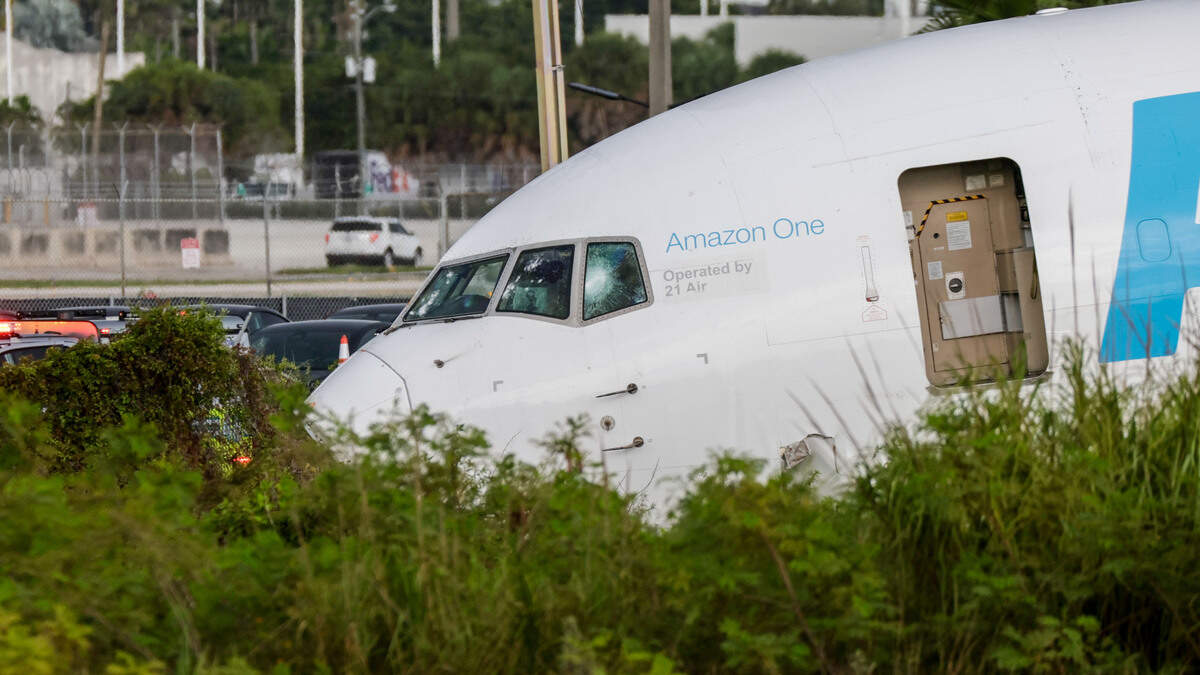
MIA doesn’t have EMAS. What is it? Could it have prevented plane crash deaths?
In the aftermath of a cargo plane crash that led to five deaths at Miami International Airport on Sunday, some people have been wondering why MIA does not have a runway safety feature known as an engineered materials arresting system — a crushable, lightweight material at the end of a runway that can slow down a plane in case of emergency.
Read more ‘Please help’: Miami family searching for loved ones after plane vanishes in Bahamas
Jennifer Homendy, chairwoman of the National Transportation Safety Board, said in a press briefing Monday that 72 U.S. airports have EMAS, another level of runway safety. Miami International Airport isn’t included in that number.
The Federal Aviation Administration says EMAS has stopped 26 aircraft that have overrun runways since 1999. Most airports install EMAS when they can’t meet runway safety area standards of 250 feet on each side of the runway’s center and 1,000 feet from the end of the runway. MIA’s runways meet those standards, including the runway involved in Sunday’s crash.
“Runway 12/30 at Miami International Airport has the full 1,000-foot Runway Safety Area mandated by the FAA,” said a Miami International Airport Monday night statement. “Engineered Materials Arresting Systems, or EMAS, are generally used at airports where space constraints prevent a full safety area from being provided. No U.S. airport has EMAS at a runway end that also maintains the full, unobstructed 1,000-foot safety area. EMAS is intended as an alternative, not as an additional layer on top of one.
“MIA undergoes a comprehensive FAA safety inspection every year and has consistently met federal airfield safety requirements.”
Still, when Homendy finished speaking to the media about the early investigation into Sunday’s fatal runway runoff by a 767-300 Amazon cargo plane, the media swarmed Miami-Dade Mayor Daniella Levine Cava to ask about EMAS and MIA.
“We’ve learned about that,” Levine Cava said. “We know that it’s not a requirement under FAA regulations, but we’re certainly interested to learn more. And, so we can do everything possible for safety.”
Read more One person dead in Miami-Dade County apartment fire, sheriff’s office said
READ MORE: Former pilots weigh in on what may have caused cargo jet to overshoot MIA runway
The FAA says EMAS are placed at the far end of a runway. The material crushes as a speeding plane passes over it, “slowing it down considerably faster than open space.”
On Sunday, the cargo plane operated by 21 Air for Amazon.com rambled over 1,300 feet beyond the end of the runway, Homendy said, smashing into a Ford Econoline van and a Toyota Corolla Cross in the process. The five people who died were in those vehicles.
Asked if EMAS would’ve helped prevent Sunday’s deaths and if it should be mandatory, Homendy said: “That’s an excellent question. That will be a key part of our investigation. Thank you for asking.”
READ MORE: NTSB: Amazon plane hit MIA cleaning contractor van filled with 7 people
Read more Officials searching for small plane that went missing midway from Bahamas to Miami
This story was originally published September 7, 2026 at 7:51 PM.










Post Comment