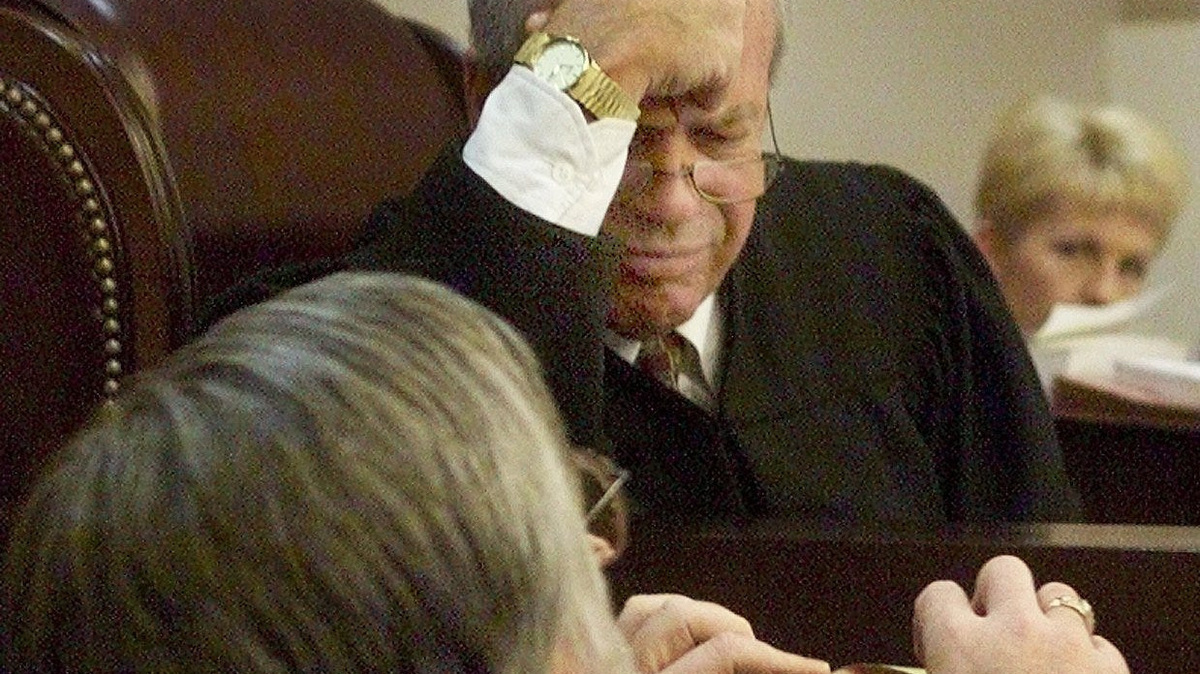
Judge Sandy Sauls, who ruled in 2000 presidential recount, dies at 85
Norman “Sandy” Sanders Sauls, the circuit judge whose Tallahassee courtroom became the focal point of the disputed 2000 presidential election, died Aug. 29. He was 84.
Read more Madrid overrules Ceuta authorities to set up migrant camp at port
Sauls’ ruling against Vice President Al Gore’s recount challenge helped shape one of the most consequential legal battles in American history. He grew up in Monticello, spoke in a Panhandle drawl and was known for his strict control of the courtroom.
To admirers, he was independent, intellectual and unmoved by political pressure and public opinion.
“He was a judge that followed the law and had a passion for doing the right thing,” said Kelly Overstreet Johnson, a former president of The Florida Bar and a past president of the Tallahassee Bar Association.
“I had known Judge Sauls for most, if not all, of my career,” Johnson said. “He wanted you to be prepared. He wanted to know that you knew what the case was about and the law. He was prepared. He expected you to be the same.”
He was known to chomp on cigars back in his chambers between hearings but brooked no interference on the bench. He once told a persistent Tallahassee Democrat reporter, only half in jest, “If I could blink my eyes and make you disappear, I think I would.”
Retired Circuit Judge George Reynolds III said Sauls’ legal credentials were often overshadowed by controversies that followed him. “Judge Sauls was an excellent attorney,” he said. “He had a lot of legal experience, and he knew the law very well.”
Reynolds said Sauls’ career included service with the prominent Pennington law firm, years as a federal bankruptcy judge and more than two decades on the circuit bench.
Critics, however, said Sauls could be stubborn and overconfident in his judgments.
During a personnel dispute that ultimately led to his removal as chief judge in 1998, Florida Supreme Court Justice Gerald Kogan said other judges and court personnel complained that Sauls managed the courthouse “in an extremely autocratic manner.”
Reynolds, at the time, served alongside Sauls on the 2nd Judicial Circuit. He said the dispute appeared rooted more in management style than in questions about Sauls’ judicial ability.
“He was very, very well liked where he served,” Reynolds said. “He was friendly and affable. He was easy to get along with.”
The judge at the center of the 2000 recount
Sauls spent 22 years on Florida’s 2nd Judicial Circuit and left behind one of the most complicated legacies in Florida judicial history.
To supporters, he was a disciplined jurist guided by the text of the law and indifferent to politics. To critics, he could be rigid and confrontational.
And yet colleagues across the ideological spectrum agreed that when history unexpectedly placed a presidential election in his courtroom, Sauls approached the dispute the same way he approached every case: By following the law as he understood it.
The assignment came two years after his removal as the circuit’s chief judge – and thrust Sauls onto the world stage.
It placed his courtroom at the center of the legal battle over the presidency as Republican Texas Gov. George W. Bush and Gore, the Democrat, fought over disputed ballots.
On Dec. 4, 2000, Sauls rejected Gore’s request for a manual review of disputed ballots, ruling that the vice president had failed to meet the legal burden required to overturn Florida’s certified election results. The Florida Supreme Court later reversed his ruling but the U.S. Supreme Court effectively ended the recount in its landmark Bush v. Gore decision, securing Bush’s narrow Florida victory and thus the presidency.
Reynolds said few judges would have been comfortable under the intense scrutiny during the recount.
Read more America’s Road-Safety Agency Accused of Moving Too Slowly to Save Lives
“I don’t think anybody would be comfortable in the national spotlight,” Reynolds said. “But I think he did a very good job handling that case and all of the attention that it was getting, with the whole world looking.”
And “he knew the law.”
Sauls: From Monticello courthouse to circuit bench
Born in 1941 and raised in Monticello, Sauls grew up around courthouses and politics. His father, Clyde, served as Jefferson County clerk of court, while his mother, Genevieve, was a longtime Democratic activist and political leader.
As a child, he roamed the halls of the Jefferson County Courthouse and became intrigued by the men in black robes. At Jefferson County High School, classmates voted him “Most Likely to Succeed,” “Most Intellectual” and “Friendliest.”
Sauls graduated from Florida State University and received his law degree from the University of Florida. He worked as a prosecutor, entered private practice and later served as a federal bankruptcy judge.
In 1989, then-Gov. Bob Martinez appointed him to Florida’s 2nd Judicial Circuit, which serves Leon, Wakulla, Gadsden, Jefferson, Franklin and Liberty counties.
Though appointed by a Republican governor, Sauls remained a registered Democrat and frequently defied political labels. He was comfortable standing apart from colleagues and friends if he believed the law compelled a particular result.
While Sauls is best known for the 2000 recount, his local legacy includes a courthouse dispute that cost him his position as chief judge in 1998.
Disputes over personnel decisions, management style and the attempted dismissal of Court Administrator Tom Long generated complaints from judges, lawyers and court employees. The Florida Supreme Court intervened and stripped Sauls of the administrative position, citing “continuing disruption in the administration of justice.”
Two years later, when the presidential recount occurred, national reporters revisited his record and found a judge who “inspired unusually strong opinions” while his critics acknowledged his intelligence, work ethic and commitment to the law.
The national spotlight faded after the election litigation ended. Sauls returned to handling the routine work of a circuit judge, presiding over civil, criminal and family-law cases throughout north Florida. He retired Aug. 31, 2011.
But the attention did not end when the recount did.
National recognition and a return home
In January 2001, Judicial Watch honored Sauls at Washington’s National Press Club, praising what founder Larry Klayman called not the outcome of the recount case but “the way he handled the case.” The group had filed briefs in the case for clarification of ballot-counting standards and to provide for public inspection of the ballots.
Klayman said observers saw “justice and the appearance of justice” in Sauls’ courtroom.
Accepting the award, Sauls reflected on the constitution’s checks and balances, saying the disputed election had provided Americans with “an essential re-education” about the separation of powers and the role of the judiciary in a constitutional republic.
And then, the keynote speaker at a National Press Club’s $95-a-plate ($180 in today’s dollars) luncheon talked about home. “Now, if you don’t mind, I think I’d just like to go back to my little courthouse in Wakulla County, Florida.”
Despite all the attention and the history he participated in, Sandy Sauls always saw himself as a north Florida judge, just doing the work he had dreamed about since was a boy.
He is survived by his wife of 51 years, Cindy Sauls; his son, James Sauls; his daughters, Cindy Kynoch (Robert) and Amy Hart (Mark); his daughter-in-law, Shannon Sauls; his sister, Mary Ellen Higginbotham (Ed); and his grandchildren, James Henry Sauls, Audry Ann Sauls, Genevieve Kynoch, and William Kynoch, according to an online obituary. He was preceded in death by his parents; his brother and sister; and a daughter, Christine Elaine Sauls.
More information
- Memorial donations can be made to Global Outreach International, P.O. Box 1, Tupelo, Mississippi.
- A graveside service for family, with honors by the Leon County Sheriff’s Office, will be held at Tallahassee’s Roselawn Cemetery on Sept. 3.
- A celebration of life will be held that same day, 2–4 p.m., Golden Eagle Country Club, 3700 Golden Eagle Drive East, in Tallahassee.
Jim Rosica contributed reporting. James Call is a member of the USA TODAY NETWORK-Florida Capital Bureau. He can be reached at [email protected]. Follow on X: @CallTallahassee.
This article originally appeared on Tallahassee Democrat: Judge Sandy Sauls, who ruled in 2000 presidential recount, dies at 85
Read more Kenny Minchey (4 TDs), Kentucky open with rout of Youngstown State
Reporting by James Call, USA TODAY NETWORK – Florida / Tallahassee Democrat
USA TODAY Network via Reuters Connect
Copyright Reuters or USA Today Network via Reuters Connect
This story was originally published September 5, 2026 at 5:21 PM.









Post Comment