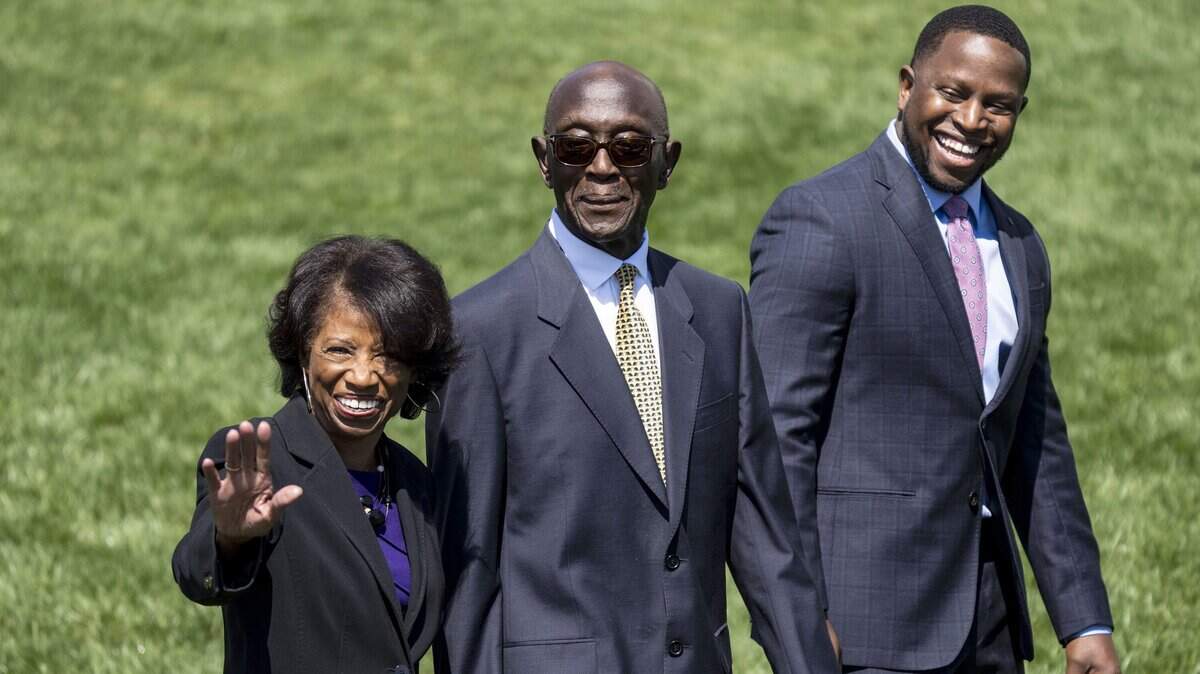
Johnny Brown, father of Supreme Court justice Ketanji Brown Jackson, dies at 80
Johnny Brown, a longtime attorney for Miami-Dade County Public Schools and father of Supreme Court of the United States Justice Ketanji Brown Jackson, died Wednesday from natural causes. He was 80 years old.
Read more Broward man indicted on murder charges after stabbing 3 people, cops say
Brown worked for the school district’s legal office for more than 20 years, rising to become the district’s top attorney from 1999 to 2005.
He is survived by his wife, Ellery, two children – Justice Jackson as well as Ketajh Brown, a Chicago-based attorney – two grandchildren Talia and Leila, his sister Carrie Mae Stone and his son-in-law Patrick Jackson.
Ellery Brown also worked for many years in Miami-Dade’s public school system, leading New World School of the Arts, a public magnet high school and college, from 1993 to 2007.
Brown is remembered as a “quiet and reserved spirit,” dedicated to both his legal profession and the wellbeing of his family, according to his brother-in-law Calvin Ross, former City of Miami Chief of Police.
“He wasn’t a brother-in-law, he was really a brother. Other folk may have seen him from the business side or from a different social setting, but I was able to see him from a very personal standpoint. Though he was not a blood brother, if I had to choose my brother, he would have been one that I would have chosen,” Ross said.
Brown was also an inspiration to Jackson in her legal journey, which led her to the highest court in the country when she was confirmed to the Supreme Court of the United States bench in 2022. Jackson made history as the first-ever Black woman appointed to the role.
In her memoir, “Lovely One,” Jackson recalled engaging with Brown about the law while he studied for exams at the University of Miami School of Law. After spending several years as a teacher in Washington, D.C., where he helped design an African American history curriculum that was later incorporated into the district’s standard history course, the family moved back to Miami on the outskirts of campus.
“I wanted to be just like the ebony-skinned, gentle-voiced man who would sometimes look up from his textbooks to talk to me about his cases, to ask me what I thought, as if I weren’t four years old. The conundrums he described fascinated me; they were stories of people in trouble, conflict, or sorrow, seeking the even-handed recourse of the law,” Jackson wrote.
Miami roots
Brown’s family moved from the small town of Fitzgerald, Georgia, to Liberty City in the 1950s. He met members of the Ross family, including his wife, while attending Miami Northwestern High School.
According to Jackson’s memoir, Ellery was the statistician for the basketball team on which Brown starred.
Brown, the first in his family to attend college, initially attended Kentucky State University, but decided to transfer to North Carolina Central University. In Miami over winter break he mentioned to Ellery’s brother that he needed someone to type up his transfer application essay. That brother recommended Ellery.
“My parents’ story flowed from there,” Jackson wrote.
The family eventually settled in South Miami-Dade in the 1970. Jackson attended Miami Palmetto Senior High School in Pinecrest where she excelled in speech and debate and was elected student body president. She went on to attend Harvard University for her undergraduate studies and law school.
Ross described Brown as a caring father, referring to him as “an encourager.”
He recalled when Brown arranged for Ross to discuss a career in law enforcement with his son, Ketajh. Ketajh later spent several years as a detective with the Baltimore Police Department before becoming an attorney.
“He wasn’t there to drive them, but to support them, and that, to me, was the real hallmark of a supporting parent — one that allows their children to pursue their dreams and is there to support them, not making them do something.”
In her memoir, Jackson described her parents’ core values as “hard work, a belief in the vastness of individual potential, and fierce pride in the journey and legacy of Black Americans.”
Read more Miami-Dade commissioner’s PAC got $38K in World Cup tix from county tourism bureau
Ross admired that Brown always kept a cool head.
“He certainly enjoyed a good argument, but never to the point of becoming angry. I just can’t ever recall him becoming angry… That was not Johnny. That was not him at all,” Ross said.
Brown also had an edge to him, as evidenced by the many times he and Ross played cards. Games like tonk, bid whist and poker were favorites.
“He was a ruthless card player, to say the least. His focus and his intent was on winning — and he did a lot of that,” Ross said.
Ross, who was also Florida’s Secretary of Juvenile Justice under former governor Lawton Chiles, added that he and Brown largely kept their high-stakes work at the office when spending time as a family. They would go on fishing trips to catch snapper in the Florida Keys and hold bible study in each other’s homes. Work was put to the side at those times.
“We didn’t talk shop. … We had more important things to talk about, like, ‘What’s the card game for the day?’ or ‘Who made the macaroni and cheese,’” Ross said.
Before joining the school district’s legal office in 1983, Brown worked as a corporate attorney, first for Burger King, then in commercial real estate for Pantry Pride, a now-defunct supermarket chain.
According to a 1999 Herald story, Brown was selected as lead attorney for the district in a tight 5-4 vote over another senior attorney at the district.
Brown helped the district navigate a period of growth as well as funding cuts from Tallahassee. With a background in commercial real estate, he assisted the school board in pursuing several construction projects during that period. He faced attacks from some school board members who tried to remove him from his position amid controversies over certain land deals and bureaucratic issues. However, each of those efforts failed.
Marta Perez, a former school board member who served the entirety of Brown’s time as the top attorney, said those votes reflected divisions and factions within the board more than anything.
“There was no real controversy with him, except in the inside baseball of the board,” Perez recalled.
Perez voted for Brown’s hiring and recalled him as “very nice and very personable.”
Luis Garcia, current deputy general counsel with the school district, worked under Brown for the entirety of his six-year tenure as lead attorney. Garcia called him a “great supervisor,” and a “family first” role model who didn’t let the pressure-cooker nature of the job get to him.
“He was unfazed by the job of being a school board attorney, which is very demanding,” Garcia said.
No formal service has been scheduled for Brown. A family spokesperson told the Herald a family gathering will take place in Miami “in the near future.”
Read more Broward man indicted on murder charges after stabbing 3 people, cops say
This story was originally published July 17, 2026 at 3:16 PM.











Post Comment