Is a walkable Miami possible? This 225-mile trail could answer that one day
South Florida isn’t an easy place to walk. All those whizzing cars, disjointed streets and too-short “Walk” signs make life difficult for pedestrians.
Read more Planning a cruise from the Miami seaport? Check which ships are coming
But local leaders want to prove Miami can join the ranks of walkable cities like New York, Boston and San Francisco, and they’re betting that 225 miles of trails can help solve some of the issues.
So, they’re doubling down on the Miami Loop, a countywide network that will connect a labyrinth of walking and cycling paths, corridors and green space.
The project has been in the works since 2015, but has stalled several times in the last decade despite support from city and county leaders, transit advocates and residents.
The project’s ambitious scale is only partly to blame.
Sections of the Miami Loop are still being designed or under construction as individual trails struggle with multimillion-dollar cost estimates. The project is also the ultimate test of whether city, county, state and federal leaders can work together to get the job done.
MORE: The Underline’s bike and walk trail is complete. It’s named after a billionaire
The Loop falls under the jurisdiction of several local governments, as well as special districts including the Miami Downtown Development Authority, and has required lots of approvals to get off the ground.
Here’s what to know about the Miami Loop’s stops and starts:
Inside and outside the Loop’s delays
If you’re on the fringes of Miami-Dade County, the Miami Loop won’t be extended into your backyard anytime soon.
Building out the project’s “inner loop” — a collection of six trails largely concentrated in the city of Miami — is the priority because “a lot of it is operational already,” former state Rep. Julio Robaina, a voluntary inter-agency liaison for the project, told the Miami Herald.
Robaina’s history with the Miami Loop goes back to his time as South Miami mayor in the early 2000s. While in office, he passionately supported the Loop’s Ludlam Trail, a 5.6-mile path carved out of an abandoned railway line running from Northwest Seventh Street to Southwest 80th Street.
He was tapped into the Loop initiative earlier this year as part of Miami City Commissioner Ralph Rosado’s efforts to revive the dormant plans.
While paths within the Miami “inner loop” — including The Underline, Commodore Trail, Miami River Greenway, Baywalk, Ludlam Trail and Heritage Trail — are up and running to various degrees, none of them are fully finished.
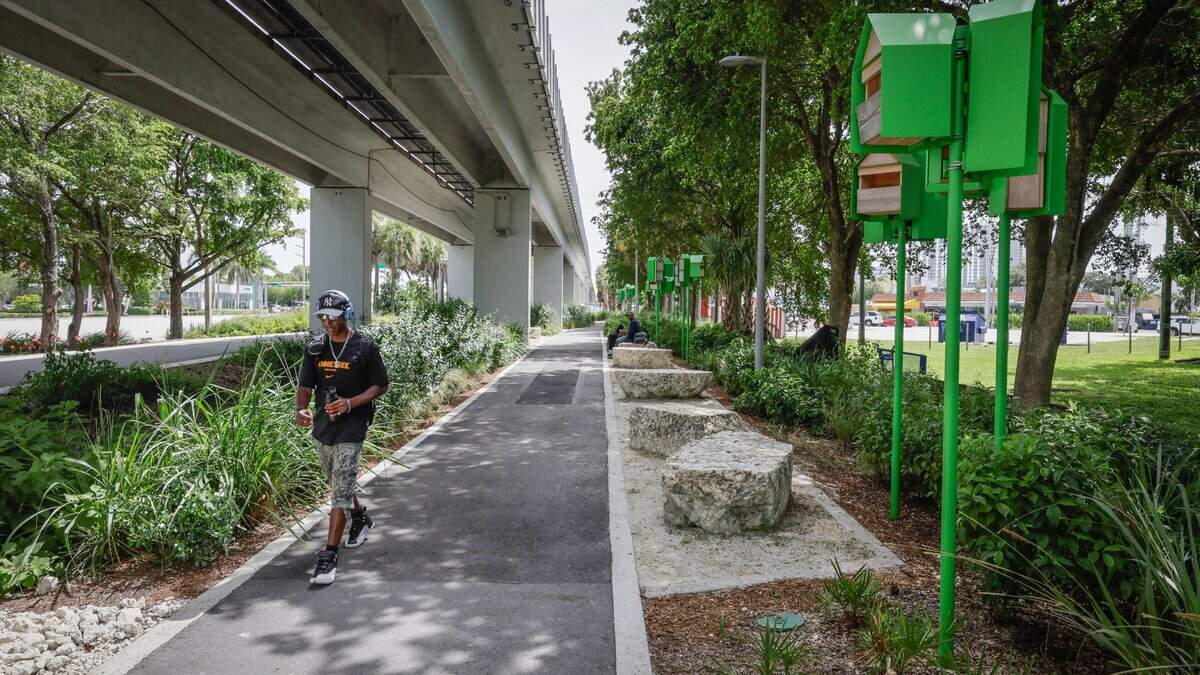
The Underline, a 10-mile park built under the Metrorail, and Commodore Trail, a five mile path that runs through Coconut Grove and Coral Gables, are on track to wrap construction this year. The Underline’s bike-and-walk path opened in mid-November, but the urban park has not been integrated into the Loop and has several amenities under construction until early 2027.
The Miami River Greenway and Baywalk, waterfront pedestrian and bike paths along the Miami River and Biscayne Bay, are 68% and 89% complete, respectively.
But the Ludlam Trail and the Rev. Edward T. Graham “Heritage Trail,” a 33-acre green space that will go under the I-395 Signature Bridge — the spider-like highway overpass rising in downtown Miami through numerous delays — are mostly stuck in the design phase.
Design plans for Ludlam Trail will be finalized early next year, and construction for the first phase, a 1.6-mile chunk, is slated for 2028.
Completion of the Heritage Trail, also called the “Underdeck,” has been pushed back to 2031 and could see more delays after the Trump administration cut the Biden-era grant funding it last year.
Finishing the “outer loop” is shaping up to be even more elusive, according to Rosado’s team.
While many of the trails are complete, they’re missing several miles of junctions — connecting crosswalks or paths. Because those trails sprawl into unincorporated Miami-Dade, that means Loop completion is up to city and county officials agreeing on plan approvals and coordinating funding.
Several of the project’s advocates blame bureaucracy.
“There were a lot of politics being played, and I think they realized that we were serious about getting this going, but more importantly, serious about opening up the communication.” said Robaina about his early days on the Loop project.
He cited Miami-Dade’s nearly two-decade delay and silence surrounding Ludlam Trail, as did Peter Rabbino, president of advocacy group Friends of the Ludlam Trail, and Cathy Dos Santos, who runs the nonprofit Transit Alliance Miami.
“Every time you talked to them: ‘cone of silence, cone of silence,’ said Rabbino, referring to a local law that bans verbal communication about a project that is actively soliciting bids.
Read more ‘Could have died’: Details emerge in hazing case involving Miami Secret Service agent
“It’s a very rigid process,” added Dos Santos. “They have their playbook that they follow.”
The railway-turned-park is now regaining traction after the county approved a design contract in July and announced a construction start date earlier this month.
Miami-Dade’s parks department hasn’t responded to the Miami Herald’s request for comment. And the city of Miami and Miami-Dade County haven’t given an estimated completion date for the Miami Loop to the Herald.
‘There has to be a shift’
Though the Loop is proving to be an uphill battle, the project has a dedicated following because of this goal — make a Miami where you can walk or bike to work, to school or to your morning coffee run with safety and ease.
That rings especially true in a region where development looms larger and green spaces are getting smaller.
Just 6% of Miami’s land is used for parks and recreation, nonprofit Trust for Public Land reported in May. The national average is 15%.
“There isn’t a day that goes by that we don’t hear about people getting struck, either pedestrians or bicyclists,” Robaina said. “We’ve got a lot of concrete in Miami-Dade County, and we do need to have that balance to have the safe, walkable, and bike-friendly areas.”
Advocacy groups including Transit Alliance Miami say that an overhaul of the region’s car-centric model is overdue.
“People are already walking and biking around Miami, and it is, generally, pretty dangerous to do so,” said Cathy Dos Santos, the nonprofit’s executive director. “There has to be a bit of a shift, and that’s why I say that residents have to be an important voice.”
An inaugural roundtable summit to discuss the Loop’s latest updates drew residents with similar concerns.
Most of the people who gathered at Miami Dade College’s Wolfson Campus on Oct. 10 said they’d swap certain car trips for walking or biking if safe, comfortable and shaded routes existed.
People also characterized the Loop as a neighborhood hub, not just a web of trails.
Some also suggested ways to lure users: public art displays, concerts, a “transit food tour” where culinary hotspots are mapped across the trails.
But whether those ideas pan out hinges on the Loop passing the design and construction process with few holdups. To that end, city of Miami leaders say the project’s momentum won’t let up on their watch.
Last fall, Miami city commissioners voted to create an oversight and coordination process to move the project along. The item, proposed by Rosado, called for an appointed Loop coordinator to provide monthly status reports as well as hold quarterly roundtable discussions with county officials and neighboring cities.
That committee now meets every two months, and its next meeting is scheduled for early December, according to Rosado’s team. The coordinator role has also been filled.
Scouting funding sources is also on the list of priorities. Robaina said he’s “devoting my time to continue to bring the money in.”
In October, the Miami City Commission approved $5 million toward the design and construction of Ludlam Trail segments in the city. Those dollars — pulled from the city’s budget — are available for the county’s build-out of the trail.
Rosado also has pushed a zoning plan approved by the Miami commission in June to find more money for the Loop.
The measure allows developers to build taller and larger projects near bike and pedestrian paths in exchange for cash contributions to those trails, which include Ludlam Trail, Commodore Trail, The Underline and the Miami River Greenway.
“I really am optimistic,” said Rabbino about Ludlam Trail and the Loop. “Kids are going to be walking to school, visitors are going to be coming to see what it’s all about, we’re going to have art in public places. … Once people see what it could be, the rest of it is going to unfold pretty quickly.”
Read more Refunds? What travelers should know about the ground stop at MIA and FLL







Post Comment