After quiet maneuvering, power shifts on the Miami-Dade County Commission
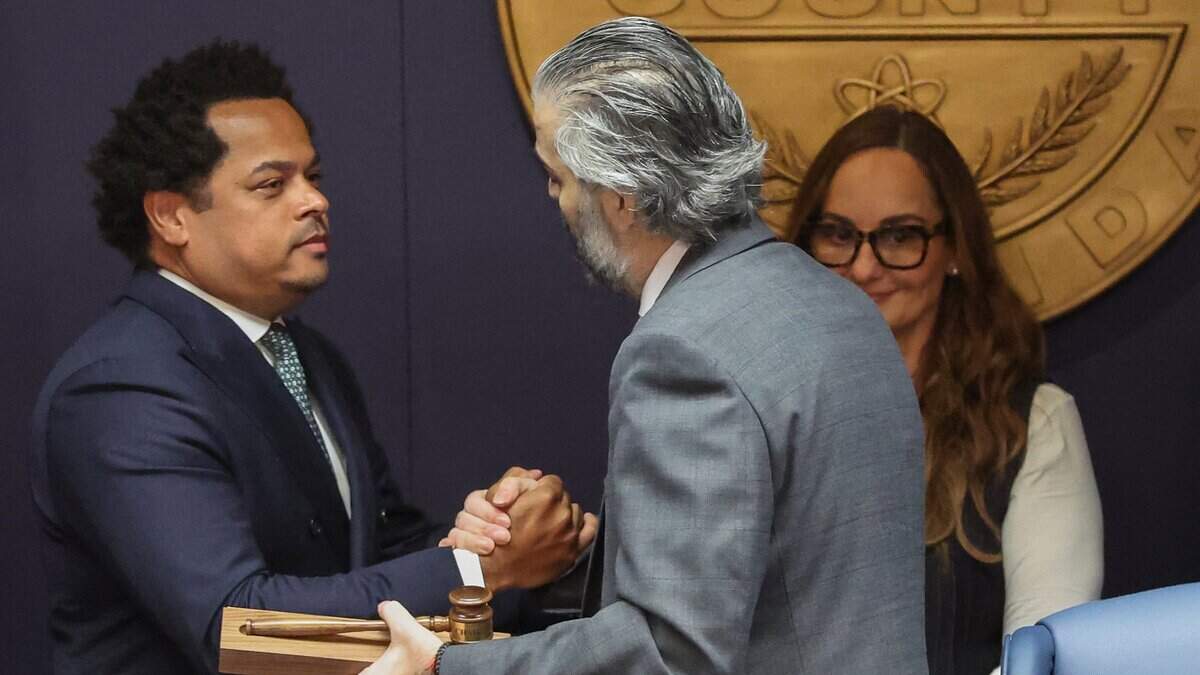
Political power in County Hall shifted on Tuesday as Miami-Dade Commissioner Keon Hardemon won the election to be the County Commission’s next chair, a post that lets him decide whether fellow commissioners’ legislation will get a vote or stay stranded in the agenda pipeline.
Read more After quiet maneuvering, power shifts on the Miami-Dade County Commission
While there was no public contest for the position — Hardemon was the only nominee — the last few months saw behind-the-scenes maneuvering and alliance-making in the contest to succeed outgoing Commission Chair Anthony Rodriguez.
Insiders said Hardemon and Danielle Cohen Higgins were the two commissioners vying for the chair position in the run-up to Tuesday’s unanimous vote for Hardemon to inherit the gavel from Rodriguez. Commissioners also elected Commissioner Juan Carlos Bermudez as vice chair.
A lawyer who grew up in Liberty City, Hardemon won the open District 3 seat in 2020 after seven years on the Miami City Commission. In nominating Hardemon for chair, Commissioner Oliver Gilbert praised Hardemon as well suited to lead the board.
“He’s been able to actually understand the community from the perspective of people who don’t often sit in rooms like this, who don’t have access to power and resources like this,” Gilbert said. Hardemon did not speak before the vote and took over from Rodriguez immediately after his selection as chair.
Hardemon, 43, previously served as chair of the Miami City Commission when he was a commissioner there. He is set to leave his post as a county commissioner in two years due to term limits.
Hardemon represents the northern portion of Miami, including much of the city’s downtown waterfront and the neighborhoods of Edgewater, Little Haiti, Overtown and Wynwood. In his first term, Hardemon was the architect of an anti-violence spending plan championed by Mayor Daniella Levine Cava known as the “Peace and Prosperity Plan,” which used naming-rights revenue from the Kaseya Center to fund summer youth programs and other initiatives.
Hardemon’s elevation as chair is also bound to bring more attention to the role of his aunt, consultant Barbara Hardemon.
Read more ‘Lot of history here’: Mark Consuelos goes back home to Florida — and his first job
She’s been pouring money into a political committee that Hardemon registered to raise money for two years ago, All Miami-Dade. Her public affairs consulting firm, B&B Professional Consultants, has given more than $350,000 to All Miami-Dade this year. Hardemon has told the Herald he’s no longer involved with All Miami-Dade.
Tuesday’s vote followed a brief ceremony honoring Rodriguez. Speaking in an unusually soft voice, Rodriguez for the first time publicly addressed a health crisis he’s facing but did not offer details. “I was recently diagnosed with a terrible disease,” said Rodriguez, whose second term ends in 2030. He said if not for the meeting, he would be in the hospital for treatment. Even so, Rodriguez told the audience: “I’ll be fine.”
The 13-member commission has an unofficial tradition of rotating the chair position between Hispanic and Black members, which has also resulted in switching between Republican and Democratic members on the nonpartisan board for more than a decade.
That unspoken tradition held on Tuesday, even with GOP members holding a majority of the seats under Rodriguez, a Republican and Hispanic. Hardemon and Cohen Higgins are both Black and members of the Democratic Party.
Fellow commissioners elect the chair, and siding at the right time with the right candidate can mean being rewarded with chairmanships for the county’s committees, which are made up of smaller groups of county commissioners.
The power of the County Commission chair largely rests on his or her control of the agenda and which items of legislation are presented for votes by the full commission. As chair, Hardemon also oversees multiple offices controlled by the commission, including Miami-Dade’s lobbying division and the international trade staff.
He also gets to pick seat assignments for the other 12 commissioners. Typically, top allies get seats near the center of the dais, while the most remote perch is sometimes called the “punishment chair.” Under Rodriguez, that’s where Bermudez sat. On Tuesday, he moved to the second chair, by Hardemon’s side.
Read more After quiet maneuvering, power shifts on the Miami-Dade County Commission
This story was originally published November 17, 2026 at 3:16 PM.










Post Comment