How 7 FIU students are testing Florida’s restrictions on campus free speech
It was a Friday the 13th and something was bound to go wrong.
The president of Florida International University, Jeanette Nuñez, was set to hold a “fireside chat” with former Major League Baseball star Alex Rodriguez at an auditorium on campus.
Read more State expands bear hunt permits and adds private lands to the mix
For some FIU students, the event in March was a critical chance to finally voice their opinion on a polarizing university matter directly to Nuñez.
Last year, FIU became the first university in the nation to sign what’s called a 287(g) agreement with U.S. Immigration and Customs Enforcement. The agreement allows campus police to enforce immigration laws on campus. These students, known as the ICEBreakers, demanded that the school end the voluntary arrangement. Yet attempts to engage with university leadership had been met with the silent treatment for months, students said.
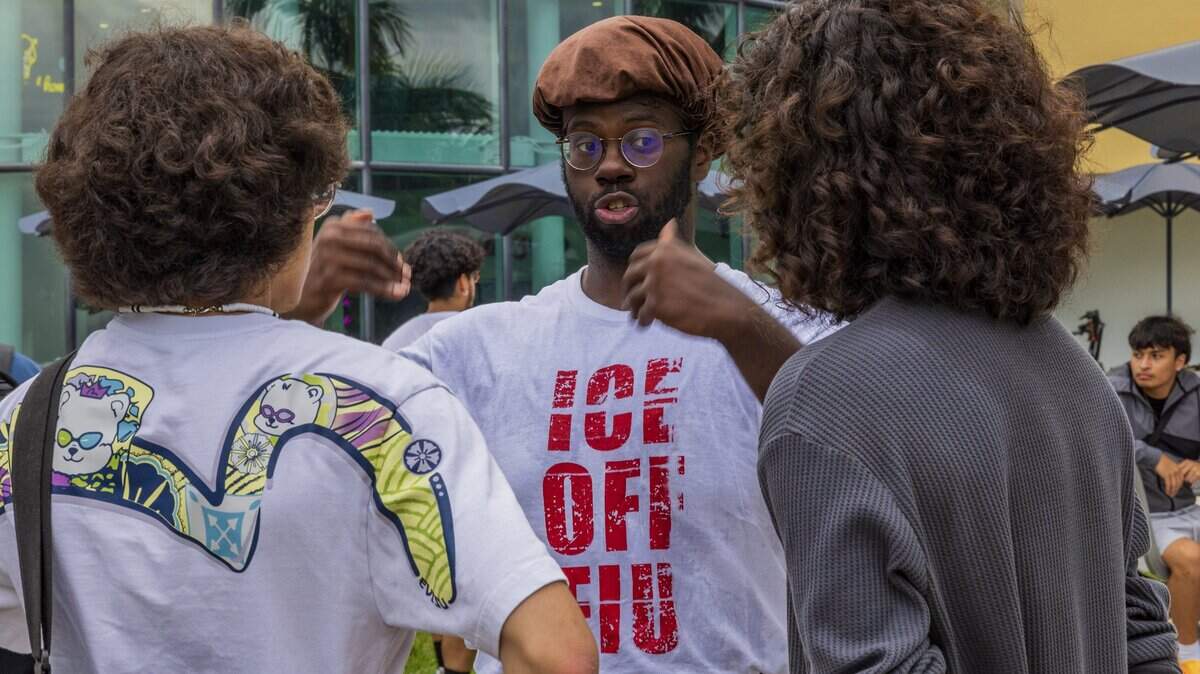
The fireside chat was their chance. Between 15 and 20 members of ICEBreakers got tickets, and around a half-hour into the program they stood up and turned around, revealing white t-shirts that said in red letters: “ICE OFF FIU.” They made no noise. Rodriguez and Nuñez continued to speak.
In police body camera footage released by FIU, Nuñez briefly joked with Rodriguez about the silent protest.
“Don’t worry, this is not for you,” Nuñez told the former baseball star, gesturing to the silent protesters with a chuckle.
“No, no, I’m good. We’re having fun right now,” laughed Rodriguez. The crowd joined in laughter. A woman seated directly behind some of the students pulled out her phone and snapped a picture of the standing students.
READ MORE: FIU moves to discipline 7 students for ‘indoor’ silent protest on immigration policies
The event continued. A few moments later, the students walked out of the gathering on their own volition. No police officer or security guard asked them to leave.
It was those few, innocuous moments that then became the center of a major free speech battle in Florida universities.
Outside the event, university police demanded the names of students. FIU faculty members stood by the students’ side and told officers that the students had done nothing wrong in the auditorium. Several faculty members could be seen telling police: “It’s their First Amendment right.”
FIU Officer Michael J. Cal in the body cam footage could be seen arguing that the students had broken campus policy during the silent protest. While speaking to a Cuban-American passerby who supported the students a few minutes later, Cal told her: “ If [they] keep breaking [policies], the university might have to get involved and expelling and stuff like that.”
Natalia Giordano, a clinical assistant professor at FIU’s School of Social Work, was among those telling the police that they were violating the students’ First Amendment rights. She told WLRN that the way the police handled the situation left her deeply uneasy.
“I think they’re trying to silence dissenting voices and continue the facade that everything is okay here on this campus when it’s not. These students have every right to protest the 287(g) agreement and all the other ways in which the university is not meeting their needs,” said Giordano.
A few moments after the confrontation with students and police, a full volume protest began on the grass about 100 feet away from the building. Students demanded that their university cut ties with immigration enforcement.
Leading the chants was Carlton Daley with the Young Democratic Socialists of America chapter at FIU. Daley said the silent protest was necessary because Nuñez and university leaders had refused to meet with students to talk about the impacts of immigration enforcement on campus.
“We want some accountability, we want some transparency, and Nuñez has demonstrated that she’s not willing to do that,” Daley said. “It’s very clear that the general body here is frustrated. We’re frustrated for a multitude of reasons.”
The ban on ‘expressive activities’ inside campus facilities
Three months after the silent protest, the school informed seven students that it would pursue disciplinary charges against them. The charge: That they had violated a against “expressive activities” inside of university buildings.
The policy itself specifies that “expressive activities” are “protected under the First Amendment to the United States Constitution and Article 1 of the Florida Constitution,” underscoring an irony that would underpin much of the free speech battle that followed.
The ban on “expressive activities” indoors had not been around for a long time. The university Board of Trustees it campus policy in June of 2024, as pro-Palestinian sit-ins and protests were taking place at FIU and other campuses across the state and nation. The Board of Trustees in the same meeting banned camping on campus, a common tactic taken in the pro-Palestinian movement.
Weeks before FIU adopted the policy, Republican Gov. Ron DeSantis said the state would not tolerate growing campus activism in support of the Palestinian cause. Israel was months into a massive bombing campaign in Gaza in response to a rapid Hamas invasion and attack on Israel, in which over 1,000 were killed. The Israeli bombing campaign in turn reduced most of the Palestinian territory to rubble. Tens of thousands of civilians were killed, according to the United Nations and other groups.
“We will not let the inmates run the asylum in the Sunshine State,” said DeSantis about the movements in support of Palestinians on university campuses.
The law cited by the FIU Board of Trustees in passing the indoor ban is the Campus Free Speech Act, passed by Florida lawmakers in the wake of the 2018 mass shooting at Marjory Stoneman Douglas High School in Parkland that left 17 dead. The law protects the right to free speech in outdoor areas of a campus but does not specifically mention indoor exceptions.
Adam Saper, an attorney from the Community Justice Project who represents the students, said the action taken against the anti-ICE protesters seemed to be the first time the policy was enforced against anyone at FIU.
“I’ve asked the school for any documentation of any similar prosecution in the university’s history, and they have not provided it,” said Saper.
Read more Orange Blossom Classic to honor Teddy Bridgewater, historian Dorothy Jenkins Fields
Saper immediately raised constitutional issues with the decision to take disciplinary actions against the students.
According to the landmark Supreme Court case Tinker v. Des Moines, schools can only limit speech when it is materially disruptive, whether indoors or outdoors. The 1969 case came when a school in Iowa disciplined high school students for wearing black armbands to protest the Vietnam War. The court ruled that was unconstitutional because the black armbands didn’t cause disruption, so the school was suppressing pure speech.
An email from an FIU employee who organized the event told investigators that the silent protest in arch “did not disrupt the event,” and that no one lodged any complaints about the action.
Yet the school still decided to press forward with the charges. The school did not allege a disruption took place; it simply pointed to the policy that bans expressive activities indoors and said the students had violated it. Saper saw the whole episode as a frontal attack on the free speech rights of the students.
“ They’re saying you are not allowed to exercise your First Amendment. You’re not allowed to express yourself inside a university building,” he said.
The students agreed, and vowed to fight. Now known as the FIU Seven, they presented a united front in pushing back against their university.
“The only thing we were charged with was standing up inside of the auditorium with our shirts,” said Katya Tripath. “I just feel really disappointed and like as if my own free speech is being restricted because of my opinions on what FIU has been doing.”
The school found the students “responsible” after a disciplinary hearing in June. As punishment the students would receive a written reprimand and would also be forced to record two-minute videos reflecting on the campus policy they allegedly broke and their own behavior. The videos needed to be “original” and “thoughtful,” according to the university, and the school can make students record the video over and over again until they were satisfied with the outcome.
Free speech groups like the Foundation for Individual Rights in Education (FIRE) had already been warning the university to drop the charges, saying the school was violating students’ right to free speech. Now they were even more alarmed at the video requirement.
“FIU must drop the charges, rescind the compelled ‘reflection’ video requirement, and stop trying to turn protected expression into state-scripted obedience,” FIRE wrote in an open letter to FIU.
Andrew Caro, one of the students charged, told WLRN he planned to file an appeal against the university finding the students “responsible” for violating the policy, but he still felt that he would be forced to record the video.
“When I record my video, I have no intention of apologizing. I have no intention of admitting any wrongdoing because, to me, I did not engage in anything that was wrong or that violated our regulations within the university,” said Caro. “I am going to make it very clear that FIU Regulation 110 directly infringes on my First Amendment right and is completely unconstitutional as per my freedom of speech.”
The contentious court hearing and temporary ruling
The university-level appeal was denied.
In early August the seven students decided to escalate. They sued FIU in federal court with help of the Community Justice Project and the American Civil Liberties Union of Florida, saying the school violated their right to free speech.
At the first federal court hearing for the case on August 20, Southern District of Florida Judge Jacqueline Becerra sharply questioned FIU’s attorney Mohammed Jazil about the campus policy. She said the main issue with what FIU was doing to the students was disciplining them for expressing themselves, even though the March 13 event was not disrupted. The ban on “expressive activities” indoors policy seemed to ban all kinds of expression, even something as simple as friends gathering at the student union to discuss politics, she noted.
Becerra asked Jazil: If the students with “ICE OFF FIU” t-shirts simply stood up and walked out of the event at the same time, could that be considered a “protest” that might subject the students to disciplinary action?
“Perhaps, your honor,” Jazil responded.
“That’s exactly the problem. You hesitate. The record won’t show this but you hesitate before you answer and that’s the problem,” said Becerra. “Because if you’re not sure and you’re an esteemed member of the Bar, do you think these 18- and 19-year-olds can figure out this policy and say: ‘We can stand. We can’t stand. We can turn. We can’t turn. We can’t stand for too long. We can leave at the same time?’”
“The policy on its face tells me that if it’s an exercise of free speech, you cannot exercise your free speech indoors at FIU. Whoever wrote this — and I’m not making this up, this is how it’s written,” said Becerra. “I’m not sure who read this [policy] before it passed, but it doesn’t seem like a lawyer did.”
Three days after the hearing, a day before Fall Semester began, Becerra issued a preliminary injunction, temporarily blocking FIU from enforcing the ban on “expressive activities” indoors against members of ICEBreakers.
READ MORE: Federal judge says FIU violated First Amendment rights of anti-ICE student protesters
FIU’s attempt to justify punishing students for standing up with t-shirts in a university building takes the fundamental First Amendment issue “down a road not taken in any school speech case either by the Supreme Court or the Eleventh Circuit [Court of Appeals],” wrote Becerra.
The ICEBreakers rejoiced at the decision.
“It was just such a moment of celebration for all of us. We were all, like, very happy to hear the news,” Caro told WLRN immediately after the preliminary injunction came down. “Just knowing that the judge that was hearing us, Judge Becerra, was ruling in our favor was, very overwhelmingly positive for me and my six other students charged.”
The group has already begun planning for further actions pushing the university to break ties with federal immigration enforcement. They distributed several dozen “ICE OFF FIU” t-shirts on campus and are planning a series of protests and town hall meetings in the near future, and say the attention brought about by the court case has only helped the cause.
“ I feel like our momentum is really building,” said Max Fodren, the president of ICEBreakers.
In a statement, FIU spokesperson Madeline Baró said the university “will comply with the court’s order while considering our legal options.”
Read more Sears and Taco Viva at Aventura Mall? See when the center had a different vibe
This report was produced by Miami Herald news partner WLRN Public Media.







Post Comment