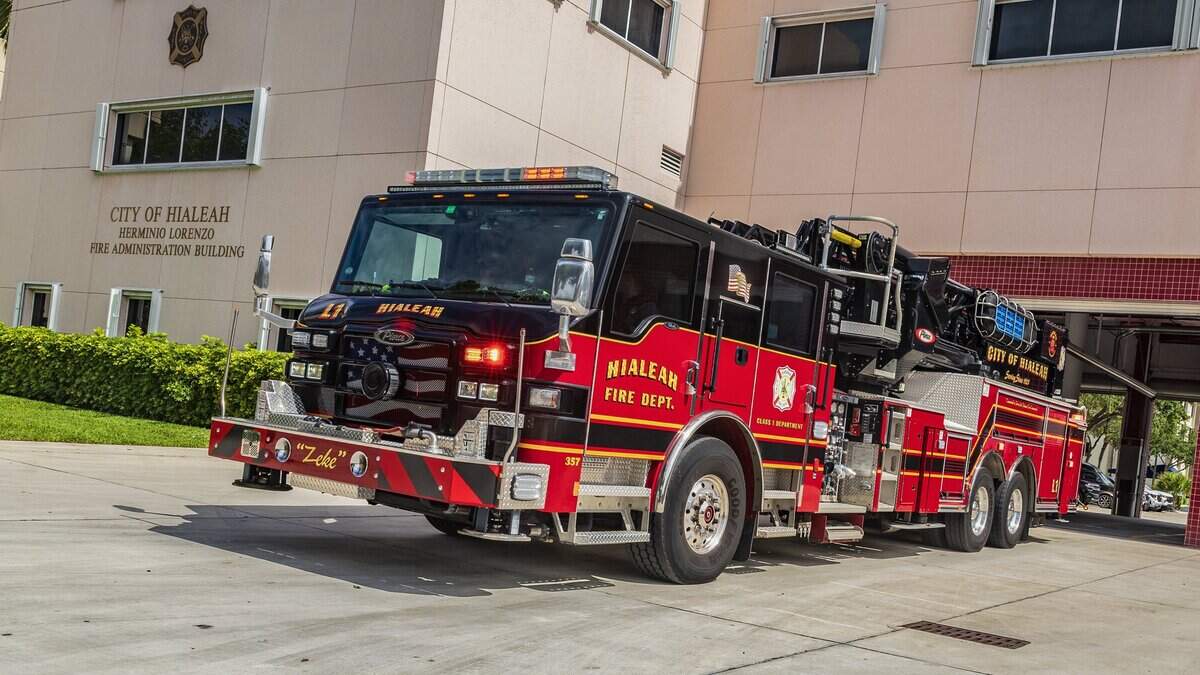
‘Hialeah is no longer competitive’: Why firefighters are leaving the department
The City of Hialeah is losing firefighters faster than it can replace them, leaving fewer crews to respond to a growing number of emergencies and forcing the city to spend millions of dollars each year just to keep fire trucks on the road.
Read more ‘Haiti is hell’: Ohio governor says kicking Haitians out of U.S. hurts economy
The Hialeah Fire Department employs 226 firefighters, about 74 fewer than it did two decades ago, despite responding to more than 31,000 fire and medical emergency calls each year amid growing demand for services. The staffing shortage is expected to worsen: At least 14 firefighters are preparing to leave the department, according to Miami Herald interviews with several department personnel.
The firefighters’ union has been warning city officials for years that the department is operating with dangerously low staffing levels.
“We can’t afford to lose another firefighter. Right now, we have 22 budgeted vacancies, and we’re already operating with a very low staffing level,” Eric Johnson, president of the Hialeah Firefighters union, told the City Council during a recent meeting as he outlined what he described as the department’s staffing and operational challenges.
Johnson noted that over the past two decades, the department has shrunk even as demand has continued to rise.
“Our call volume has increased by 40%, and we’ve added two more fire stations,” he said. “Our city has grown, and the Fire Department has to grow with it.”
Many firefighters point to a combination of reasons for the decreases in staff numbers: lower pay, pension reductions and limited career opportunities. The problems have left Hialeah struggling to compete with neighboring departments for both new recruits and veteran firefighters.
Fire Department Lieut. Harold Estrada has spent nearly a quarter-century with the fire department. Hired in 2001, he said he remembers a time when firefighters competed for the opportunity to work in the city.
“Hialeah is no longer competitive,” Estrada said. “We are far behind other fire departments in Miami-Dade County, but it wasn’t always like this, it was a great department. Everybody wanted to work at Hialeah Fire.”
Now, he is preparing to leave for the Jupiter Fire Department in Palm Beach County.
Records show that over the last eight years, Hialeah has hired 149 firefighters, but at least 65 have since departed, while another 34 have retired over the past three years.
A department under strain
Interim Fire Chief Humfredo “Freddy” Perez acknowledged that staffing levels have forced the department to operate below industry recommendations.
During a recent tour of Hialeah’s nine fire stations, he told the Herald that all department vehicles—including engines, ladder trucks and rescue units—respond with three-person crews rather than the four recommended by national fire service organizations.
“We are the only municipality in the surrounding area that staffs a suppression unit with three firefighters instead of four,” Johnson, the union president, told the Herald. “Regardless, Hialeah firefighters get the job done, doing more with less.”
The International Association of Fire Fighters and the National Fire Protection Association have long maintained that four-person staffing is the minimum standard needed for firefighters to safely and effectively respond to emergencies.
“Anything less puts lives, property and firefighters at risk,” the association says.
Beyond pay
For firefighters on the front lines the issue extends beyond paychecks.
Nearly 90 percent of the department’s calls are medical emergencies. Those incidents often require advanced life-support interventions that only certified paramedics can perform.
Yet firefighters say Hialeah has increasingly relied on hiring Emergency Medical Technicians instead of paramedics because of a shrinking pool of qualified applicants and lower salaries. While EMTs provide basic emergency care, paramedics are trained to perform advanced life-support procedures.
As a result, at least 30 of the department’s firefighters—approximately 13% of the workforce—are unable to perform advanced life-support procedures such as administering intravenous medications or intubating patients, placing additional demands on the firefighters who are fully certified as paramedics. Firefighters say that places greater demands on certified paramedics and can create challenges during critical emergencies.
But the staffing shortage is not limited to medical certifications.
“The lack of staffing puts strain on officers and creates a potential safety risk for residents as well,” Estrada said.
His concern about having enough personnel to respond to emergencies is shared across the department, where firefighters say staffing shortages have become an ongoing challenge.
‘Far behind’
The loss of firefighters that began during the administration of former Mayor Carlos Hernández over 15 years ago has continued through three subsequent administrations, leaving the department with fewer firefighters, mounting staffing pressures and an increasingly difficult challenge retaining experienced personnel.
Salary comparisons, created by the Hialeah Firefighters union, show Hialeah ranks last among the six fire departments in Miami-Dade County — Coral Gables, Miami Beach, Key Biscayne, Miami and Miami-Dade Fire Rescue — at nearly every rank.
The disparity is evident among mid-level and senior officers.
A Hialeah fire lieutenant with 10 years of experience makes just over $100,000 a year, the lowest salary among comparable fire departments in Miami-Dade County, according to the Hialeah union analysis. At the same experience level, a lieutenant in Miami Beach earns nearly $71,000 more annually, while counterparts in Miami-Dade Fire Rescue and the City of Miami earn about $20,000 and $25,000 more, respectively. Even Coral Gables—the next-lowest paying department—pays more than $17,000 above Hialeah for that level of experience.
Read more ‘Zero unsafe structures’: Aventura officials dispute state building-safety report
According to the union estimates, each time a firefighter leaves the department, Hialeah loses on average more than $109,000—the approximate cost of having recruited, trained and certified the employee who left.
But the cost of those departures is not limited to recruitment and training
The lower numbers of Fire Department employees has forced the city to rely heavily on overtime to keep fire trucks and rescue units staffed. With vacant positions remaining unfilled, firefighters are frequently required to work back-to-back shifts or stay beyond their scheduled hours. According to city records, Hialeah spent approximately $7 million on firefighter overtime last year.
City’s response
Mayor Bryan Calvo has said he is concerned about the city’s spending on firefighter overtime. Soon after winning election in November, he told the Herald one of his priorities for improving retention was creating workforce housing for first responders, arguing that more affordable housing could help the city recruit and retain firefighters.
In June, weeks before contract negotiations with firefighters were set to begin, the Herald asked Calvo about his plans to prevent additional resignations from the Fire Department. He pointed to the redevelopment of a city-owned property as a potential solution, saying the city could use that land to build housing for fire and police personnel.
He is eyeing a 55-acre parcel of city-owned land behind police headquarters to transform one of the city’s vacant properties into subsidized housing for first responders.
“We can’t necessarily give a 30% raise to be competitive, but we can offer a highly subsidized apartment, if not free,” Calvo said. “That will, I believe, retain many employees, because 50% of anyone’s salary here in Miami-Dade County goes toward housing.”
The proposal is aimed at retaining newer recruits with fewer than five years in the department, the group that has been leaving in the greatest numbers for departments offering more competitive salaries.
But for veteran firefighters with many years, sometimes decades, of service who have advanced through the ranks, have established families and already own homes, the housing initiative offers little incentive. Many say what would make the biggest difference is a salary increase that would improve their current pay and increase the pension benefits tied to their earnings when they retire.
Merger with the county
For many firefighters, the only long-term solution to stem the loss of firefighters is a merger with Miami-Dade Fire Rescue. While such a move would reduce the city’s direct control over fire services, union leaders argue it would provide firefighters with better pay and benefits while expanding services available to residents. However, the possibility of a merger has not been seriously considered by city officials in years.
In 2006, the administration of Mayor Julio Robaina explored the feasibility of merging the Hialeah Fire Department with Miami-Dade Fire Rescue, but the proposal never went further. Two years later, firefighters say the department began experiencing a wave of departures that intensified after pension and salary cuts implemented in 2011.
“In 2008, the exodus began. We had salary cut, pension cuts —it has been over 18 years of disruption,” Lieut. Estrada said.
The idea of merging with Miami-Dade Fire Rescue appears to be off the table.
“Not right now,” Calvo said before he was even sworn into office, ruling out exploring the merger possibility.
“The overarching decision hinges on why we are a city and the autonomy that brings,” Calvo said. “Because if we reach the point where we’re handing over water services, fire services and trash collection, then there comes a moment when you have to ask: what is the point of having a city government?. To me, the whole idea of being a city is to provide better service than what residents would otherwise receive at the county level.”
He added: “I realize they aren’t getting that right now. But the goal over these four years is to improve service, cut costs and reach a point where people are far more satisfied than they are today. I don’t think the path we should take is handing things over to the county—unless it’s the only option.”
Working conditions
The challenges are not limited to mandatory overtime and lower salaries. Many firefighters say they are also working under conditions that add to the strain of an already high-risk profession. Firefighters face an elevated risk of developing cancer because of repeated exposure to hazardous chemicals and toxic smoke. Yet some are assigned to work double shifts in a trailer that was intended to be only a temporary solution for serving the Hialeah Heights community.
The city’s newest neighborhood, located in the northwestern corner of Hialeah and home to more than 16,000 residents, went years without a fire station until former Mayor Esteban Bovo installed a “temporary” facility to serve the community. Five years later, firefighters are still operating out of the trailer.
A proposal to build a new government center in the area was scheduled to begin construction in 2026, but the new administration shifted the funding plan toward expanding and redeveloping City Hall, citing a state law that took effect in July restricting the use of excess building-permit fee revenues for construction projects.
During recent wildfires on the western side of Miami-Dade County, smoke lingered for days across the region, creating additional challenges for firefighters assigned to the temporary Station 9. Firefighters said the trailer’s air-conditioning system pulled in outside air, allowing smoke from the surrounding area to enter the station and affecting the conditions where they worked and rested.
A new agreement
As the city and the firefighters’ union begin negotiating a new collective bargaining agreement, many firefighters say the talks represent one of the department’s best opportunities to reverse nearly two decades of losses.
Without meaningful changes, they warn, the departures will continue.
Almost all firefighters who have left the department must start over elsewhere, often forfeiting rank and rebuilding their careers from the bottom despite years of experience in Hialeah. Yet they continue to leave.
While firefighters say they remain proud to serve the Hialeah community, some argue the city has not done enough to address long-standing staffing, training, and compensation challenges, contributing to continued turnover and operational pressure.
Estrada summarized the frustration in blunt terms.
“They use delay and prey as a negotiating strategy,” Estrada said. “Eventually people get tired of waiting and leave.”
Read more With work permits expired, Haitians await federal judge’s order for formal end of TPS










Post Comment