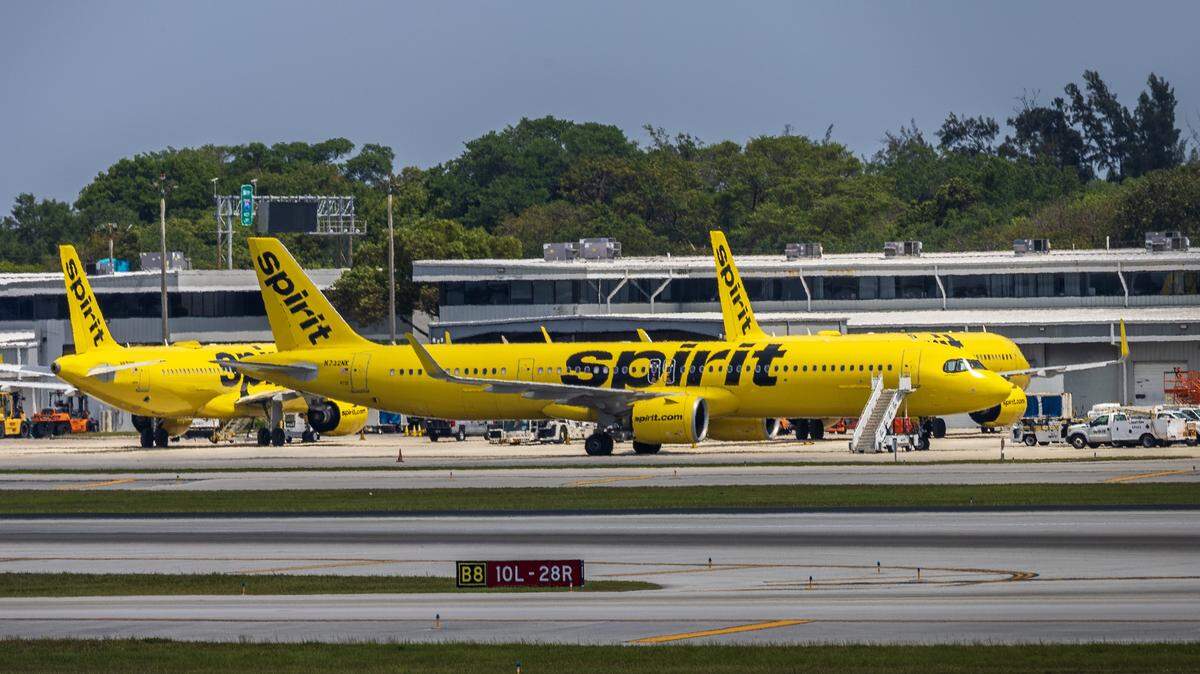
From Spirit Airlines’ graveyard: planes, headquarters — and now a data sale
Spirit’s liquidation has proceeded as you might expect for a bankrupt airline: planes sold or returned, landing rights auctioned to other carriers, the headquarters bought by another firm.
Read more Man shot in ‘lower extremities’ in Gladeview area, Miami-Dade deputies say
Now the process is colliding with the times in which we live — the digital age — with conflict involving Google and other Silicon Valley companies.
Massive troves of data that the Broward-based airline maintained, including about employees, are being put up for sale. They include at least 100 million emails, tens of millions of files stored in the cloud and tons of chats and calendar items.
At least three California-based tech companies are involved in the dispute, each with different roles. Two of them want the data to train their artificial intelligence technologies. As hot as AI is, real-world data needed to train the machines is even more lucrative, and tech companies are willing to pay millions of dollars.
But the auction process has angered the union representing Spirit’s former flight attendants. They worry sensitive information about former employees will be made public, and that enough protections aren’t in place.
In filings with the New York bankruptcy court overseeing the case, both Spirit’s representatives and the interested bidders say privacy and personal identity will be protected. They also say what’s being sold is internal company data, not information about consumers.
But those promises haven’t soothed critics. At stake is not just concerns over privacy but also ownership of intellectual property, or who has the right to sell what.
“All the employees that trusted the company with their information are at great risk,” said Adam Schwartz, privacy litigation director at Electronic Frontier Foundation, a San Francisco-based non-profit focuses on digital civil liberties. “We urge companies like Spirit not to do this.”
On Aug. 14, Spirit and its representatives held an auction for large amounts of data the airline maintained. Google won with a bid of $10 million.
Google agreed that the data chest would first go to a third-party firm that acts as a “deidentification agent.” That’s a company that can scrape off personally identifying characteristics. And the data awarded didn’t include the personal information of customers or consumers, both Google and Spirit said.
The “buyer publicly commits to maintain and use the deidentified data in deidentified form, and that it will not intentionally associate the deidentified data with any person or household,” said a court filing. The data also wouldn’t include “privileged materials,” according to the filing.
“We’re acquiring part of an enterprise dataset from Spirit Airlines, which can be helpful in improving our products and AI models,” Google spokesperson Gareth Evans said in an email to the Miami Herald. “We will not receive any personal information from this dataset. Any data we receive will be rigorously scrubbed of any personally identifiable information by a third party before receipt.”
The amount of data awarded in the auction is massive. Google obtained access to productivity and collaboration data, “including, without limitation, email data, calendar data, chat, collaboration and messaging data, documents, presentations, spreadsheets, knowledge repositories and wikis,” according to court documents. Former Spirit employees don’t seem to be protected.
Spirit’s representatives also picked an alternate bid, from San Francisco-based AI company Mercor for $7.5 million.
But the union representing former Spirit flight attendants has criticized the carrier for selling the data.
The Association of Flight Attendants-CWA, AFL-CIO filed an objection with the New York bankruptcy court, saying that former employees would be put at risk if confidential work information were released.
“The proposed sale would transfer to Google LLC (and, in the alternative, to Mercor.io Corporation) substantially the entire employment and workplace record of Spirit Airlines, including decades of payroll, timekeeping, training, travel, and recruiting files,” the Aug. 18 objection said. That’s “together with approximately 100 million emails, 80,000 email accounts, 17,082,644 OneDrive items, 20,577,677 SharePoint items, and 500,000,000 Teams items.”
The union gave examples of its concerns, saying a flight attendant’s disciplinary correspondence, a request for leave or an internal Teams exchange about staffing remain sensitive even if employee names are stripped. It said there’s no protection against confidential information from being divulged.
While the union acknowledged that consumers do get some protections, it wrote: “The employee data is far more confidential than the customer data, yet receives far less protection than the customer data.”
Other information Google would get access to comes from over 1 million time cards, 148,000 employee tax forms and over 3 million payroll records, according to the union.
Whether removing identifying information is sufficient to protect privacy, Electronic Frontier Foundation’s Schwartz said one could delete the “To” and “From” on an email but “what’s left will nonetheless contain information that can identify someone.”
Read more Buzz that Donalds will pick Miami running mate builds ahead of Freedom Tower event
He said rather than companies making decisions on removing identifying information and what’s sufficient, the employees should get to make those decisions. “It’s their information and it’s their privacy risk.”
Following the objection from the Association of Flight Attendants-CWA, the court postponed the hearing to approve the sale of the data from Aug. 19 to Sept. 9.
For another Silicon Valley company, that delay became an opportunity,
Micro1 missed the original court-imposed deadline for bids but contacted Spirit’s representative last week, expressing interest in the data, according to a person familiar with the tech company’s thinking. It now expects to make a bid of $12.5 million that will enter the court docket. The company is taking more time to prepare its offer, hoping to address the flight union’s concerns.
Ali Ansari, founder and CEO of micro1, declined to discuss specifics of their interest but said in an email to the Miami Herald on Monday that “we are moving quickly to prepare a bid for filing on the docket.”
He noted that “as part of that process, we plan to engage with AFA [the flight attendants union] to understand its concerns regarding the current transaction and explore whether our proposal could address those concerns and earn the union’s support.”
That may prove challenging.
Association of Flight Attendants President Sara Nelson told the Herald on Aug. 22: “Our data simply is not for sale. We did not and do not consent.”
She noted that Spirit flight attendants still haven’t been paid their accrued vacation, sick leave and other overdue compensation.
“Attempting to now sell their data is adding insult to injury. It’s outrageous.”
There is other pushback, too.
Spirit, Micro1 and Google have another objection to consider.
On Aug. 22, a third company raised an objection to the sale to Google in a court filing it made with the New York bankruptcy court overseeing the case. But it wasn’t trying to outbid the others. Its argument was that it has always been the rightful owner of much of the data and software Spirit used to maintain it.
San Francisco-based Springshot said Spirit was a customer dating back to 2022 and that a court filing provided terms of the agreement.
The tech company developed a software platform that analyzes and synthesizes tons of sources of operational data. It organized that information in ways that allow employees to know what tasks to complete and when and make quicker real-time decisions. That ultimately helps reduce flight delays.
At the conference Future Travel Experience Global 2022 in Las Vegas, Mike Byrom, Spirit’s then vice president of airport services, discussed the partnership with Springshot and its software.
“We are deploying at every airport, at every gate, on every departure, and our ramp also has full visibility of this as well,” Byrom said in a presentation on Sept. 8, 2022. The Herald viewed a video of the talk.
Spirit used Springshot through its final flights on the morning of May 2, 2026.
In a filing, Springshot requested that the court consider “Springshot’s ownership of substantial intellectual property utilized by Spirit Aviation for its operations and which appear to be among the categories of data Google is seeking to acquire” and block the sale.
Springshot said that it didn’t wish to stop the general liquidation process but was calling for “a transparent process.”
The company said in a court filing that its customer agreement with Spirit said that Springshot “owns all right, title and interest, including all intellectual property rights, in and to the software, service, any data or information generated by the service or software.”
Springshot CEO Doug Kreuzkamp was more direct.
“Springshot’s intellectual property is not for sale,” he told the Miami Herald.
“The definition of the data set that Spirit seeks to auction off includes Springshot’s intellectual property,” Kreuzkamp said. “Spirit is not authorized to transfer Springshot’s intellectual property.”
The company’s top executive, born in Fort Lauderdale, acknowledged they missed the initial deadline the court imposed to raise objections.
He said “that’s because we had no reason to believe that Spirit would sell property that wasn’t theirs.”
But since realizing what transpired, they’ve moved as quickly as they could, he noted.
In a court filing, “Springshot respectfully requests that the court decline to approve the contemplated transaction unless Springshot’s property is expressly excluded from the sale.”
Read more Judge overturns Trump’s visa ban for Cuba, Haiti, Nicaragua, and many Caribbean nations










Post Comment