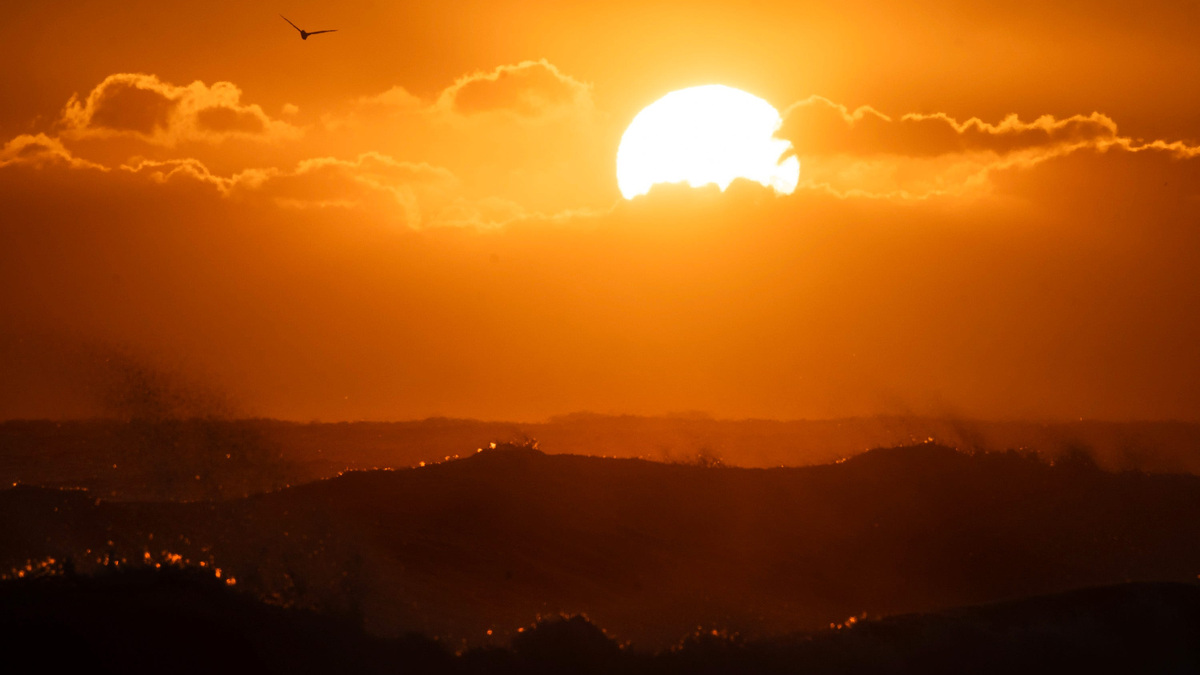
Does the sun rise earlier or later during daylight saving time?
It will likely still feel hot and summery in Florida through October, but the fall season is coming quickly, with pumpkin spice products and Halloween decor hitting shelves.
Read more Global diesel prices hit record highs, further rises possible
Another sign of the season is also coming quickly: The time change… unless the U.S. Senate votes to make daylight saving time permanent.
As of Sept. 21, there are 40 days until clocks fall back and even less time for the Senate to vote on it. With no Senate vote on daylight saving time currently scheduled, it looks like many Americans will be falling back to earlier sunrises and sunsets in just over a month.
Here’s what to know about the effort to make daylight saving time permanent, when the time is set to change this fall and how it affects sunrise and sunset times.
When does the time change in 2026? When clocks fall back
Daylight saving time for 2026 started on Sunday, March 8, at 2 a.m., when clocks sprang forward an hour, to 3 a.m.
Daylight saving time for 2026 ends on Sunday, Nov. 1, at 2 a.m., when clocks will “fall back” an hour to 1 a.m.
Are we getting rid of the time change?
It doesn’t seem likely. After over a year in committee, the Sunshine Protection Act was voted on and approved by the House of Representatives on July 14, which is one step closer to allowing states to make daylight saving time permanent.
The legislation now must be passed by the Senate and signed into law by President Trump, who has long supported making daylight saving time permanent.
Unless the Senate votes on and approves making daylight saving time permanent, and President Trump signs it into law in the coming weeks, most Americans’ clocks will fall back on Nov. 1.
Senators don’t have much time to take action, as lawmakers are scheduled to leave the Capitol again on Oct. 5 and will not return until after the time change, on Nov. 9. Not to mention, it’s unknown whether there are enough votes to pass the measure. There is no Senate vote scheduled for the Sunshine Protection Act, as of Monday, Sept. 21.
H.R. 139, known as the Sunshine Protection Act, was filed Jan. 3, 2025, by Rep. Vern Buchanan, Florida-District 16. Buchanan has brought the Sunshine Protection Act before each Congress since 2018. Trump has repeatedly supported the shift to permanent daylight saving time and has been asking senators to pass the Sunshine Protection Act ASAP.
“People are sick and tired of having to change their clocks twice a year. It is foolish, inconvenient and, in some cases, very costly,” Trump said in a Truth Social post on Aug. 12.
The Sunshine Protection Act would make daylight saving time the new, permanent standard time in the United States and would allow states to opt out to stay on standard time.
When is sunrise? Are sunrise and sunset earlier after the time change?
Sunrise and sunset will be about an hour earlier on Nov. 1 than the day before, meaning there will be more light in the morning and less light in the evening.
The sunrise on the day before, Oct. 31, will range between around 7:30 and 7:40 a.m. ET in Florida, depending on where you are in the state. The day after, on Nov. 1, when daylight saving time ends, that range will be between 6:30 and 6:40 a.m., dpeending on where you are in the state.
Although falling back gives us one more hour of sleep, the sunrise comes earlier, and so does the sunset.
When does the time change? Countdown clock to DST 2026 ending
What is DST? Is it daylight saving or daylight savings?
“DST” is an abbreviation for daylight saving time. Many people pluralize the phrase to say “daylight savings time.” The correct way to spell and say it is the singular version of the phrase: daylight saving time.
Read more Woman accused of fatal stabbing in NW Marion County
Does Florida want to get rid of the time change? 19 states want to ‘lock the clock’
Yes. Florida supports permanent daylight saving time. In fact, it was a Florida congressman that introduced the Sunshine Protection Act. Rep. Vern Buchanan, Florida-District 16, filed the Sunshine Protection Act on Jan. 3, 2025, and before that, brought it before each Congress since 2018.
According to congress.gov, 19 states have enacted legislation that would implement permanent daylight saving time if such action is allowed by Congress:
- Alabama
- Colorado
- Delaware
- Florida
- Georgia
- Idaho
- Louisiana
- Maine
- Minnesota
- Mississippi
- Montana
- Oklahoma
- Oregon
- South Carolina
- Tennessee
- Texas
- Utah
- Washington
- Wyoming
Who invented daylight saving time?
Although the earliest known proposal to “save” daylight came from Benjamin Franklin’s “An Economical Project” in 1784, he is not the reason we observe the time change today.
According to the Old Farmer’s Almanac, the first true proponent of daylight saving time was a London builder named William Willet, who “noticed that the shutters of houses were tightly closed even though the sun had risen” while he was riding his horse on an early morning in 1907.
“Willet spent a small fortune lobbying businessmen, members of Parliament, and the U.S. Congress to put clocks ahead 20 minutes on each of the four Sundays in April and reverse the process on consecutive Sundays in September. But his proposal was met mostly with ridicule,” the almanac says.
It wasn’t until World War I that countries started adopting the concept to conserve fuel and resources. The Germans were the first to adopt the system in 1915, Britain followed in 1916 and the U.S. started observing the time change in 1918, when Congress passed its “Standard Time Act” that established time zones.
“Many Americans viewed the practice as an absurd attempt to make late sleepers get up early. Others thought following ‘clock time’ was unnatural instead of ‘sun time.’ A columnist in the Saturday Evening Post offered this alternative: “Why not ‘save summer’ by having June begin at the end of February?” according to the almanac.
“The matter took on new meaning in April 1917, when President Woodrow Wilson declared war. Suddenly, energy conservation was paramount, and several efforts were launched to enlist public support for changing the clocks.”
A common daylight saving time misconception is that it was created to help farmers have more daylight hours to complete their work outdoors. But the opposite is actually true.
At the time daylight saving time was adopted in the U.S. – during World War I – farmers were the strongest opponents of this time change. They didn’t like having to do their early morning farm chores in the dark.
“Many Americans wrongly point to farmers as the driving force behind daylight saving time. In fact, farmers were its strongest opponents and, as a group, stubbornly resisted the change from the beginning,” according to the almanac.
“When the war ended, the farmers and working-class people who had held their tongues began speaking out. They demanded an end to daylight saving time, claiming it benefited only office workers and the leisure class. The controversy spotlighted the growing gap between rural and urban dwellers.”
Lianna Norman and Cheryl McCloud are trending reporters for the USA TODAY NETWORK-Florida, covering lotteries, weather, Florida wildlife, breaking news and more. You can get all of Florida’s best content directly in your inbox each weekday by signing up for the free newsletter, Florida TODAY, at https://floridatoday.com/newsletters.
This article originally appeared on Treasure Coast Newspapers: Does the sun rise earlier or later during daylight saving time?
Reporting by Lianna Norman and Cheryl McCloud, USA TODAY NETWORK – Florida / Treasure Coast Newspapers
Read more Analysis-Porsche’s decline from crown jewel to millstone for parent Volkswagen
USA TODAY Network via Reuters Connect
Copyright Reuters or USA Today Network via Reuters Connect
This story was originally published September 21, 2026 at 12:03 PM.











Post Comment