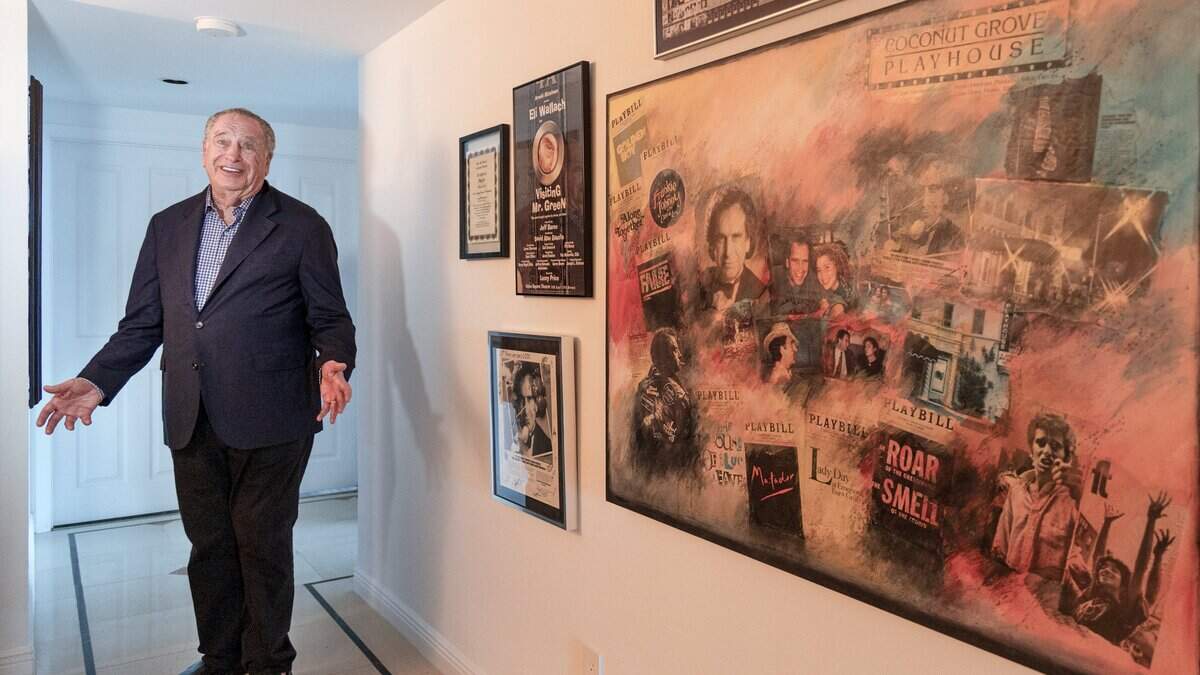
Coconut Grove Playhouse had a 50-year run. See all its stars in new digital archive
The very first day it opened in 1956 as a live theater, the Coconut Grove Playhouse made U.S. cultural history — even if the inaugural production wasn’t exactly a hit with the Miami crowd.
Read more Ex-UM urologist arrested on allegations that he sexually assaulted his students
The American premiere of Irish playwright Samuel Beckett’s absurdist “Waiting for Godot,” co-starring Bert Lahr, the Cowardly Lion in “The Wizard of Oz,” drew a full house. But the play, destined to become a classic of world theater, had been inexplicably promoted as a light comedy. (Spoiler: It’s not.)
By the time the curtain came down after the first act, much of the audience could wait no more and fled for the exits.
But they would have a chance to come back, and they did, time and again.
Over the next 50 years, until its sudden closing in 2006, the playhouse earned a reputation as one of the leading regional theaters in the country, producing a mix of classic and new plays, many of them hits and some flops, while welcoming legendary and future stars of stage and screen — Liza Minnelli! Mae West! Henry Fonda! José Ferrer! David Letterman! Oscar Isaac! — to its picturesque 1927 Mediterranean building, a former silent movie palace.
Now, to ensure its illustrious past is not left behind, the playhouse’s last and longest-serving artistic director has assembled a comprehensive, user-friendly digital archive that documents every single one of the 521 productions that took place at the theater in its first half-century-long run before the curtain came down.
The archive, at coconutgroveplayhousearchive.org, went live this week.
It’s been a labor of love for former playhouse director Arnold Mittelman. With a $100,000-plus Knight Foundation grant, Mittelman and a team of professionals and volunteers collected images of every single program and assorted photographs and playhouse memorabilia, and organized them in an easy-to-to-search format that provides a timeline of the theater’s rich and often surprising history.
The playhouse, for instance, had a long and fruitful association with several important playwrights, including 11 productions of plays by Tennessee Williams, author of “A Streetcar Named Desire,” six productions of plays by Edward Albee, author of “Who’s Afraid of Virginia Woolf?,” and 18 productions of plays by Neil Simon, author of “The Odd Couple.”
The new archive opens up that history and more to a generation of Miamians who have grown up or settled in the city without the playhouse — a vital legacy that Miami theater people and fans feared might be forever lost as politicians, bureaucrats, preservationists and Grove activists battled for more than a decade over plans to resuscitate the theater.
But all is not lost, it turns out.
The long-running war over its fate is seemingly settled after the Miami City Commission approved a controversial Miami-Dade County plan to build a new standalone theater behind the distinctive, historic front building and revive the playhouse under the management of the GableStage company.
Despite its storied stature, the playhouse never created an organized archive, Mittelman said. While its extensive costume collection and some other materials went to the University of Miami and Actors’ Playhouse at the Miracle Theatre in Coral Gables, programs, posters, promotional photos and materials had scattered to the winds. Mittelman himself had only a small personal collection.
“We began to pull in from every source we could imagine,” including archives at the Miami Herald, Newspapers.com, UM and the Museum of Miami, as well as the homes and storage bins of theater buffs and former playhouse employees and supporters, Mittelman said.
Gathering the materials and creating the digital archive took two and a half years. Supporters “were so excited that this was happening,” he said.
“The fear was that, like so many things in Miami, and in life, out of sight means out of mind. It disappears,” he said.
The idea grew out of a conversation with Alberto Ibargüen while he still led the Knight Foundation, Mittelman said.
Read more Fewer lives lost: Miami-Dade hits lowest murder count in nearly 60 years
“For me, this is a large part of Miami’s cultural heritage,” said Ibargüen, who retired from the foundation in 2024. “It’s a really important history in terms of national and regional theater. Arnold was a real player in regional theater. Miami was a major stop. Who would have thought that?”
‘There was lots of culture here’
The archive and the playhouse’s long run are both evidence that Miami was not quite the cultural desert many thought at mid-century, and a necessary reminder of something great that locals built, a foundation for much that came afterward, Ibargüen said.
“It’s been closed so long, no one in power would have known this history existed,” Ibargüen said. “This was a sign that there was lots of culture here that has now grown up.”
Financially speaking, though, the playhouse had a checkered history, and its operators often failed to keep the doors open. The Coconut Grove Theater, as it was named originally, was built by realtors Irving Thomas and Fin Pierce as part of the Paramount movie theater chain but struggled during the Great Depression and closed in the 1930s. It served during World War II as a training school for Air Force navigators before closing again at the end of the conflict.
Oilman George Engle bought the vacant, rundown building in 1955, renamed it the Coconut Grove Playhouse and hired famed Miami architect Alfred Browning Parker to convert it to live theater, but closed it again in 1960. Broadway producer Zev Buffman leased it for several years before buying it in 1966, only to sell it to actor Eddie Bracken four years later.
When Bracken fell behind on his debt, the theater was sold at a foreclosure auction by Arthur Cantor and Robert Fishko, who reopened for the 1971-72 season. They in turn sold it in 1977 to the Players Repertory Theater, which renamed it the Players State Theater.
In 1980, the state of Florida acquired the theater by purchasing its $1.5 million mortgage, then turned over management to a nonprofit that restored the Playhouse name.
In 1982, famed Oscar-winning and multiple Tony-winning actor and director José Ferrer was brought in as artistic director for $1 a year and managed to burnish the playhouse’s artistic luster, championing high-toned, commercially appealing dramas and directing a successful Spanish-language adaptation of Tennessee Williams’ “The Glass Menagerie.”
But Ferrer resigned in 1985, citing low attendance, mounting financial pressures, and criticism of his hiring of his sons to direct and act. Mittelman then took over for the next 21 years.
The archive Mittelman created covers every iteration of the live-theater playhouse and has several sections, one of which lists the name of everyone who ever performed on its stage. The timeline allows visitors to go season by season, or to follow the tenures of directors and producers. Mittelman also recorded some 200 brief commentaries on especially significant productions.
It also includes at least one non-theatrical performance — the 1996 broadcast of “Late Show with David Letterman” from the playhouse stage.
“It’s a very comprehensive resource,” Mittelman said. “We have a certain pride that this is now available. What’s really struck me about this, as I drive by the now-demolished playhouse, there are banners that say, ‘Bringing great theater back to Coconut Grove.’
“I wonder, do people understand what that means? Do they understand this was one of the great theaters in American regional theater history? When I go other places and say ‘Coconut Grove Playhouse’ on Broadway or in London, people say, ‘Wow.’ How wonderful was that?”
Read more How did the ‘Big One’ change Miami? Look back at Hurricane Andrew’s impact
Which stars performed at the Coconut Grove Playhouse?
Here are some highlights from the Coconut Grove Playhouse archive:
- “Waiting for Godot” was produced twice — the first, the U.S. premiere in 1956, starring Bert Lahr (the Cowardly Lion in “The Wizard of Oz”) and film and Broadway actor Tom Ewell, and a new production with an all-Hispanic cast in the 1995-96 season.
- Under Mittelman, the Playhouse produced a revival of the Neil Simon play “The Sunshine Boys” during the 1997-98 season, starring Jack Klugman and Tony Randall. The production went to Broadway and was a hit. That was just one of 18 productions of plays by Simon at the playhouse, including “Barefoot in the Park” with Vivian Vance (Ethel of “I Love Lucy” fame) and “The Odd Couple” during the 1966-67 season with famed Broadway and Hollywood actor E.G. Marshall, who also starred in two other productions at the playhouse.
- There were 11 productions of plays by Key West resident and Grove habitué Tennessee Williams, including “Mundo de Cristal,” the Spanish-language version of “Glass Menagerie” directed by Ferrer during the 1984-85 season, and the season before that, “Cat on a Hot Tin Roof,” also directed by Ferrer, with Oscar winner Kim Hunter (who originated the role of Stella Kowalski in “Streetcar” on Broadway and won an Oscar for the film version) in a supporting role. That was one of four stage appearances Hunter made at the playhouse, including, that same season, “Life with Father,” co-starring Ferrer and son Rafael Ferrer. Oscar winner Eva Marie Saint (”On the Waterfront,” “North by Northwest”) starred in Williams’ “Summer and Smoke” in the 1972-73 season.
- The fabled state and screen actress Tallulah Bankhead starred in “Streetcar,” one of two plays she performed in at the playhouse, in the 1955-56 season. In 1999, Bankhead came back to life on the playhouse stage, portrayed by Kathleen Turner in a one-woman play, “Tallulah.”
- Three-time Pulitzer winner Edward Albee, a part-time Grove resident, enjoyed a half-dozen productions at the playhouse, including two productions of “Who’s Afraid of Virginia Wolf?”, the first starring two-time Oscar-winning Hollywood and Broadway actress Shelley Winters, the second time, in the 1996-97 season, starring Broadway actress and Tony winner Elizabeth Ashley. The legendary acting couple Jessica Tandy and Hume Cronyn co-starred in “A Delicate Balance” in 1967.
- “Don’t Drink the Water,” by Woody Allen, was a playhouse production in 1966, about the time the comedian and writer was also first breaking into film, with future Best Actor Oscar winner F. Murray Abraham and, in the supporting cast, Paul Glaser, who later became famous as half of “Starsky & Hutch” on TV. That was one of three productions of Allen plays at the playhouse, including “Play it Again, Sam” with Oscar-winning actor and comedian Red Buttons in the 1969-70 season.
- In the 1975-76 season, iconic comedian Milton Berle starred in “A Funny Thing Happened on the Way to the Forum,” one of three works with music by composer and lyricist Stephen Sondheim at the playhouse.
- In the summer of 1964, Liza Minnelli starred in “The Fantasticks.” She also made a special one-night benefit appearance in 1994, with Desi Arnaz Jr. (son of Lucille Ball and Desi Arnaz), in A.R. Gurney’s “Love Letters,” directed by Mittelman.
- Oscar winner George C. Scott and his wife, Broadway actress Colleen Dewhurst, appeared in “The Lion In Winter” by James Goldman in the summer of 1966.
- Hollywood legend and competitive swimmer Esther Williams, who had also performed water shows in the pool at Coral Gables’ Biltmore Hotel in the 1930s and 1940s, appeared in “Kind Sir” during the 1963-64 season.
- Hollywood legend Mae West starred in “Sextet” in the 1960-61 season.
- Yet another Hollywood legend, Henry Fonda, starred in Thornton Wilder’s classic “Our Town” in the 1969-70 season.
- In 1997, “Don’t Stop the Carnival,” a world-premiere musical adapted by Pulitzer-winning novelist Herman Wouk from his own work with music and lyrics by Jimmy Buffett, became the most successful production under Mittelman at the playhouse, which sold out every performance.
- A very young and unknown Oscar Isaac, who grew up in Miami, was in the supporting cast of “Praying with the Enemy,” a satirical comedy by Luis Santeiro that centers on the Pope’s 1998 visit to Havana, during the 1999-2000 season.
- An also young Denzel Washington appeared in “Ceremonies in Dark Old Men” by Lonne Elder III during the 1979-80 season.
- Lucie Arnaz, daughter of Ball and Arnaz, was in five productions, including the very last at the playhouse — “Sonia Flew,” during the 50th anniversary season in 2006. Burdened by debt, the theater closed in the middle of the production.








Post Comment