Climate change has given this tropical fruit a warm welcome in Florida yards
Marc Ellenby has grown just about every tropical fruit imaginable on his family’s Redland farm since 1980. Avocados. Sapodillas. Longans. Mameys. But there was one tropical fruit he didn’t think could survive here: Breadfruit.
Read more New Greek restaurant opens in former Sereia space in Coconut Grove
Century-old reports from South Florida’s founding botanists say that these large, starchy fruits would only thrive in the Caribbean and Hawaii, and possibly as far north as Key West.
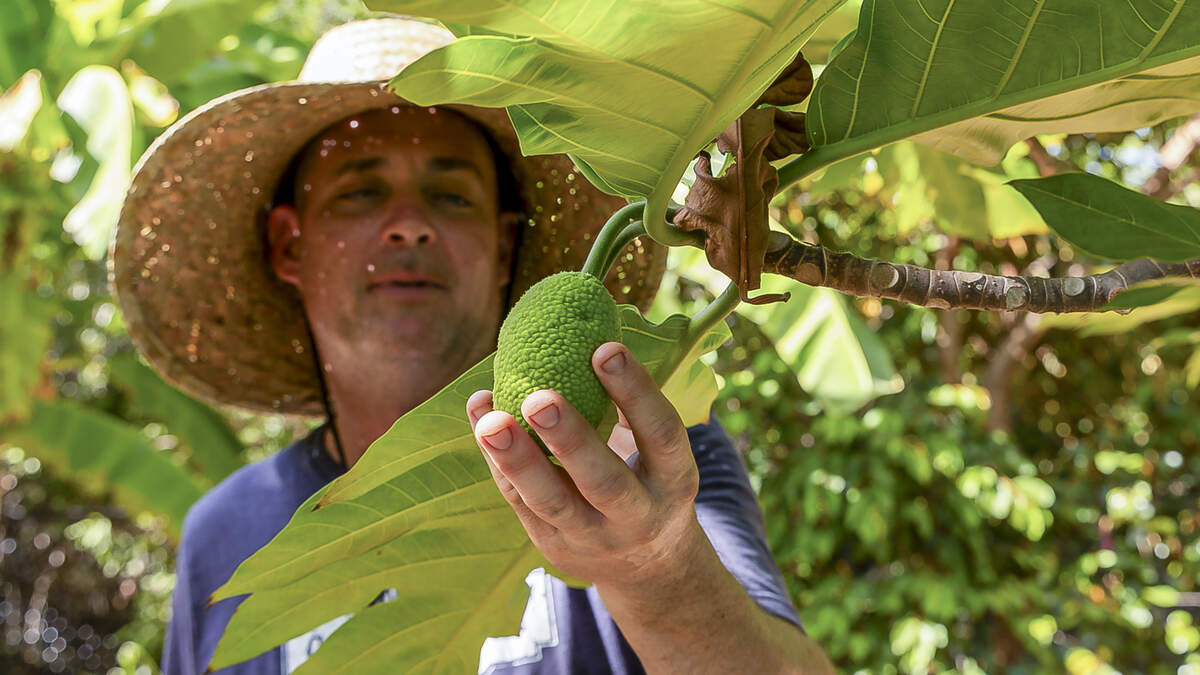
Now, as climate change pushes temperatures higher, that is starting to change. Dozens of the large-lobed, leafy trees dangling with round, bumpy green fruit are growing across South Florida and reach as far north as Brevard.
The softball-sized fruit is a Caribbean classic, first brought by the British via Tahiti as a “slave food” because it was cheap and high-calorie. But it’s since become celebrated by Caribbean chefs, who make it into stews, soup and a flour. The South Florida fruits are mostly enjoyed fresh by home gardeners, but they’ve also been baked into French fries — and even turned into vodka.
It tastes bland, kind of like a potato. But when very ripe, it tastes faintly of pineapple. It’s also very, very sensitive to the cold.
That’s what has kept it from thriving in South Florida for decades, despite early efforts by pioneering plant nerds. But now, data shows, it’s warm enough to keep a single tree alive — or even a commercial grove. That is, unless there’s a rare cold snap.
This winter, temperatures in Homestead dipped low enough to threaten Ellenby’s 225 breadfruit trees he’d been carefully nursing since the summer of 2025.
When spring arrived, the breadfruit grove looked like a graveyard. The juvenile green, leafy trees had vanished and were replaced by rows of thin, lifeless trunks staked into the ground like tombstones.
But then, Ellenby, 76, dug into the mulch surrounding his precious plants and found salvation in the form of tiny, green sprouts.
“My idea is to make breadfruit on these stunning trees, but we’ll see how it goes. I mean, it’s possible that it won’t happen, but we’re going to give it the old college try,” Ellenby said. “I’m not giving up.”
Bringing breadfruit to Miami
A hundred years ago, it was mostly too cold to grow a hyper-tropical fruit like breadfruit in South Florida. Cold snaps like this winter’s were more common and far colder.
But a century ago, even the founding fathers were thinking about the future of this fruit.
George Washington got a few from Jamaica, with a note that said if it’d thrive down South in America, it’d be a great acquisition, but said he doubted it would. That’s according to a history of the fruit compiled by Russell Fielding, a professor at Coastal Carolina University and author of “‘Breadfruit: Three Global Journeys of a Bountiful Tree,’ and Redland guava grower, Jorge Zaldivar.
The pair found that the earliest someone dared to grow it in Florida was in the 1920s, when rare fruit collector Wallace Johnston took a stab. Plant explorer and botanist David Fairchild, namesake of Miami’s premier botanical garden, believed the tree was too cold-sensitive to survive South Florida’s winters.
That was later challenged by William Whitman, an early Miami horticulturist, who grew two breadfruit trees in Bal Harbour. Whitman wrote in 1991, “If our planet continues to heat up, as some scientists predict, possibly our descendants will face a climatically changed environment.”
He was right.
It’s 2 degrees hotter in South Florida than it was in the 1920s. That’s reflected in the recent warmer shift to Miami’s growing zones.
In 2023, the U.S. Department of Agriculture “Plant Hardiness Map”, which is like a bible for farmers on what to grow and where, was updated for the first time since 2012. In 2012, the lowest winter temperature in Miami was between 35 and 40 degrees, and in 2023, it was between 40 and 45 degrees, NPR reported.
Breadfruit isn’t the only once-tropical crop that’s gained a toehold in South Florida. Growers are experimenting with commercial groves of chocolate, vanilla and coffee with some success.
In 2022, Fielding and Zaldivar identified forty-three Florida-based breadfruit growers. These weren’t all groves; some growers only had a single tree. Russell said that breadfruit will become more common as climate change continues to trend toward warmer conditions throughout the world as a response to burning fossil fuels.
There’s a towering tree that’s fruiting at the Truman House in Key West. Some are growing in neighborhoods in Little Haiti, and there’s a couple of 25-footers in a greenhouse at the Fruit and Spice Park. The park is experimenting with growing a few trees outside.
“Since climate change and winters are getting warmer, I said, what the heck, why not give it a try,” Louisse King, a Fruit and Spice staff member, said.
Fielding sees breadfruit growing in Florida as a “tool for adaptation.” As the Earth warms, farmers won’t be able to just carry on as usual. As breadfruit gets easier to grow, other fruit and vegetables will get harder.
Read more This could be the deadliest year for child drownings in Florida’s history
Zaldivar, 40, is a fruit farmer and amateur historian who helped save cuttings from one of the oldest breadfruit trees in Miami, from the Coconut Grove home of one of Miami’s earliest rare plant collectors, Dr. Robert McNaughton, to grow at his guava farm, PG Tropicals.
“As a tree collector, I’m in possession of these trees from his yard, saving them, his legacy, posterity,” Zaldivar said. “What I see is a glimpse of Miami history.”
The first and largest breadfruit grove in the U.S.
In Big Pine Key, tucked between protected woodlands where endangered Key deer wander freely, is Grimal Grove — the most successful breadfruit grove in the continental United States.
Patrick Garvey opened the gate in a floppy straw sunhat and a sweat-stained shirt that read: ‘Don’t be afraid to go out on a limb. That’s where the fruit is.”
When Garvey discovered the neglected Grimal Grove in the early 2010’s, it was choked with debris and had $850,000 worth of code compliance tickets piling up. He got the fees down (by paying a lawyer in mangos) and sank his retirement into restoring the property.
As soon as he started to see profit, Hurricane Irma came thrashing in with 120 mph winds that destroyed the entire grove, house and cars.
The 2017 storm destroyed basically everything he planted, he said. Everything except his breadfruit.
“Even though they looked dead after the storm, they came back with a vengeance,” he said.
Within about 15 months, they were fruiting again.
“Based on that resilience compared to the other trees that I was growing, I thought that would be an interesting foot forward,” Garvey said.
Now, he has forty breadfruit trees that tower over 30 feet. As you walk around the grove, you can hear the fruit thump to the ground.
Breadfruit has an extremely short shelf life, and eating them fresh is reserved for the first few days. He is working on turning them into new products. He partnered with Mutiny Island Vodka, which they’re calling the world’s first island vodka distilled from breadfruit from Grimal Grove and Caribbean rainwater in the U.S. Virgin Islands.
The Northernmost Tree
For now, most commercial breadfruit groves are still setting root, leaving the growing to the same type of people who once introduced it to the region — the plant fanatics.
The northernmost fruiting breadfruit tree in Florida may belong to Brevard County’s Matthew Rowlings, or so he claims.
“I get to have the bragging rights because of all the effort I put into protecting that tree,” Rowlings said.
When the tree began flowering, he said it was “kind of a big deal.”
“I literally remember my wife and I just freaking out over it,” he said. “We stared at the flower for at least half an hour.”
The couple eventually harvested a single breadfruit and turned it into fries, which he said were delicious.
When it was threatened by a winter freeze, Rowlings pulled out all the stops. He strung the tree in the old-fashioned kind of Christmas lights, the incandescent ones that burn warm. He wrapped the tree in insulation, soaked the soil, covered it with a tent, and layered plastic tarps.
Around the tree, he placed Home Depot buckets and aluminum trash cans filled with water. The night before the cold arrived, he used a submersible heater to warm the water, creating a small pocket of warmer air around the tree.
“In the moment you’re like, ‘Am I crazy? Am I a madman?’” he said. “But then, when you actually look at your tree a month later, when it’s starting to warm up and wake up again, you’re like, ‘No, it was worth it.’”
Rowlings said he’d do it all over again.
“I’d do it again until I am old and decrepit,” he said. “I do it for the love of the game.”
Ashley Miznazi is a climate change reporter for the Miami Herald funded by the Lynn and Louis Wolfson II Family Foundation and MSC Cruises in partnership with Journalism Funding Partners.
Read more Miami approves $3M sale of historic Brickell cottage to billionaire Ken Griffin







Post Comment