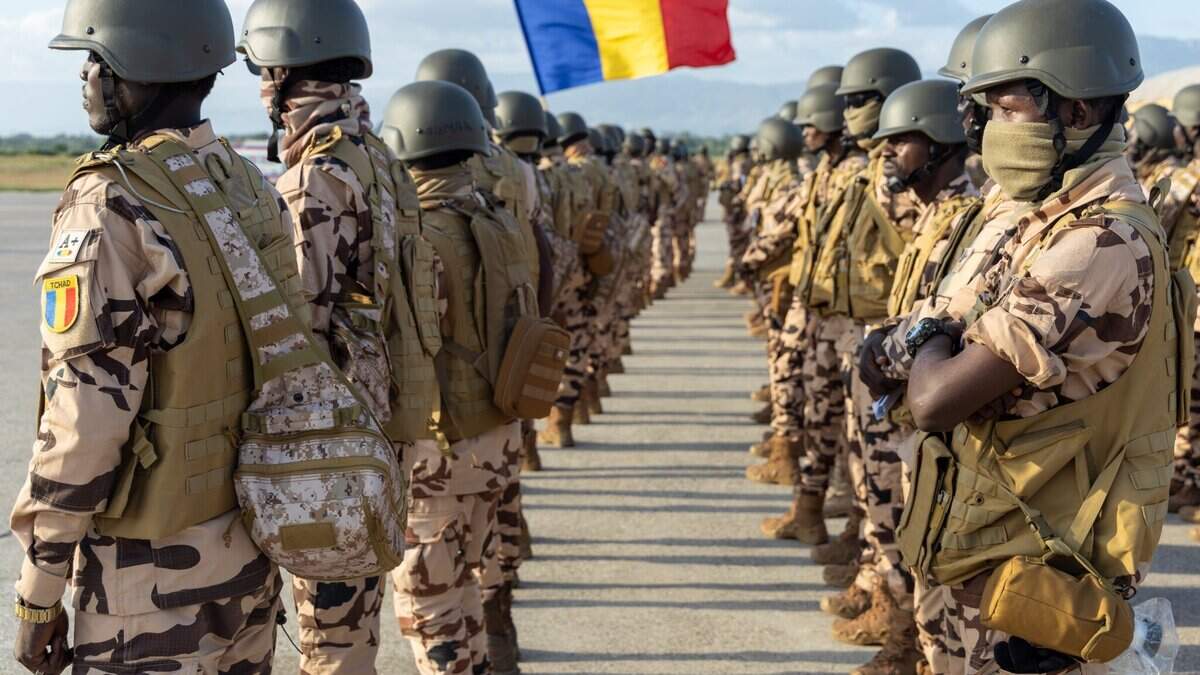
Chadian troops arrive in Haiti as police say arrested Florida resident had AR-15
Hundreds of additional Chadian soldiers are arriving in Haiti to bolster the United Nations-backed gang fighting force, which remains badly short of troops and equipment as the volatile Caribbean country attempts to hold its first general elections in more than a decade.
Read more NFL Announces Punishment Decision After Patrick Mahomes Incident
The soldiers are being deployed in groups: one contingent arrived Friday and the final one is scheduled to arrive this weekend. Together, they will bring an additional 300 troops to the force since its deployment began in April.
In a post on X, the Gang Suppression Force said the soldiers from the Central African country are part of its continuing build-up and deployment. The international force, created with by the U.S. and authorized by the U.N. Security Council, is authorized to have 5,500 personnel, most of them military.
But with just over 1,000 deployed, the mission has lacked the manpower and equipment to conduct major operations.
The latest contingent is arriving as Haiti confronts a deteriorating security and humanitarian environment and struggles to organize its first general elections in more than a decade. The arrest Saturday of a Florida man who was allegedly carrying an assault rifle in his luggage offered a stark reminder of the challenges facing the country.
The government also faces a difficult decision over whether to reschedule the Dec. 13 vote. The process has been slowed by lagging voter and political-party registrations, revised and extended deadlines and, now, another pending change to the country’s electoral law — developments that the international community is watching closely.
Prospective candidates have complained that many of the requirements to run are unwieldy and onerous, including the 26 documents being required. While international observers acknowledge that some documents, such as a medical certificate, might not be necessary, they are concerned that loosening the requirements on who can run could open the door to candidates who have been sanctioned by the U.S., Canada and the European Union, or connected to criminal groups.
As of Friday, just over 610,000 people of voting age with national identification cards had registered to vote out of more than 6.5 million with the cards, a requirement to register to vote. The 610,000 figure is far below the target of 3 million set by election officials. Only 28 of the 105 political parties and groupings approved by the Provisional Electoral Council to contest elections for president, Parliament and local posts, had reached the threshold of registering 30,000 members.
Meanwhile, the electoral council, known as the CEP, still lacked access to voting centers in at least 23 municipalities in three regions where deadly armed groups continue to control large swaths of territory.
The lack of access, along with a recent surge in kidnappings and renewed massacres, including the latest attack in Kenscoff — the fifth assault on the mountainous community in 15 months — and the slow deployment of the gang-fighting force have created a daunting security environment for the vote.
Obstacles to GSF deployment
Even with their growing numbers, the force has come under fire from armed gangs. Meanwhile, its deployment continues to face a series of obstacles, including delays by troop-contributing countries and difficulties getting equipment into Haiti. The war in the Middle East has complicated maritime shipments, forcing equipment, which countries are required to bring with them, to be airlifted at significant costs. Foreign diplomats and Haitian authorities have called for the deployment to be ramped up and have urged donor countries to provide logistical support or additional financing.
Their calls come as the force also approaches a critical deadline. The GSF’s one-year mandate expires on Sept. 30, and its renewal is before the Security Council. The U.S. and Panama, which are responsible for drafting resolutions on Haiti on the council, are seeking a six-month technical extension to allow the remaining troops to arrive and to assess whether changes to the mandate are needed.
Read more NFL Announces Punishment Decision for Cowboys After Cam Skattebo Incident
The mandate’s renewal, as well as the elections, will be among the issues discussed next week as the U.N. General Assembly opens in New York.
Deepening security, humanitarian crisis
In a sign of the continuing security concerns, Haitian police on Saturday arrested Orlando resident Claudin Sainvilus, 45, after allegedly finding an AR-15 rifle and tactical equipment in his luggage.
Sainvilus, a U.S. citizen of Haitian origin, arrived at Cap-Haïtien International Airport, which has become Haiti’s main gateway for international commercial flights because the main airport in Port-au-Prince remains closed to such traffic due to gangs’ gunfire.
After a recent visit to Port-au-Prince by its Eminent Persons Group, the Caribbean Community (CARICOM) said the security situation in Haiti remains of concern. The group, made up of the former prime ministers of The Bahamas, Jamaica and Saint Lucia, noted the recent spread and spike in violence and kidnappings by armed gangs, as well as the challenges contributing to the slow deployment of the GSF.
“In their discussions, all stakeholders underscored the critical importance of ensuring a security environment that will allow for country-wide registration of voters, political campaigning, freedom of movement and for citizens to vote safely,” CARICOM said. “Deployment of the additional forces and resources pledged by various countries and strategic operational coordination among these and the Haitian security forces are of paramount importance in achieving this objective.”
More than 3,000 Haitians have been killed this year in violence, most of it perpetrated by gangs, according to the U.N. The global body on Friday noted that in addition to continuing to exact mounting deaths, the decaying security situation is continuing to worsen Haiti’s humanitarian crisis.
UNICEF, the Food and Agriculture Organization and the World Food Program said more than a quarter-million children between 6 months and 59 months old are expected to suffer from acute malnutrition between June of this year and May 2027. Nearly 94,000 of them are projected to face severe acute malnutrition, a potentially life-threatening condition without timely treatment.
“Continued violence forces families to flee their homes, and disrupts children’s access to food, healthcare and nutrition treatment,” Stéphane Dujarric, spokesman for U.N. Secretary-General António Guterres, told reporters on Friday.
Some 1.5 million people are internally displaced, about half of them children, while nearly half of Haiti’s population of 12 million faces hunger, Dujarric said.
“Our humanitarian colleagues warn that the situation might become critical between December of this year and May of next year, when 29 out of 140 municipalities are projected to reach” a critical malnutrition phase, he said. The neighborhoods of Cité Soleil and Cabaret, two areas that are in metropolitan Port-au-Prince and have seen increased gang fighting in recent months, are expected to reach Phase 4, or critical levels, Dujarric said.
Yet, the nutrition sector under the Haiti Humanitarian Response Plan remains severely underfunded. Of the $41 million that the U.N. is asking for, only $7.5 million — less than 20% — has been received. “We need more money, and we need it very, very soon,” said Dujarric.
Read more Alabama vs. Florida State Suspended Due To Weather









Post Comment