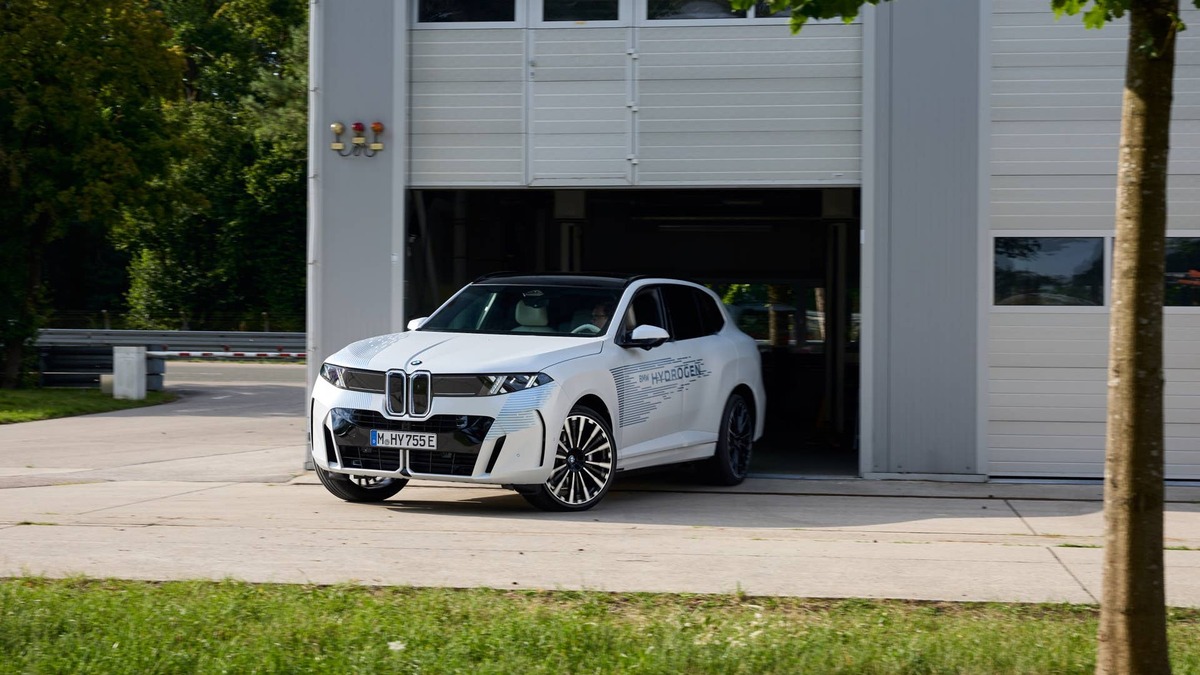
BMW’s iX5 Hydrogen Targets 466 Miles and a Five-Minute Fill
BMW is two years from putting a hydrogen fuel cell X5 on sale. Prototypes are running a road testing program, the third-generation fuel cell system co-developed with Toyota has entered a new assembly phase in Munich, and BMW Group Plant Steyr in Austria has taken delivery of its first test benches and manufacturing equipment. The targets are a range of up to 466 miles, refueling in under five minutes and 0 to 62 mph in less than five seconds. All of that is real engineering progress on a very difficult problem. It is also happening while the refueling network the car depends on shrinks, and while the public money paying for the vehicle is walled off from fixing that.
Read more Exclusive-Kimberly-Clark readies EU remedies in bid for Kenvue deal, sources say
Where the program stands
The work is split across three sites. BMW’s hydrogen competence center in Munich handles prototype assembly of the fuel cell system, with the current phase focused on finalizing test methodology and preparing manufacturing processes. The previous phase covered component buildability and basic supplier qualification. Steyr is being readied for series production of the fuel cell system, with staff trained in stages. Landshut builds the Energy Master, the central control unit for the high-voltage system, which in this application is mounted on the hydrogen tank assembly rather than a battery pack.
Josef Hochreiter, head of Hydrogen Vehicles at BMW Group, says testing shows the fuel cell system, high-voltage battery and electric drivetrain are already integrated, and that “a perfectly coordinated overall system is crucial.” Claudia Stephan, who runs technology development and fuel cell prototype assembly, describes the current phase as knowledge transfer to the Steyr team.
The hardware is impressive. BMW’s Flat Storage system uses seven carbon-fiber-reinforced tanks at 700 bar, or close to 10,150 psi, holding at least 15 lb of hydrogen in the same package space the Gen6 battery occupies. That packaging is why the new X5 can be offered with five drivetrains: gasoline, diesel, plug-in hybrid, battery electric and fuel cell. A pilot fleet of fewer than 100 prototypes has been running since February 2023.
273 million euros of public money, and what it does not cover
Germany’s Federal Ministry of Transport is providing 191 million euros toward the program and the state of Bavaria a further 82 million, a total of 273 million euros under the HyPowerDrive project within the European Important Project of Common European Interest (IPCEI) Hy2Move framework. BMW received it in November 2025.
BMW has confirmed that the funding covers the vehicle side only: the fuel cell system, the hydrogen storage system and component integration. No portion extends to hydrogen supply or refueling infrastructure.
That is the whole problem in a sentence. The state has paid to develop a car that cannot be used without a fuel network, and explicitly not to build the fuel network. BMW is participating in an industry initiative called Hydrogen Mobility at Scale, which pools demand across trucks, buses and cars to make stations viable and has pilots running in Germany and France. That is a reasonable effort. It is also a fraction of the size of the problem, and it is not what the 273 million euros bought.
The network has halved while the car was being developed
BMW’s pilot fleet has been on the road since February 2023. Here is what happened to German refueling across that window.
H2 Mobility, Europe’s largest station operator, closed six locations on December 31, 2024, eleven more in March 2025 and another eleven by the end of that June. Germany went from 79 open stations to 57 across that single sequence. By January 2026 the national total stood at close to 50 publicly accessible stations, against more than 80 two years earlier and more than 90 at the high point. Of those remaining, 13 offer only the 700-bar pressure passenger cars need, 35 offer both pressures and two offer only the 350-bar standard used by trucks and buses.
The Europe-wide picture is the same story told differently. Station-level records show 700-bar-only sites falling from 108 in 2023 to 32 by May 2026, while dual-pressure sites rose from 50 to 129. The total moved from 178 to 179. The network did not grow. It was rebuilt for commercial vehicles. France has 14 stations. The United Kingdom has three. In California, which has the largest network in the United States at 47 stations, Shell closed all but one of its locations.
The reason is arithmetic, not ideology. Germany’s national hydrogen organization puts average station utilization near 20%. A station costs several million euros to build and hundreds of thousands a year to run whether one car arrives or fifty. Only two fuel cell passenger cars are currently sold in Germany, the Toyota Mirai and the Hyundai Nexo, and Toyota has reported a 55.8% fall in hydrogen car sales. For scale, Germany has more than 14,000 gasoline stations and close to 40,000 public electric charging locations.
Read more Toyota Wants to Cut Costs Where Buyers Won’t Notice
BMW’s case is stronger than it looks
The counterargument deserves proper space, because BMW is not being naive. Three points hold up.
First, technology openness. Building the fuel cell X5 on the same line as the other four drivetrains means BMW carries very little dedicated capacity risk. If hydrogen fails, the line builds diesels.
Second, grid storage. BMW executive Philip Koehn has framed hydrogen’s real future as a store for surplus renewable electricity, with cars riding along on infrastructure built for other reasons. That is a more honest position than pretending passenger cars will drive the buildout, and it is where the industry is converging.
Third, regulation. The European Union’s Alternative Fuels Infrastructure Regulation (AFIR) requires 700-bar hydrogen stations across all member states by 2030. Many of the new dual-pressure truck stations are retaining 700-bar capability because of it. If that mandate holds, a passenger-car-capable network exists by the time the iX5 Hydrogen is two years old, paid for by policy rather than by BMW.
Whether it holds is the question. The 2026 AFIR review is under pressure to move away from pressure-prescriptive rules and tie public support to contracted demand instead.
What BMW still has not said
There is no price and no production volume. BMW has declined to name launch markets, saying the decision depends on infrastructure development and local customer acceptance in each country. A United States launch is unconfirmed. No assembly plant has been named for the vehicle itself, only for the fuel cell system and its components. There is no certified fuel consumption or range figure, because the cars are still prototypes.
The range target also has two versions. BMW currently quotes up to 750 kilometers, which is 466 miles. Earlier BMW material on the same tank system carried a more conservative figure of up to 385 miles. Those are 81 miles apart and BMW has not reconciled them. With everything at prototype stage and uncertified, the lower number is the safer one to work from.
What to watch
Two dates. The 2026 AFIR review will determine whether Europe keeps mandating 700-bar capability at stations, which is currently the strongest single reason to think a network will exist in 2028. And 2028 itself, which BMW has repeated for a year without attaching a month, a market or a price to it.
The engineering is not in doubt. A 466-mile fuel cell SUV that refuels in five minutes and reaches 62 mph in under five seconds is a serious achievement, and building it on a line that also makes diesels is smart risk management. The open question is who will fuel it. BMW has 273 million euros of public money to build the car, and nobody has the equivalent to build the stations.
Read more Scrubs & Beyond specialty clothing chain closing all its stores
BMW Group PressClub
BMW
Copyright 2026 The Arena Group, Inc. All Rights Reserved
This story was originally published September 14, 2026 at 7:00 AM.







Post Comment