After standoff with the U.S., Cuba wins embargo vote, but loses support at UN
The Cuban government once again won a vote at the United Nations condemning the U.S. embargo on Wednesday, but lost significant support from countries in the Western Hemisphere and Europe.
Read more ‘Highest king tide ever’ swamps South Florida and exposes danger of sea rise
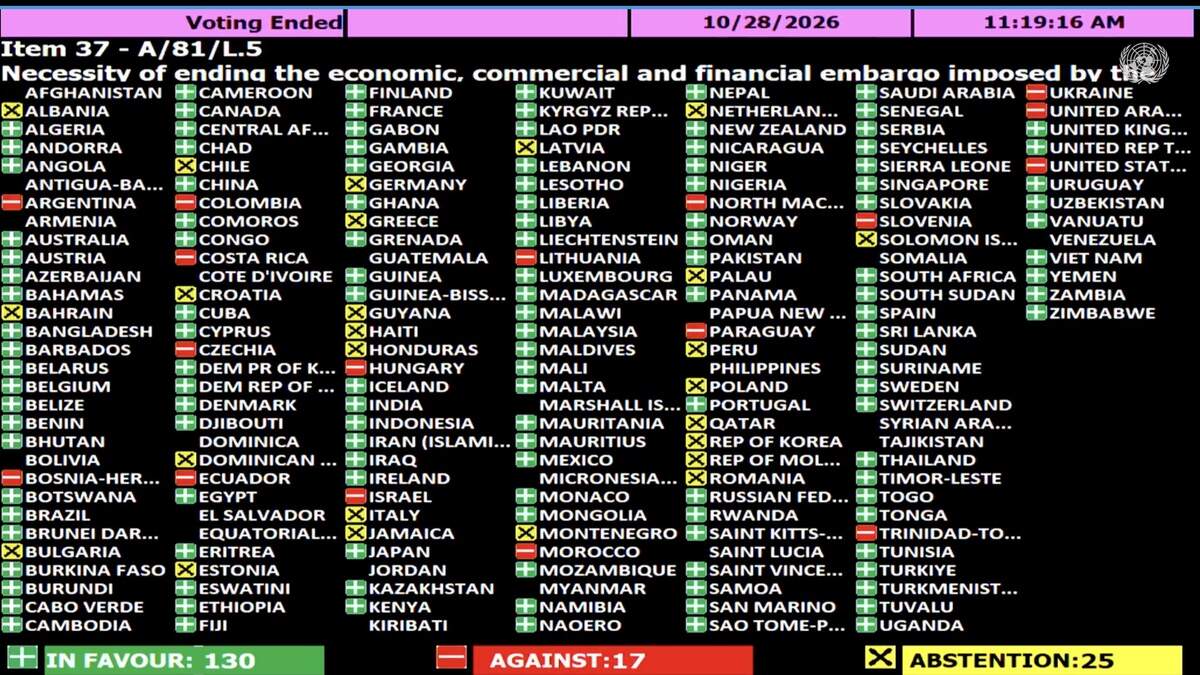
The resolution passed 130-17, with 25 abstentions, a sharp drop from last year, when it won 165 votes, with seven against and 12 abstentions. Ten countries joined the United States, Israel, Argentina, Paraguay, Hungary, North Macedonia and Ukraine in voting no this year. Colombia, Slovenia, Trinidad and Tobago and the United Arab Emirates switched from yes to no, while Bosnia and Herzegovina, Costa Rica, Czechia, Ecuador, Lithuania and Morocco went from abstaining to voting against.
Seventeen countries that backed the resolution last year abstained, including Germany, Italy, the Netherlands, South Korea, Qatar and Bahrain. Another 16 countries that voted yes last year did not vote this time.
Cuba lost significant ground in its own neighborhood. Five Latin American countries voted against the resolution: Argentina, Paraguay, Colombia, Costa Rica and Ecuador. Chile, Peru and Honduras, which voted in favor last year, abstained, as did the Dominican Republic, which did not vote in 2025. Bolivia and Guatemala, which supported the resolution last year, did not vote. El Salvador and Venezuela also did not vote.
In the Caribbean, long a reliable bloc for Havana, Trinidad and Tobago voted no, and Jamaica, Guyana and Haiti abstained after voting yes last year. Antigua and Barbuda, Dominica and Saint Lucia, which also voted yes in 2025, did not vote. Mexico, Brazil, Uruguay and Panama were among the region’s countries voting in favor.
Europe split down the middle: 14 of the European Union’s 27 members voted against the resolution or abstained, even as the bloc’s joint statement criticized the embargo’s extraterritorial reach.
The resolution, which Cuba presents annually to denounce U.S. sanctions, is not binding. Only the U.S. Congress can lift the embargo.
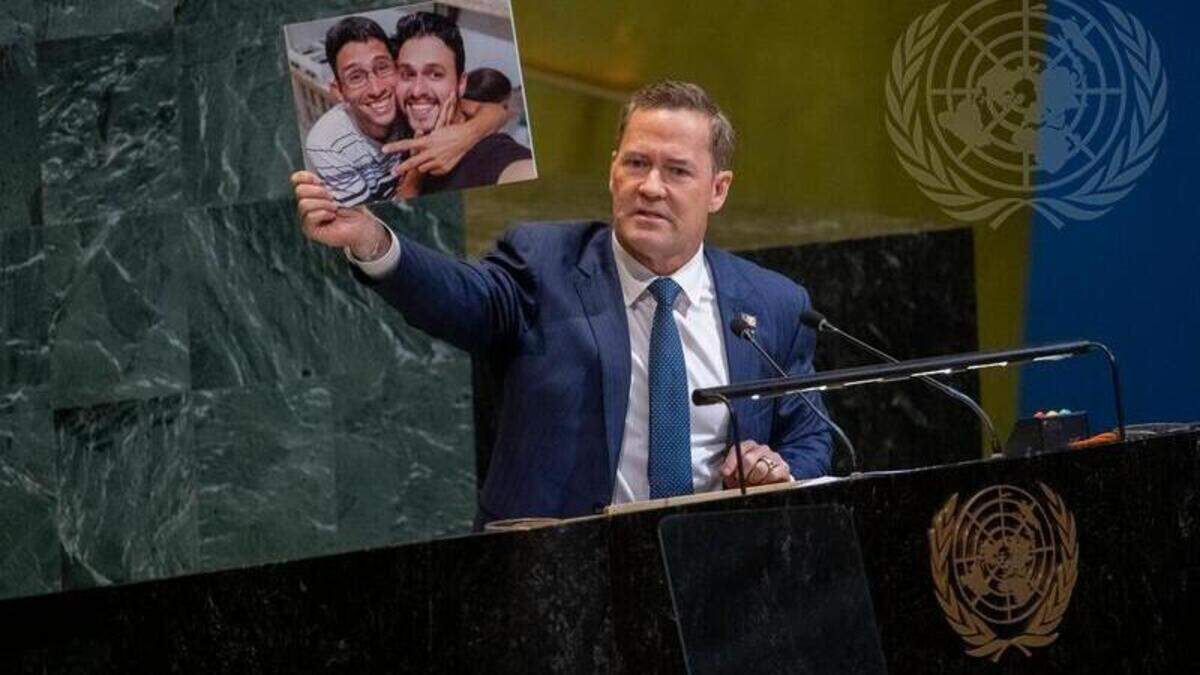
In remarks before Wednesday’s vote, the U.S. ambassador to the U.N., Mike Waltz, told members of the General Assembly that their vote was “the only thing standing between the corrupt, kleptocratic, communist regime and using this body and your vote for another propaganda victory at the expense of the Cuban people.”
Despite the erosion in support in key regions, most governments still sided with Cuba, citing international law and opposing unilateral measures, even as some made clear in their explanations that they have human-rights concerns in Cuba and that their position does not endorse the Cuban government’s policies.
Ireland, speaking on behalf of the European Union, said that lifting the embargo “could make economic reforms more effective,” but placed much of the blame for the island’s crisis on Havana.
“The decisions made by the Cuban authorities, including long-standing structural weaknesses and inefficiencies in the economic system, lack of economic, judicial, and political reforms, and inadequate investment, have significantly contributed to the current crisis,” the representative said. The EU called for the release of all political prisoners and urged Cuba to stop its nationals from joining Russian forces fighting in Ukraine, he added. He also reiterated the block’s opposition to the Helms-Burton Act’s extraterritorial reach. That’s the law that governs the U.S. embargo.
“Humanitarian support alone will not solve Cuba’s crisis,” the representative said. “Important sovereign decisions can no longer be postponed.”
Australia, also speaking for New Zealand, said the two countries “supported this annual resolution because the embargo restricts open trade and investment.” But it added that their support “should not be interpreted as an endorsement of the policies or actions of the Cuban government, or as diminishing its responsibility to uphold human rights and address the humanitarian crisis facing its people.”
The representative cited concerns about Cuba’s human-rights record and its support for “Russia’s illegal and immoral invasion of Ukraine.” He also called for the release of all political prisoners.
The Cuban government quickly hailed the results as a victory.
“The world has once again spoken out, by an overwhelming majority, against the blockade — even in the face of the crudest pressures and blackmail from the U.S. aimed at changing the outcome of this vote,” Cuban leader Miguel Díaz-Canel said on X. “This victory for Cuba today at the United Nations General Assembly is a victory for the heroic Cuban people, who do not give in to the economic strangulation, threats, and abuse from the U.S. government.”
Havana says the embargo cost Cuba $8.08 billion between March 1, 2025, and Feb. 28, 2026, the highest figure on record. Those estimates have not been independently confirmed.
Cuban Foreign Minister Bruno Rodríguez denounced Wednesday what he called a fuel blockade, “one which is equivalent to a naval blockade and is an act of war, an act of collective punishment and of genocide proscribed by international law.” He also blamed the embargo for medicine shortages, rising cancer deaths and a water crisis on the island.
Standoff at the UN
The vote followed weeks of confrontation between Cuba and the United States at the United Nations and on social media, including a shouting match between Waltz and Rodríguez that ended up with the expulsion of a Cuban diplomat.
During Tuesday’s debate, Rodríguez approached the podium as Waltz displayed photos of what he said was the Castro family’s luxurious lifestyle. Rodríguez accused Waltz of “lying grossly.”
Read more Police in Brazil killed 117 civilians, yet body cameras captured none of the deaths
“Back up, okay? This isn’t Havana,” Waltz told Rodríguez as he approached the podium to try to cut off Waltz mid-speech, and the presiding officer briefly suspended the meeting.
“He’s not going to intimidate me in the United States of America, like he tries to intimidate political prisoners,” Waltz went on.
Waltz later said on X that a Cuban diplomat had tried to get U.N. staff to cut his microphone, then tried to intimidate a U.S. staffer who noticed. A video shows a member of the Cuban delegation trying to snatch the phone from Waltz’s spokesman, J.P. Freire, as he recorded the exchange.
Waltz said on Fox News on Tuesday night that Secretary of State Marco Rubio had “signed paperwork” to expel the diplomat. “He’s gone. He is going to be on a plane to Havana within the next 24 hours,” Waltz said.
Waltz did not name the diplomat. U.S. government outlet Martí Noticias identified him as Richard Tur de la Concepción, first secretary of the Cuban mission to the U.N. since January 2024. Tur comes from a family of diplomats and represented the Group of 77 and China in the U.N.’s Fifth Committee during Cuba’s presidency of the bloc in 2023.
In the debate before Wednesday’s vote, Rodriguez turned the tables and accused the U.S. delegation of behavior similar to what the Cuban delegation has been criticized for. He accused the U.S. delegation of being “disrespectful” and “provocative” and denounced what he called “the harassment and unconsented filming by some of its delegation against our delegation.
“These are acts that are incompatible with decorum, respect for personal dignity, and privacy that must prevail in this chamber,” he said.
Speaking before Wednesday’s vote, Waltz again cited the Miami Herald’s investigation into GAESA, the military conglomerate that controls much of the island’s economy, and challenged Havana’s denials.
“Havana says these figures are false. Fine, open the books, examine these documents for yourself, permit an independent audit,” he said. He urged delegates to turn around and look at former political prisoners sitting in the chamber, including José Daniel Ferrer, and accused the Cuban government of using the annual vote to tell Cubans “that all of this suffering comes because of this fake, phony, made-up blockade.”
Intense lobbying
The spat went on for weeks.
On Oct. 19, the U.S. mission to the U.N. hosted a panel at U.N. headquarters titled “Cuba Libre: The Oppression Havana Hides,” with former political prisoners Ferrer and Luis Manuel Otero Alcántara. Minutes before it began, Cuba’s U.N. ambassador, Ernesto Soberón, and other members of the Cuban mission staged a protest, yelling and calling the panelists “terrorists” as they went up an escalator.
Rodríguez called the event “a deceitful spectacle.” On Tuesday, Waltz urged UN General Assembly representatives to watch the event’s videos and accused the “supposed delegation of diplomats” of trying to film the panelists, “intimidate them, and harass them.”
This wasn’t the first time Waltz told the Cuban delegation “This is not Havana.” He used the same words in July, after Rodríguez and Soberón began pounding their desks to protest his remarks during an extra General Assembly debate on U.S. sanctions that Cuba had forced.
The United States objected to holding that debate but lost, 136-9, with 30 abstentions. But Canada, Australia, and 15 European countries, including Germany, abstained, and several Caribbean governments abstained or stayed away, signaling fading support for the Cuban government’s anti-embargo campaign.
Both sides lobbied hard ahead of this year’s vote. In remarks Wednesday, Rodríguez accused the United States government of unleashing “a wave of pressures, intimidation, and blackmail against many member states, with a coercive, illegal, immoral, and unwarranted demand for them to change their traditional stance” on the embargo vote.
The annual resolution calling for the lifting of the U.S. embargo, which Cuba has presented at the U.N. since 1992, is a top priority for its foreign ministry, and Cuban ambassadors to the U.N. are evaluated on their performance on the matter. That may help explain why Cuban diplomats have been particularly nervous about this year’s results. Cuba observers, however, have been puzzled by how much time and resources Cuban diplomacy spends on a nonbinding resolution that has failed to achieve what it calls for.
While the Cuban delegation’s behavior at the U.N. has drawn international criticism, the Cuban government usually rewards such conduct and frames it as a show of Cuban resistance and “dignity.”
“Cuba will not back down—least of all in the face of Yankee pressures and orders,” Díaz-Canel said on X. “Bravo,” he added, mentioning Rodríguez and Soberón, “and the other members of our delegation, for such a firm stance against the disrespect, arrogance, and imperial overbearingness. They should expect nothing less from this people.”
Read more When does early voting end in South Florida? Check deadline and your options







Post Comment