Police in Brazil killed 117 civilians, yet body cameras captured none of the deaths
Before dawn on Oct. 28, 2025, a senior commander of Rio de Janeiro’s elite police battalion gathered his officers and told them it was time to show their strength, retake territory and assert the power of the government.
Read more When does early voting end in South Florida? Check deadline and your options
“Everyone here knows what we must do,” he said, according to body camera footage reviewed by the organization Human Rights Watch.
Over about 15 hours, police killed 117 men and boys in the hillside favelas of Complexo da Penha and Complexo do Alemão. Four officers died that day and a fifth weeks later. It was the deadliest police operation in Brazil’s history, according to the organization.
Officers carried hundreds of body cameras, producing roughly 4,400 hours of video. None of the footage shows a person being killed, according to a Human Rights Watch report released Wednesday, on the first anniversary of the raid.
This account is based on the organization’s report, including its interviews with relatives, residents and prosecutors and its examination of footage, autopsy reports and more than 8,800 pages of prosecutors’ files obtained through Rio’s Public Defender’s Office. Researchers found that officers covered or removed cameras during critical moments and moved bodies before forensic teams could examine the scenes. Wounds suggested some victims had been shot while lying down or otherwise incapacitated.
Nearly three-quarters of the civilians killed were shot at least once from behind. More than 40 percent were shot in the head. Seven people were wounded, hospitalized and arrested — roughly one for every 17 civilians killed.
“They went in to execute,” Tauã Brito da Cruz, whose 20-year-old son was among the dead, told researchers. “It was a strategy of death.”
Prosecutors have charged 19 officers with crimes including breaking into homes, theft and tampering with cameras. None has been charged with unlawful use of force, and no commander has been held accountable, the report said.
Trapped in the forest
Operation Containment was intended to carry out 100 arrest warrants and 145 search warrants targeting suspected members of the Comando Vermelho, or Red Command, one of Brazil’s most powerful drug-trafficking groups. About 2,500 military police and civilian police officers participated, supported by armored vehicles, helicopters and drones.
By daybreak, police were entering the community from several directions. Gang members burned tires and cars to block them. Some of the armed men and boys who fought police carried semi-automatic weapons and wore body armor, according to the report’s reconstruction.
By late morning, officers had surrounded a group in the Vacaria, a wooded slope used as an escape route during previous raids. Police held the streets below, while officers from the Battalion of Special Police Operations, known as BOPE, blocked passage into neighboring Complexo do Alemão.
After Civil Police officers were shot near the forest, the BOPE commander ordered his men down the hill. Fourteen officers were hospitalized with gunshot wounds, nearly all by 1:30 p.m. Prosecutors told Human Rights Watch they suspect the police casualties prompted retaliatory killings.
Throughout the afternoon, residents received calls from young men trapped in the trees, some likely armed. They asked for help surrendering and said they feared being killed. Relatives later lost contact with them.
Police arrested 99 people that day, apparently all in the urban part of the community. A prosecutor told researchers no arrests were made in the forest. A Civil Police commander gave the same account, saying those in the woods “either fled or they resisted.”
None of the dead were among the 51 people named in the main investigation used to justify the operation, the report found. A commander also told prosecutors that officers entered many homes but never entered the house of the local gang leader, the principal target.
As police withdrew around 8 p.m., an officer encountered Brito da Cruz and other residents trying to reach the forest. She told researchers he said police had not intended to take anyone alive because arrested suspects were soon released back on the street.
“Now go up there,” she recalled him saying. “It’s full of bodies.”
Missing footage
Rio law requires body cameras to record everything officers see, hear, say or do. Supreme Court orders and police protocols also require cameras, preservation of crime scenes and coordinated medical assistance, the report noted.
Only about 23 percent of officers deployed that day wore cameras, according to government figures cited in the report. The Military Police told researchers it had 15,000 devices. The state told the Supreme Court that technical problems had kept dozens out of service.
The Military Police provided recordings from 532 cameras worn by 527 officers. Civil Police officers reportedly wore 62 cameras, but the Public Defender’s Office had received none of their footage when the report was published.
Human Rights Watch used AI tools to flag gunfire, camera obstructions and gaps in recording metadata, then had researchers review each flagged segment.
They documented 278 instances involving 132 front-line officers in which cameras were removed or covered. Researchers suspected deliberate tampering in 146 instances, including officers covering lenses, putting cameras in pockets or backpacks, or removing them during gunfire or entry into homes. In another 97 instances, cameras were left in vehicles.
The Military Police chief suggested some batteries had died. Protocol requires officers to begin with at least a 95 percent charge and carry a spare for shifts exceeding 12 hours. BOPE commanders told prosecutors the unit had 14 spare batteries but took none.
Among 305 front-line officers whose footage was reviewed, 55 percent had recordings that ended or showed a significant gap by midday. Recordings averaged six hours and 38 minutes, roughly half a battery’s nominal life, the report said.
None of the footage from 49 BOPE officers continued past 12:11 p.m., leaving no recordings of their afternoon activities in the Vacaria, where most killings occurred. Researchers documented 26 instances of possible tampering within the unit.
A prosecutor confirmed to Human Rights Watch that the available footage shows police firing, but no one being killed.
Some recordings captured Shock Battalion officers complaining that cameras prevented them from killing suspects. Other footage showed abuse. Shortly after 10 a.m., officers found a 16-year-old boy asleep in a house near the forest. A sergeant punched him and threw him to the floor. Officers found camouflage clothing, a pistol and a radio elsewhere in the room. One told the boy he would die; another later asked what he had to offer them.
“Don’t kill me,” the boy said before handing over phones.
In another video verified by researchers, men laid down their weapons and asked a resident to record their surrender.
Read more Man caught after robbing two Miami banks in three days, FBI says
“Please don’t kill us,” one said. “It’s on tape.”
Evidence lost
Brazilian law and Supreme Court orders require officers to preserve the scene of a police killing until forensic experts examine it. Human Rights Watch found that none of the scenes underwent that process.
Police told prosecutors they had planned the operation for months and expected heavy casualties. But Alexandre Herdy Barros Silva, director of the Civil Police department responsible for investigating homicides, said he learned about it informally a week beforehand and made no preparations. Forensic teams summoned to a nearby police complex during the raid were never sent to the scenes, according to records reviewed by the organization.
At dusk, BOPE officers gathered 33 bodies, reportedly from the forest. A verified photograph shows at least 19 beside an armored vehicle. Two had their pants and underwear pulled down. Videos show bodies piled inside the vehicle while officers joked.
“Look how wonderful,” one said. “We like this.”
Police transported the bodies without forensic examinations of the scenes. Dozens of others remained in the forest for hours, many beginning to decompose before medical examiners received them, according to autopsy reports.
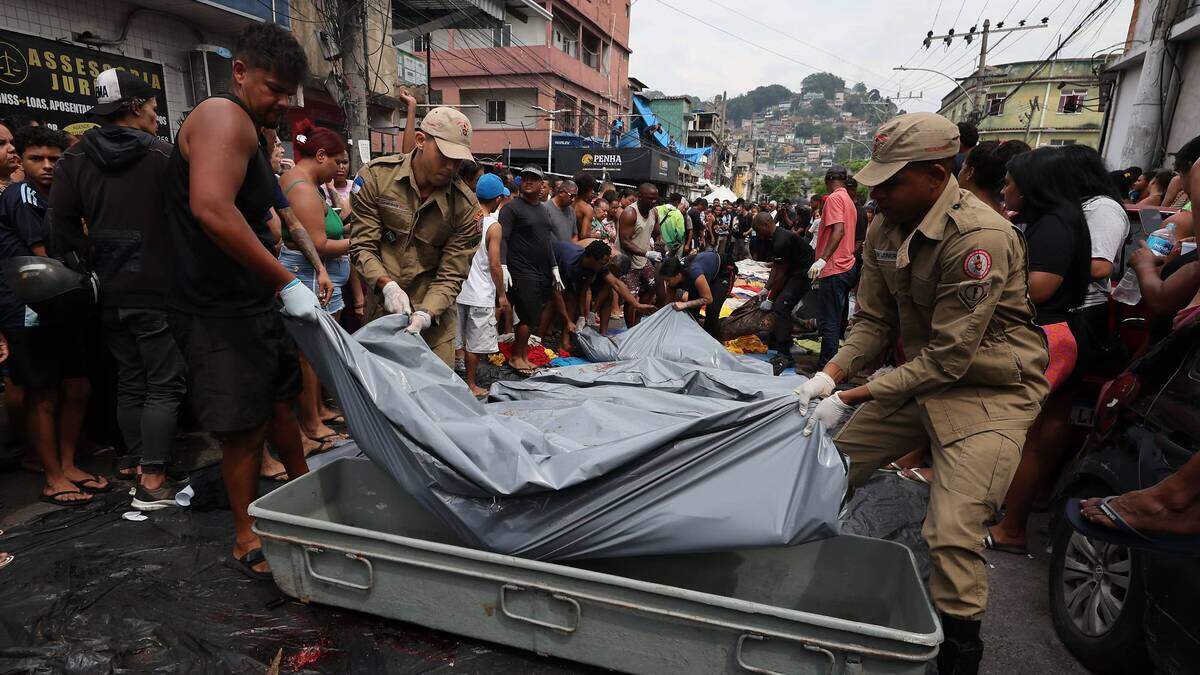
Residents recovered those bodies overnight. Mothers climbed the hillside calling their sons’ names and used phone lights to examine faces. Residents carried the dead down and placed 62 bodies in Saint Luke Square. No forensic team went there to photograph them or collect gunshot-residue samples, the report said.
Commanders said armed attacks prevented them from securing the scenes. Police also failed to examine killings inside houses or the site where two men were killed outside the favela hours before the operation officially began.
At least 16 civilians delivered by police to Getúlio Vargas Hospital were dead on arrival. The Supreme Court had previously ordered Rio to stop removing bodies under the pretext of medical assistance.
Police recorded basic information about where, when and how victims died for only two of the 117 civilians, violating a protocol Herdy had signed, researchers found. A prosecutor said those omissions continue to hamper the investigation. The Civil Police said there was no indication the protocol had been ignored.
The report also found that the 118 firearms police said they seized were displayed at a press conference rather than sealed for fingerprint and ballistic testing. Television footage showed officers and reporters handling them without gloves.
What the autopsies found
Human Rights Watch reviewed the autopsies with specialists from the Independent Forensic Expert Group of the International Rehabilitation Council for Torture Victims. The experts concluded that wounds suggested many victims had been deliberately targeted and killed.
The civilians had an average of four bullet entry wounds. More than 60 percent were shot at least four times, and 71 percent had wounds on two or more sides of the body. Twelve were shot only from behind.
In many cases, bullets traveled upward through the body, which can indicate a victim was lying down or otherwise incapacitated, according to the forensic analysis. Of 19 people killed by a single bullet, four were struck in the back of the head.
The youngest victim, a 14-year-old boy, was shot in the head, chest and arm, and three times in the back. A 37-year-old man was shot at least 11 times in the back. Four of the five officers who died were killed by a single shot to the front of the head or body.
The forensic review had limitations. Many autopsies lacked enough information to establish firing range, partly because bodies had been moved and stripped of clothing.
More than 85 percent of the civilians killed were Black. They ranged in age from 14 to 54. The following day, Rio’s then-secretary of Civil Police declared that everyone killed was a criminal, the report noted.
Social media profiles suggest many victims supported or belonged to the Red Command. Human Rights Watch did not seek to establish membership, noting that neither gang affiliation nor a criminal record justifies excessive force or an extrajudicial killing.
Mothers seek answers
Brito da Cruz told researchers she found her son, Wellington Brito Santos, near a staircase leading into the forest at 1 a.m. He had been shot five times, including in the lower back and side of the head. His hands were bound with black fabric, she said. Researchers could not determine when or why.
Drone footage showed him climbing the stairs that morning, apparently carrying a weapon. At his funeral, his mother said, a young man told her he had survived by playing dead and described police finishing people off.
“People mock [his death], saying, ‘Good riddance — a good criminal is a dead criminal,’” she said. “But why does a person from the favela not deserve another chance?”
Community members told researchers that Ronaldo Julião da Silva, 46, was not a gang member and appeared unarmed. A witness reportedly saw police shoot him with his hands raised, then drag his body into an alley.
Yago Ravel Rodrigues Rosario, 19, was found decapitated in the forest. His wounds suggested a large blade. Researchers verified video of an officer carrying a machete that day, but did not establish who killed him.
Debora Moreira Lemos’ son, Gabriel, 23, was found with four gunshot wounds. She told researchers she had not known he belonged to the gang. He had told a relative he wanted to leave and study.
“I’ve seen [police] operations like this my entire life,” she said. “Nothing has changed.”
Six months later, residents told Human Rights Watch the Red Command still controlled the community and had recruited more boys to replace those killed.
Rio’s governor at the time, Cláudio Castro, called the operation a success. Human Rights Watch urged prosecutors to investigate senior officials and police commanders, and called for forensic services to be made independent of the Civil Police, the same force participating in the raid and investigating the deaths.
The report describes Lemos standing at her living room window at night, looking over the city.
Read more Amendment 3 seeks to lower taxes for second homes and investors. Will it?
“People are afraid,” she said. “But the mothers want justice.”







Post Comment