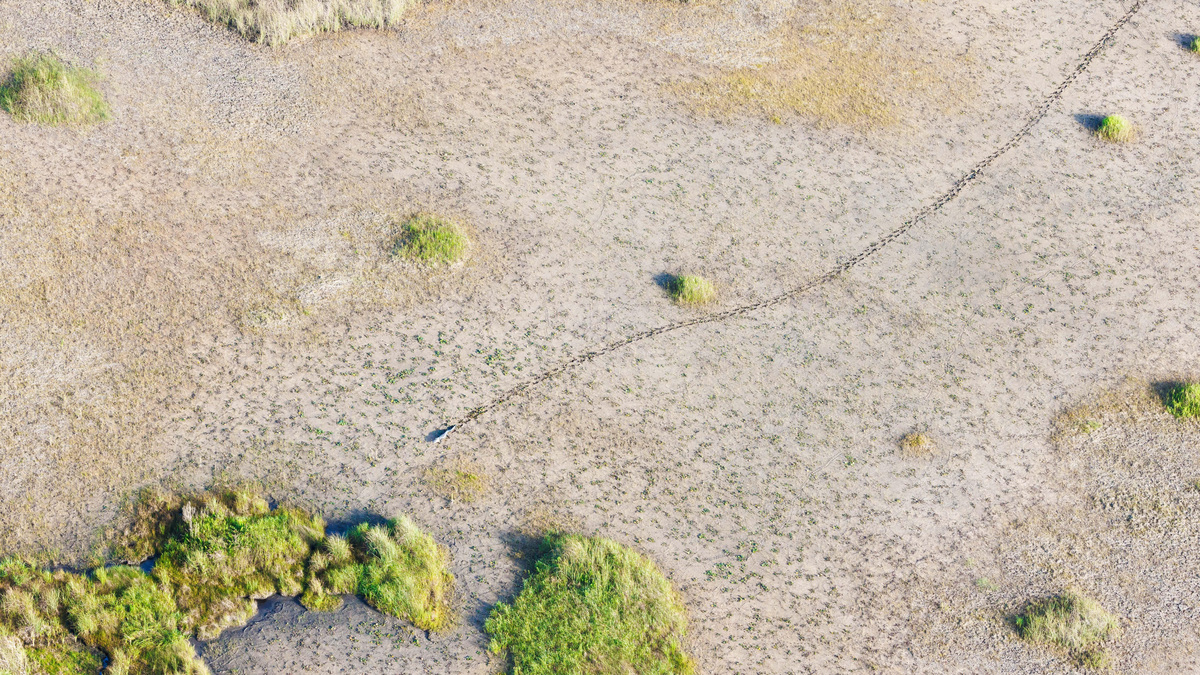
Why Florida’s drought is threatening more than lawns
Droughts occur throughout the country, but Florida’s droughts surprise many due to its reputation as a wet state.
Read more Behind the story: Michaela Galligan on Florida’s drought
According to the University of Florida Institute of Food and Agricultural Sciences (UF/IFAS) Extension office, a drought is a period of abnormally dry weather that causes a water shortage or jeopardizes our water resources.”
Drought is calculated using a number of indicators such as rainfall, soil moisture and streamflow with local observations to determine the severity of dryness.
Drought intensity is measured on a scale of abnormally dry – a warning sign of drought – to exceptional drought, with moderate, severe and extreme drought in between the two.
The driest seasons in Florida typically occur from November to May, but recent years have seen drought periods extended further.
According to NASA, Florida has been experiencing large percentages of the state in severe, extreme and exceptional drought, some of the highest reports since 2000.
As of mid-July 2026, 15.5 million of 23.5 million Florida residents live in areas of drought.
While no part of the state is in exceptional drought, 16.2% of Florida is in extreme drought.
Sarasota, Manatee counties are affected
The National Integrated Drought Information System (NIDIS) states that 100% of Sarasota County is affected by drought, with the county experiencing its fifth-driest June on record over the past 132 years.
In mid-July, 50.2% of the county was reported to be in an extreme drought.
NIDIS reports that Manatee County is seeing similar numbers, with 100% of the county being affected by drought and experiencing its fourth-driest June on record over the past 132 years
In mid-July, 53.7% of Manatee County was reported to be in an extreme drought.
The 2026 drought also extended into Florida’s lightning season of May to October, with peak strikes in the summer months.
When lightning hits dry, drought-ridden ground, it is more likely to ignite into a fire, with some landing close to home in Sarasota County.
There are many other environmental impacts of drought in Florida, including wildlife displacement.
According to research by Florida International University, the state’s drought also threatens to impact access to clean water, which is forcing local governments and organizations to confront the challenge of protecting accessibility.
How do Sarasota, Manatee residents get clean water?
Sarasota and Manatee County residents get their clean water from a number of resources.
The two counties are managed by the Southwest Florida Water Management District (SWFWMD), and they are among many communities whose water resources are overseen by the agency under state law.
Brooke Bailey, Sarasota County’s public utilities director, said the county obtains its water from three main sources: the Peace River/Manasota Regional Water Supply Authority, Manatee County and the T. Mabry Carlton, Jr. Memorial Reserve Treatment Plant.
Bailey added that water is pulled from 16 wells on the T. Mabry Carlton, Jr. Memorial Reserve, which is where the Carlton Water Treatment Facility is located in Venice.
“Sarasota County Public Utilities uses a water treatment process called Electrodialysis Reversal (EDR) to demineralize and prepare our water for drinking,” Bailey told the Herald-Tribune.
Manatee County follows a similar technique.
“Manatee County’s drinking water system utilizes a diversified water supply that includes surface water from Lake Manatee and groundwater wells,” said Chris Collins, Manatee County’s utilities deputy director.
Collins said Manatee’s “water treatment facility “continuously monitors and treats water to meet or exceed all state and federal drinking water standards before it reaches our customers.”
How do counties manage drought, water access?
In times of drought, clean water access becomes harder to come by, so local governments and agencies often put in place guidance to navigate issues in advance.
“Sarasota County remains on a once-per-week watering schedule year-round to conserve water,” Bailey said.
Meanwhile, Collins said Manatee County plans for drought by “maintaining multiple water sources, following established water shortage plans when necessary, and working closely with SWFWMD to ensure water supplies remain reliable.”
Residents of Sarasota and Manatee counties can find watering restrictions on the websites of their respective counties.
Read more Saudi, Gulf stocks fall after Houthis claim Riyadh attacks
However, extreme, continued droughts – such as the one seen in 2026 – further impact clean water access beyond what year-long water conservation measures can secure.
The National Integrated Drought Information System outlines key points, such as utility operations and aquifer depletion, as factors greatly affected by extreme drought. An increased demand for clean water from rising temperatures and population growth also makes the situation more dire.
Drought conditions have also sparked conversations about where to find alternative water sources.
ManaSota-88 Inc., a local environmental nonprofit group, has raised concerns that the Southwest Florida Water Management District may begin to take water from other natural sources if its declaration of water storage emergency order is lifted.
According to ManaSota-88, the SWFWMD is “looking to rivers, lakes, and wellfields” as potential water sources, which would in turn “cause intensified conflicts between human water demands and the needs of natural systems.”
However, the water district has stated that natural systems would not be impacted due to already in place protections.
“Minimum flows and levels are scientifically established limits set by the district to protect natural water bodies from significant ecological harm,” said Randy Smith, resource management director for the Southwest Florida Water Management District.
Smith added that minimum flows “are the threshold applied to rivers, streams and springs to prevent significant harm caused by water withdrawals.”
Because minimum levels are the threshold applied to lakes, wetlands, and aquifers., the Southwest Florida Water Management District uses minimum flow levels to evaluate water-use permit applications, and to shape regional water supply planning.
Smith said that if a water body falls below its flow level – or is projected to do so within 20 years – the Southwest Florida Water Management District must implement a recovery or prevention strategy to restore water levels.
In addition to water depletion concerns, Glenn Compton – the director of ManaSota-88 Inc. – also raises the point of environmental and economic impacts of taking water from alternative sources.
“The one thing we can be sure of is Florida will become a much more expensive place to live as we search for alternative drinking water sources,” Compton said.
“Regardless of how future drinking water supplies are developed, they will have an enormous environmental impact.”
While acknowledging population concerns, the Southwest Florida Water Management District upholds its commitment to reducing environmental and economic impact through its work and advanced planning.
“Despite significant population growth over the last 40 years, the District has been able to reduce both groundwater withdrawals and total water use due to water conservation efforts, and the development of alternative water supplies and reclaimed water projects,” Smith said.
Smith said the Southwest Florida Water Management District “has prioritized more than $600 million in cooperative funding for alternative water supply projects in Tampa Bay, Polk County and our southern counties to meet the projected needs of the growing population over the next 20 years.”
The Peace River Manasota Regional Water Supply Authority, a water supplier for Sarasota, Manatee, Charlotte and DeSoto counties, also takes measures to ensure environmental protection in its work.
“The Authority utilizes alternative water supplies to minimize the use of traditional groundwater from Florida’s underground aquifer system,” said Richard Anderson, the authority’s executive director.
“The key to using a seasonally available surface water as a reliable public water supply is the ability to harvest and store large volumes of water during relatively short periods of availability,” Anderson said.
“To accomplish this, the Peace River facility utilizes off-stream raw water reservoirs and an aquifer storage and recovery system to support the use of supplies withdrawn from the Peace River.”
While the 2026 drought continues to impact clean water access in the state, local and regional leaders in the industry are working to ensure water is accessible and that methods of collection carry limited impact on the environment.
Michaela Galligan served as a summer intern for the Sarasota Herald-Tribune and covered a variety of topics.
Support local journalism by subscribing.
This article originally appeared on Sarasota Herald-Tribune: Why Florida’s drought is threatening more than lawns
Reporting by Michaela Galligan, Sarasota Herald-Tribune / Sarasota Herald-Tribune
Read more At 93, this Sarasota man went back to work. Here’s why. | Exclusive
USA TODAY Network via Reuters Connect
Copyright Reuters or USA Today Network via Reuters Connect
This story was originally published September 20, 2026 at 4:00 AM.











Post Comment