At 93, this Sarasota man went back to work. Here’s why. | Exclusive
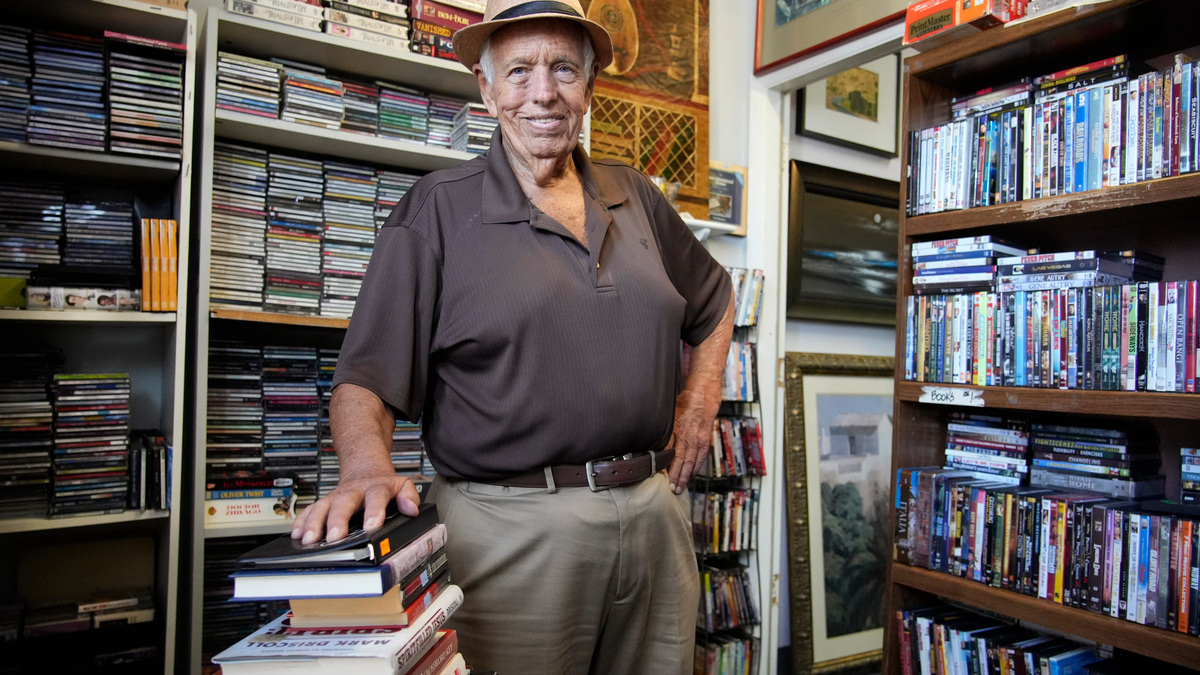
Inside the HOPE Chest Thrift Store in Bradenton, Stewart Ogilby carefully and meticulously arranged donated CDs, albums and cassettes on their separate shelves.
Read more Fresh voices, new ideas: A changing era for South Florida’s arts scene
Though he helps with furniture and most anything else where he’s needed – chatting up co-workers, volunteers and shoppers along the way – Ogilby naturally gravitates toward the music section.
He likes to recall his days as a Sarasota Orchestra patron. But these days Ogilby listens to classical music only at home.
That’s because Ogilby still works for a living, something he never imagined doing at 93.
Seniors and financial fragility
Ogilby, who lives in Sarasota, is like millions of seniors across the country.
They are facing financial fragility in retirement amid soaring housing, food, utility and medical costs.
While many low-income older adults on fixed incomes are increasingly vulnerable to losing the roofs over their heads, retirees like Ogilby – moderate-income people who were persons of means in their younger days – are also finding themselves in dire straits.
Ogilby, a homeowner, retired businessman, author and financial advisor once featured in the national press, said two jarring reality checks hit him over the past year: skyrocketing premiums for his Medicare supplemental plan and yet another increase in his homeowners association fees.
“I thought, ‘What am I going to do? Go out and get a job?'” Ogilby said.
The unavoidable answer was “yes.”
‘House poor’
Ogilby isn’t alone.
Nationwide, 37% of older adults feel financially insecure, while 60% report feeling concerned about not having enough money to last through retirement, according to a recent study by the AARP.
That includes growing numbers of those with annual household incomes of $75,000 or more.
Among this group, 20% reported feeling financially insecure – up from 15% in 2022, according to the AARP study.
Seniors overwhelmingly pointed to higher costs this past year in housing, food, transportation and health care.
“When nearly 7 in 10 say prices are rising faster than their income, that is not a story about individual financial decisions. It is a story about affordability that is touching households at every income level,” said Richard Johnson, vice president of financial security at the AARP Public Policy Institute.
Homeowners are not immune.
Once considered a source of security in retirement, homes have become a burden for seniors struggling to keep up with related costs and maintenance.
That’s particularly the case in hurricane-prone Florida, where recent storms destroyed many affordable senior mobile home parks.
Already living paycheck-to-paycheck on fixed incomes, some seniors found themselves falling between the cracks of insurance coverage or FEMA help.
Unable to afford repairs on their own or qualify for public assistance, they instead were forced to live with leaking roofs and other damage.
But even those untouched by storms – and who own their homes outright – are weathering burdens.
A recent USA TODAY national report showed that a record 12.5 million senior households – or more than a third of the plus-65 population – may be feeling “house poor,” meaning they are spending disproportionate amounts of their monthly incomes on housing.
In what one expert called “staggering increases,” the report stated that almost every housing-related expense “has skyrocketed since the pandemic, faster than the 28.67% overall pace of inflation.”
For instance, the report found that median property taxes had increased 30%, home insurance premiums 40.4% and electricity 40%.
What’s more, when seniors go to sell their homes, they tend to earn lower prices compared to their younger counterparts, largely due to deferred maintenance, The New York Times reported, citing a recent study by the Federal Reserve Bank of Philadelphia.
And even if they were to sell – given high rents and long waiting lists for affordable units – there is another issue to confront. “If they want to downsize or leave or sell, where do they go?” said Zayne Smith, the senior director of advocacy at AARP Florida.
The missing middle
Smith noted that for decades now, Florida’s building model has moved away from smaller, easier-to-maintain homes in favor of master-built communities of large, single-family houses or luxury condos.
As a result, Smith said, Florida has become a far more expensive place for retirement.
She and her organization have encouraged legislators and policymakers statewide to aggressively embrace “missing middle” alternatives.
That includes accessory dwelling units, duplexes, triplexes, quads and townhomes that could provide people of all ages, especially seniors, with smaller and more affordable options.
“Affordability is really at a crisis point,” Smith said, “and it all starts with housing.”
And that’s why seniors are streaming back into the workforce, Smith said.
Smith, who lives in Manatee County, said she regularly sees seniors bagging groceries, running carts to cars and doing other jobs that college or high school students once did for spending money.
“It’s mind-boggling,” Smith said. “Everywhere you go, you see that.”
Back to work
Trina Steinmaker is on the front lines helping seniors find jobs.
For the past four years, Steinmaker has been a project director working with AARP Foundation’s Senior Community Service Employment Program (SCSEP).
Her office oversees Sarasota, Manatee, DeSoto, Lee, Hendry and Glades counties.
SCSEP, funded by grants through the U.S. Department of Labor, provides training, stipends and paid work opportunities to low-income residents over 55 who want to return to the workforce.
The program pairs them with partnering nonprofits, where they can brush up on employment skills with the goal of helping them transition into a full- or part-time job.
In a national study, the AARP found that this summer, 6% of retirees reported returning to work the past six months.
The No. 1 reason listed – at 48% – was economic need.
“I’ve never seen the demand like this before in this area,” Steinmaker said. “We can’t keep up with the number of applications coming in.”
With nearly 100 participants, the office’s program is at between 120% and 125% over-enrollment.
In the past, applicants typically needed help transitioning to another job after being laid off, worried that their housing was at risk.
But now many are already homeless, living in their cars.
“Now it’s immediate,” Steinmaker said.
This summer Ogilby was referred to her office by Senior Friendship Centers.
In his earlier years, Ogilby had helped countless seniors with reverse mortgages and had already taken out one himself.
So that route was not an option for him to keep up with rising expenses.
Steinmaker’s office connected him with training at HOPE Chest.
With the stipend, Ogilby has been able to live more comfortably.
Steinmaker said big-picture solutions are needed at policy levels to address the affordability crisis.
But in the meantime, programs like hers are doing everything possible on the ground to help.
“We can work with one person at a time,” Steinmaker said.
What happens next?
For now Ogilby is enjoying his work at HOPE Chest – and the chance to socialize with so many people.
“I love working here,” he said. “It’s not just to make money.”
And the staff loves Ogilby back, said HOPE Chest store manager Maria Briones.
Briones said she is seeing more seniors, not just workers and volunteers but shoppers as well, coming into the store because they are struggling to keep up with expenses.
Ogilby lifts up everyone’s spirits with his humor and charm.
“He keeps us going,” Briones said. “He’s great. He cheers everyone up.”
But Ogilby admitted he has begun to wonder how much longer this can last.
He has outlived almost everyone in his personal circle – life partners, a stepson, colleagues and former sailing buddies.
And while Ogilby said he’s among the lucky ones who is able to keep going, his daily life remains full of challenges.
“We’re living longer, and it’s costing us more and we’re running out of money,” Ogilby said of his generation.
“What if I live to be 100?”
This story comes from a partnership between the Sarasota Herald-Tribune and the Community Foundation of Sarasota County. Saundra Amrhein covers the Season of Sharing campaign, along with issues surrounding housing, utilities, child care and transportation in the area. She can be reached at [email protected].
Support local journalism by subscribing.
This article originally appeared on Sarasota Herald-Tribune: At 93, this Sarasota man went back to work. Here’s why. | Exclusive
Read more Sunday Night Football DFS Showdown Strategy: Kenneth Walker III Looks to Continue Hot Streak
Reporting by Saundra Amrhein, Sarasota Herald-Tribune / Sarasota Herald-Tribune
USA TODAY Network via Reuters Connect
Copyright Reuters or USA Today Network via Reuters Connect
This story was originally published September 20, 2026 at 4:01 AM.











Post Comment