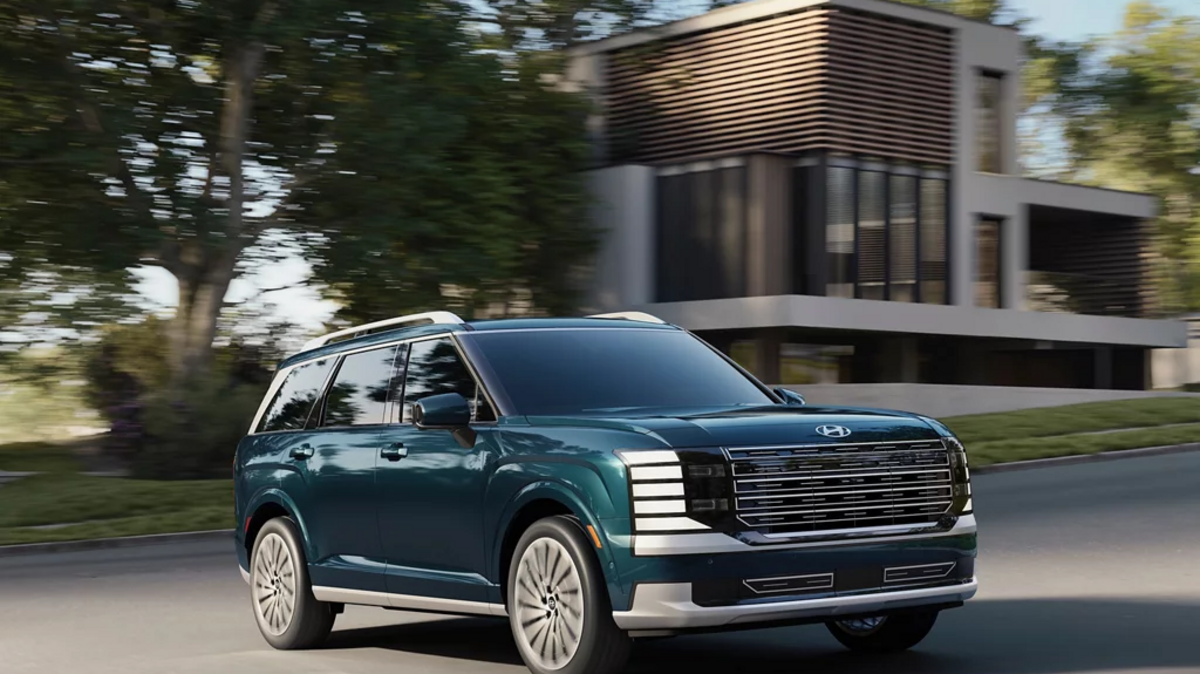
We Compared the 2026 Hyundai Palisade and Chevrolet Traverse. One Comes Out Ahead
Chevrolet built the Traverse on cargo volume and Hyundai rebuilt the Palisade on everything else. The Traverse holds nearly eleven cubic feet more with the seats down, makes 41 more horsepower from a smaller engine and fits the largest screen in the class at 17.7 inches. The Palisade answers with a completely new design, a third row that folds flat into the floor, and a depreciation figure 4.4 points better. Both are excellent and they are excellent at different jobs, which makes the five-year figures the useful tiebreaker rather than the spec sheet.
Read more We Compared the 2026 Chevrolet Trailblazer vs. Kia Seltos: One Is Worth Paying More For
What’s New for 2026
Hyundai completely redesigned the Palisade for 2026. The second generation adopts a squared-off silhouette, a premium interior with available quilted Nappa leather, power-folding third-row seats and a relaxation mode for the front and second rows. The 3.5-liter V6 produces 287 horsepower and 260 lb-ft, seating runs eight on lower trims and seven where captain’s chairs appear, and pricing starts at $41,035 across seven trims to $56,160. The Palisade was selected as the 2026 North American Utility Vehicle of the Year.
Chevrolet redesigned the Traverse for 2024 and carries it into 2026 with few changes, which means it keeps what made that redesign work. A 2.5-liter turbocharged four produces 328 horsepower and 326 lb-ft, the 17.7-inch central touchscreen remains the largest in the segment, and Super Cruise hands-free highway driving is available. Pricing starts at $42,795.
Specs and Pricing
Hyundai Palisade
- Price: From $41,035, to $56,160 for the Calligraphy
- Engine: 3.5-liter V6
- Horsepower: 287 hp, 260 lb-ft
- Transmission: 8-speed automatic
- Drivetrain: Front-wheel drive standard, HTRAC all-wheel drive optional
- EPA city / highway: 19 / 25 mpg
- Towing: 5,000 lbs
- Maximum cargo: 86.7 cu ft
- Seating: 8 on lower trims, 7 with captain’s chairs
- Third row: Power-folding, folds flat into the floor
- Basic warranty: 5 years or 60,000 miles
- Powertrain warranty: 10 years or 100,000 miles
- Five-year depreciation: 47.5%
Chevrolet Traverse
- Price: From $42,795
- Engine: 2.5-liter turbocharged four
- Horsepower: 328 hp, 326 lb-ft
- EPA city / highway: 20 / 26 mpg
- Towing: 5,000 lbs
- Maximum cargo: 97.6 cu ft, best in class
- Central display: 17.7 inches, largest in the segment
- Available technology: Super Cruise hands-free highway driving
- Basic warranty: 3 years or 36,000 miles
- Powertrain warranty: 5 years or 60,000 miles
- Five-year depreciation: 51.9%
Hyundai undercuts Chevrolet by $1,760 at the entry point and covers the powertrain twice as long. The Palisade range spans seven trims with a hybrid available, and the Traverse lineup runs from the LT to the High Country with the Z71 handling the off-road brief.
Hyundai’s redesign put it up against its corporate cousin first, where the Palisade meets the Kia Telluride at $50,000 and the five-year costs finish $133 apart.
Powertrains and Driving
Chevrolet wins output from the smaller engine, which is the surprise on this specification sheet. The 2.5-liter turbocharged four produces 328 horsepower and 326 lb-ft against the Palisade’s 3.5-liter V6 at 287 and 260, gaps of 41 horsepower and 66 lb-ft from an engine 1.0 liter smaller.
Forced induction explains it. Torque comes from the mass of air burned per cycle rather than from displacement, and a turbocharger forces considerably more air into a 2.5-liter than atmospheric pressure pushes into a 3.5-liter.
Hyundai’s counterargument is architecture. A naturally aspirated V6 carries no turbocharger, no intercooler and no boost-related heat cycling in a vehicle that will spend its life carrying seven or eight people, and for a buyer planning a long ownership that simplicity has value the horsepower figure does not capture. Both use eight-speed automatics and both tow 5,000 lbs, so neither buys an advantage there.
The Traverse is the quicker of the two and buyers will notice it merging with a full load. The Palisade is the more refined, and independent comparison testing has ranked the Palisade XRT PRO above the Traverse High Country in a direct head-to-head.
Real-World Fuel Economy
Chevrolet wins by 1 mpg on each cycle, which is close enough to call a tie in practice. The Traverse returns 20 mpg city and 26 mpg highway, working out near 22 mpg combined. The Palisade returns 19 and 25, near 21 combined. That is 1 mpg city, 1 mpg highway and 1 mpg combined.
The result is worth noting because it runs against the usual pattern. Chevrolet’s turbocharged four produces 41 more horsepower and returns better economy than Hyundai’s larger naturally aspirated V6, which is the whole argument for downsizing working exactly as intended.
Over 60,000 miles the difference amounts to 130 gallons, or $520 at $4.00 a gallon, which is $104 a year. That is not a figure that decides a $42,000 purchase.
Both run on regular unleaded, so neither carries a fuel-grade penalty. Hyundai offers a hybrid Palisade producing 329 horsepower, and Chevrolet offers no electrified Traverse at any trim, which is the one configuration where the fuel comparison stops being close.
Design and Presence
Hyundai took the risk and it worked. The redesigned Palisade’s squared-off silhouette invites comparisons to considerably more expensive vehicles, with upright surfaces and a deliberate stance that reads as premium rather than merely large. Being named North American Utility Vehicle of the Year for 2026 reflects how that landed.
Chevrolet’s Traverse is the more conventional shape, redesigned in 2024 and carrying over. It is handsome and unremarkable, and its proportions serve the cargo hold rather than the photograph, which is consistent with what the vehicle is for.
Outward visibility is comparable in both and neither is compromised. The Palisade’s advantage in this section is presence rather than proportion. It looks like more money than it costs, and the Traverse looks like exactly what it costs.
Cabins and Technology
Chevrolet wins the display comparison outright and by a wide margin. The Traverse’s 17.7-inch central touchscreen is the largest in the segment, easy to read and easy to operate with a glance, and no Palisade trim approaches it.
Super Cruise is the second and it is more consequential. GM’s hands-free highway system is widely considered the best of its kind, and it is available on the Traverse where Hyundai offers no equivalent. On a three-row bought for family road trips, that is a genuine fatigue reducer rather than a feature-list entry.
Hyundai’s answer is material and detail. Available quilted Nappa leather, a relaxation mode for the front and second rows and a massaging driver’s seat produce a cabin closer to a lounge than a family hauler, and the Calligraphy includes a head-up display the Traverse does not offer at any trim.
Convenience details favor Hyundai as well. The Palisade’s front power windows open and close with one touch, and the Traverse’s front passenger window does not close automatically.
Practicality and Space
Chevrolet wins cargo decisively and Hyundai wins how you use it, which is a genuinely even split. The Traverse holds 97.6 cubic feet with all seats folded against the Palisade’s 86.7, a difference of 10.9 cubic feet, and it has more space behind the third row than almost any midsize SUV. For a household that loads to the roof regularly, that is the single most useful number in this comparison.
Hyundai’s third row folds flat into the floor as standard, which Chevrolet does not offer at any trim. That means a Palisade clears its cargo area quickly and completely without wrestling seats, while a Traverse owner works harder to reach a larger space. Passenger measurements favor Hyundai narrowly, with 0.1 inches more front hip room, 0.7 inches more rear head room and 1.5 inches more rear leg room. Third-row passengers notice the legroom.
Read more Bewildering new tech rules face students across US
Both seat eight in their base configurations, with the Palisade dropping to seven where captain’s chairs appear. A household maximizing volume takes the Chevrolet. A household reconfiguring the interior weekly takes the Hyundai. Buyers weighing three-row cargo above all should note that the Traverse also leads the Honda Pilot on maximum volume.
Safety and Driver Assistance
Both fit comprehensive standard suites covering forward collision avoidance, blind-spot monitoring, adaptive cruise control and lane keeping assist. Chevrolet’s Super Cruise is the most advanced driver-assistance system available in this pairing, operating hands-free on a wide network of mapped highways, and Hyundai has no equivalent in the Palisade.
Hyundai’s answer is standard content and independent recognition. The Palisade earns a predicted reliability score of 84 out of 100 and carries a recommendation from an independent testing organization based on reliability, safety and performance, while the Traverse does not carry that recommendation. That difference in recommendation is the more consequential safety-adjacent finding, since it reflects assessed reliability rather than a single feature.
Resale and Cost of Ownership
Hyundai wins this section on both columns that matter. The Palisade surrenders 47.5% of its value across five years and the Traverse 51.9%, so Hyundai retains 4.4 points more. Applied to their entry prices the Traverse sheds $22,211 and the Palisade $19,492, a difference of $2,719 despite the Hyundai costing $1,760 less to buy.
Warranty is the second and the gap is wide. Hyundai covers the Palisade for five years or 60,000 miles basic and ten years or 100,000 miles on the powertrain, against Chevrolet’s three and 36,000 and five and 60,000. That is two additional years bumper to bumper and five additional years over the engine, transmission and driveline.
Repair costs are comparable and neither publishes a model-level figure that separates them decisively. Depreciation is the largest single line in either ownership column, and the point at which the curve flattens decides whether selling at year three or holding longer is the less expensive move.
What Five Years Actually Costs
Assumes 12,000 miles a year over five years, 60,000 miles total, regular fuel at $4.00 a gallon, front-wheel drive on both, and repairs at a midsize SUV reference of $573 a year applied equally since neither publishes a directly comparable model-level figure.
Hyundai Palisade
- Purchase price: $41,035
- Fuel over 60,000 miles at 21 mpg: $11,429
- Depreciation over five years at 47.5%: $19,492
- Repairs and maintenance at $573 a year: $2,865
- Five-year cost to own: $33,786
Chevrolet Traverse
- Purchase price: $42,795
- Fuel over 60,000 miles at 22 mpg: $10,909
- Depreciation over five years at 51.9%: $22,211
- Repairs and maintenance at $573 a year: $2,865
- Five-year cost to own: $35,985
The Palisade costs $2,199 less to own across five years. Depreciation accounts for $2,719 of that and Chevrolet claws back $520 on fuel, so the depreciation column alone reverses both the fuel advantage and closes the gap. Hyundai’s ten-year powertrain warranty covers forty thousand miles the Traverse leaves exposed, which is protection this table does not price.
Which Version to Buy
On the Hyundai side, the redesign concentrated its value in the cabin, so climbing the range is more rewarding than usual. The Calligraphy at $56,160 brings quilted Nappa leather, a massaging driver’s seat and the head-up display, and it is the trim that delivers the luxury argument the redesign was built on. Below it the XRT handles the off-road brief, and buyers who want efficiency should price the 329-horsepower hybrid rather than any gasoline trim.
On the Chevrolet side, the LT is the value stop and the High Country is where the material quality justifies the price. Super Cruise availability should guide the trim decision for anyone covering long highway distances, since it is Chevrolet’s strongest technology advantage and Hyundai has no answer. The Z71 covers the rugged brief.
Buyers should note that the Palisade’s third row folds flat into the floor on every trim, so that capability requires no upgrade.
Scorecard
- Design and presence: Palisade. A squared-off redesign named 2026 North American Utility Vehicle of the Year
- Cabins and technology: Traverse. A 17.7-inch touchscreen, the largest in the class, plus available Super Cruise
- Powertrains and driving: Traverse. 328 hp and 326 lb-ft against 287 and 260, from an engine a liter smaller
- Practicality and space: Traverse. 97.6 cubic feet maximum against 86.7, a 10.9 cubic foot advantage
- Real-world fuel economy: Traverse. 22 mpg combined against 21, worth $520 across five years
- Capability: Draw. Both tow 5,000 lbs, and both offer a rugged-appearance trim
- Resale and cost of ownership: Palisade. $2,199 less across five years, 47.5% depreciation against 51.9%, and double the powertrain warranty
Traverse 4, Palisade 2, one draw.
So Which Comes Out Ahead?
The Palisade, and the scorecard goes the other way, which is worth stating rather than adjusting. Chevrolet wins four categories including the two that describe raw capability, and the Traverse is genuinely the more capacious and more powerful vehicle.
Ownership decides it. The Palisade costs $1,760 less at signing and $2,199 less across five years, because it sheds $2,719 fewer depreciation dollars at 47.5% against 51.9%, which more than absorbs Chevrolet’s $520 fuel advantage. Hyundai’s warranty runs ten years or 100,000 miles on the powertrain against five and 60,000, covering forty thousand miles the Traverse leaves exposed. The Palisade also earns a predicted reliability score of 84 out of 100 and a recommendation from an independent testing organization that the Traverse does not carry.
The redesign earns the rest. Being named 2026 North American Utility Vehicle of the Year and ranking above the Traverse High Country in a direct comparison test are not marketing claims, and a third row that folds flat into the floor on every trim is a genuinely useful feature Chevrolet does not offer at any price.
Three buyer profiles should take the Traverse. Anyone who loads to the roof regularly, since 97.6 cubic feet against 86.7 is nearly eleven cubic feet and no Palisade trim closes it. Anyone who covers long highway distances, because Super Cruise is the best hands-free system available and Hyundai offers nothing comparable. And anyone who wants the largest screen in the class, since 17.7 inches is a daily difference the Palisade cannot match.
Take the Chevrolet Traverse for cargo, power, the screen and Super Cruise. Take the Hyundai Palisade for the design, the folding third row, double the warranty and a five-year cost $2,199 lower.
Alternatives to Consider
The Kia Telluride shares the Palisade’s engineering with 22.3 cubic feet behind its third row and the same ten-year warranty. The Toyota Grand Highlander offers three powertrains including a hybrid returning up to 36 mpg. The Honda Pilot fits eight seats with a clean 2026 recall record. And the Mazda CX-90 brings a turbocharged inline six and a cabin a class above either.
Frequently Asked Questions
Which is more affordable?
The Palisade, by $1,760 at $41,035 against $42,795. Across five years it costs $2,199 less to own because it sheds $2,719 fewer depreciation dollars.
Which has more cargo space?
The Traverse, at 97.6 cubic feet maximum against the Palisade’s 86.7, a difference of 10.9. Hyundai’s third row folds flat into the floor and Chevrolet’s does not.
Which is more powerful?
The Traverse, with 328 hp and 326 lb-ft from a 2.5-liter turbocharged four against the Palisade’s 287 and 260 from a 3.5-liter V6.
Which has the better warranty?
The Palisade, by a wide margin. Five years or 60,000 miles basic and ten years or 100,000 on the powertrain, against Chevrolet’s three and 36,000 and five and 60,000.
Read more A quarter-century later, 9/11 still shapes Pentagon worker’s life
Copyright 2026 The Arena Group, Inc. All Rights Reserved
This story was originally published September 6, 2026 at 6:00 AM.











Post Comment