25 years after 9/11, many Muslims fear a new backlash
The morning of Sept. 11, 2001, began like any other day. Sabinah Mohyuddin was getting her kids ready for school in Clarksville, Tennessee, while her husband, a cancer physician, was still asleep.
Read more We Compared the 2026 Hyundai Palisade and Chevrolet Traverse. One Comes Out Ahead
Then the first plane struck the north tower of the World Trade Center in New York City.
“I remember when it happened, because my husband always put his alarm to National Public Radio,” she said. “He came running out shouting, ‘Turn on the TV!'”
It wasn’t clear whether the first strike was intentional. After dropping her kids off, Mohyuddin watched in horror as a second plane crashed into the south tower.
She and the rest of the nation waited in petrified anticipation for answers about who was behind the attack that killed nearly 3,000 people.
Then Mohyuddin, a Muslim, learned the hijakers also followed Islam.
“It fell on me like a heavy weight,” she said. “What did this mean for the Muslim community? What did this mean for me?”
Now, 25 years after the attacks, Muslims across the country are asking the same question as they experience rising Islamophobia and concerns about their First Amendment right to religious freedom.
Over 40% of U.S. adults believe Muslims are less patriotic than other Americans and that Muslim Americans are having a negative impact on the country, according to a Pew Research Center survey conducted in May.
The stigmatization, often amplified by politicians, has affected everything from immigration statuses to due process rights and everyday religious practices. Muslim leaders and community members, in turn, told the USA TODAY Network they’re left fighting to defend their faith and warning the nation that its founding principles are at stake.
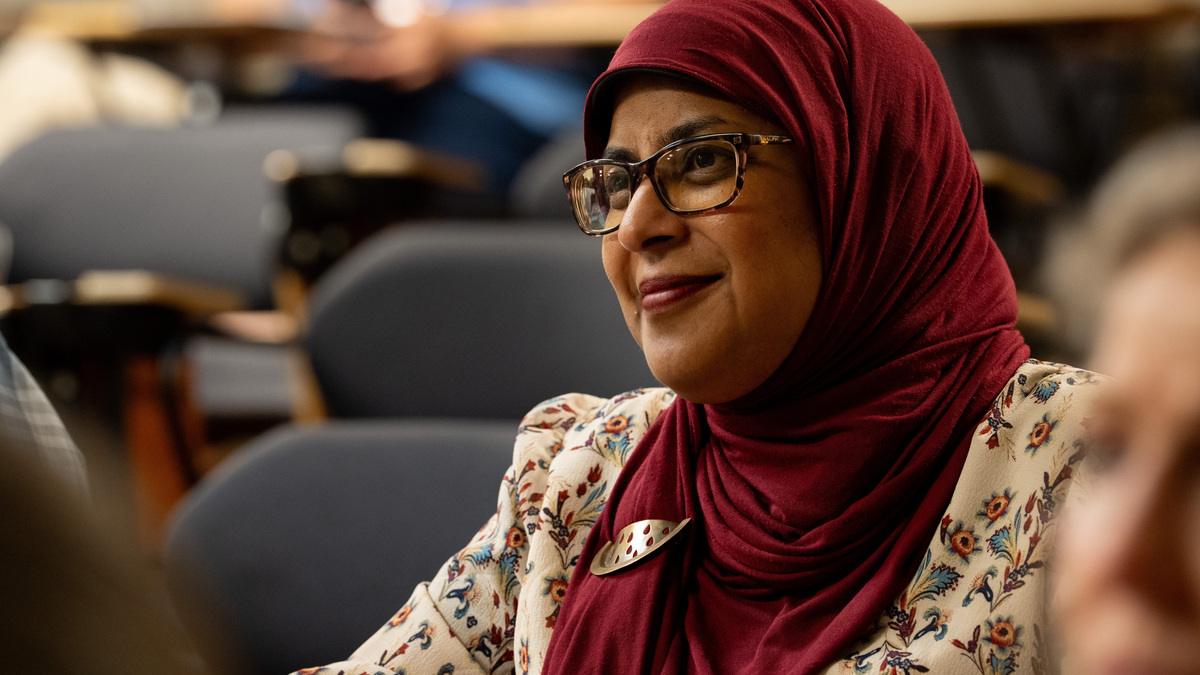
“Being Muslim doesn’t make me less American,” Salam Jabaieh, a Muslim woman from Arizona, said. “Those things are part of who I am, and I shouldn’t have to make myself less visible or less Muslim in order to prove I belong here.”
Hate crimes, anti-Muslim rhetoric after attacks
In the days after 9/11, then-President George W. Bush made public statements defending Islam and differentiating the faith from the attack.
He quoted from the Quran and said “Islam is peace” during remarks at the Islamic Center of Washington, DC. Bush also met with Islamic leaders, including Nihad Awad, national executive director and co-founder of the Council on American-Islamic Relations. CAIR was established in 1994 and is the country’s largest Muslim civil liberties organization.
Though Awad disagreed with many of Bush’s policy positions, he told USA TODAY he saw “sincerity” and “openness” from Bush, a desire for unity amid the devastation.
But the violence that plagued Muslims and mosques in the days and years after 9/11 stood in stark contrast to those sentiments.
The first 9/11-linked hate crime came just a few days later, when an Arizona man murdered Balbir Singh Sodhi, a Sikh man who wore a turban the shooter interpreted as a sign he adhered to Islam. Muslims were killed in attacks that family members and advocacy groups tied to the spike in Islamophobia. A number of mosques were also burned to the ground or severely damaged in arson fires.
But Muslim leaders described a notable shift when President Donald Trump launched his presidential campaign in 2015. He initiated what became known as the “Muslim ban” during his first term and has taken similar action since returning to office.
Federal authorities have arrested and sought to deport pro-Palestinian activists, actions that judges have deemed a First Amendment violation.
Some Republican leaders also have used rhetoric and pushed policies that have come under criticism by Muslim Americans and others. Texas Gov. Greg Abbott designated CAIR a terrorist group in 2025, which initially excluded a number of Islamic schools from a state-sponsored voucher program because of perceived affiliation with the organization, according to a lawsuit. Florida Gov. Ron DeSantis also issued the designation, which a federal judge struck down in March.
Such action by governors has had a trickle-down effect on local municipalities and school boards, according to Adam Abutaa, of the Muslim civic engagement organization Emgage Florida. Muslim students are less likely to feel they can freely express themselves on their campuses or to their elected officials, he said.
Saajid Khan, a 21-year-old University of South Florida student, echoed those sentiments. He was one of several students who were praying in a parking garage on campus in November 2025 when several men disrupted them, shouting profanities and taunting them with bacon − a forbidden food in Islam. The men were later charged over the incident.
“I think there’s a lot of propaganda pushed against Muslims, which leads to an unsafe environment,” Khan said.
Abutaa fears that won’t change anytime soon.
“We’re going to see, at least unfortunately the way the waves are going, more anti-Muslim rhetoric than ever before,” Abutaa said. “It’ll probably be worse than post-9/11, especially with the demonization of Muslims in America being the new McCarthyism.”
Islamic centers boost security
Religious centers nationwide have boosted security in recent years, but mosques in particular have been on high alert – especially since teenage shooters killed three men at a San Diego mosque in May.
Read more We Compared the 2026 Chevrolet Trailblazer vs. Kia Seltos: One Is Worth Paying More For
Rashed Fakhruddin, president of the Islamic Center of Nashville’s board of trustees, said it is important to work to combat anti-Muslim attacks.
“We want to make sure people know us for who we are, and not by the narrative based on what others are painting us as,” Fakhruddin said. “Combating Islamophobia has been really a big mission of what I try to do here.”
Fight over religious practices and the First Amendment
A fight for the right to wear a hijab in a booking photograph has also come to the forefront. There have been at least seven lawsuits over the matter since 2024, according to Religion News Service.
Among them is a complaint by four Muslim women in Arizona who sued multiple police departments and Arizona State University after male officers removed their hijabs while arresting them at pro-Palestinian campus protests in 2024.
The women alleged the officers violated their First Amendment rights by denying their request for religious accommodations, such as removing their hijabs only in front of female officers. An Arizona district court judge dismissed several of their claims, though one against the Maricopa County Sheriff’s Office remains.
Jabaieh was one of those women, telling the USA TODAY Network she was in jail for 26 hours without the covering she’d worn since she was in high school.
“You wouldn’t want somebody to take off your shirt,” Jabaieh said. “I felt stripped, and I felt exposed. I felt scared. I felt humiliated. I felt small.”
She called wearing the hijab “something that was deeply personal between me and my religion that was taken out of my control.”
The incident echoed other interactions she’s had throughout her life related to her faith, including a man asking her as a teenager whether she was married.
“I was like, ‘Oh, no sir, I’m 15,'” Jabaieh recalled telling him. “He was like, ‘Yeah, but your people do that, right? Like Muslims, y’all get married at six, eight, nine?'”
David Chami, Jabaieh’s attorney working with CAIR in both Phoenix and Dearborn, Michigan, said it’s those stereotypes and resulting fears of discrimination that have prompted some in his family to avoid giving their children traditionally Islamic names. For his own children born in the decade after 9/11, however, he intentionally did so.
“In my view, it was important to make sure when people met them – and because I expected my children would have a positive influence on the people that they met – that they would be impressive individuals, that they would be positive role models,” he said.
At the end of the day, Chami said he believes a “significant majority of people in this country are good people.”
“Some of the people who don’t like us are just really misinformed, and their perspective changes when they actually meet Muslims,” he said.
Challenges lead to civic engagment
Despite the challenges for American Muslims, there are “silver linings in what’s been a pretty dark cloud for the last 25 years,” according to Arsalan Iftikhar, a human rights lawyer and author of books including “Fear of a Muslim Planet: Global Islamophobia in the New World Order.”
He referenced the steep rise in Muslims’ civic engagement and political representation as an example. There were a record-breaking 255 Muslim elected officials serving across 26 states in 2026, according to data CAIR published in August. Among them is Zohran Mamdani, who took office as New York City’s first Muslim mayor in January.
Mohyuddin, too, has gotten involved.
She and other Muslim leaders in Tennessee organized protests and pushback to a 2011 state bill that initially sought to make it a felony to follow Sharia law. The bill was rewritten as a provision allowing the governor to determine that a group provided “material support” to terrorists – without providing evidence to the public – and passed.
Shortly after, she became a founding board member of the American Muslim Advisory Council and now serves as its executive director. The Nashville-based organization challenges Islamophobic legislation and works to combat Muslim stereotypes.
“In hard times, what gives me hope is seeing more of the community willing to exert their rights, and willing to organize and speak up,” she said. “Even despite all of the attempts to silence us.”
The reporters’ roles covering First Amendment issues at the USA TODAY Network is made possible by a collaboration among Freedom Forum, Journalism Funding Partners and the USA TODAY Network. Freedom Forum does not provide editorial input.
This article originally appeared on USA TODAY: 25 years after 9/11, many Muslims fear a new backlash
Reporting by BrieAnna J. Frank, Cate Charron, Angele Latham, Stephany Matat and Taylor Seely, USA TODAY NETWORK / USA TODAY
Read more Bewildering new tech rules face students across US
USA TODAY Network via Reuters Connect
Copyright Reuters or USA Today Network via Reuters Connect
This story was originally published September 6, 2026 at 6:03 AM.










Post Comment