Cuba will release artist and political prisoner Otero Alcántara to exile in Miami
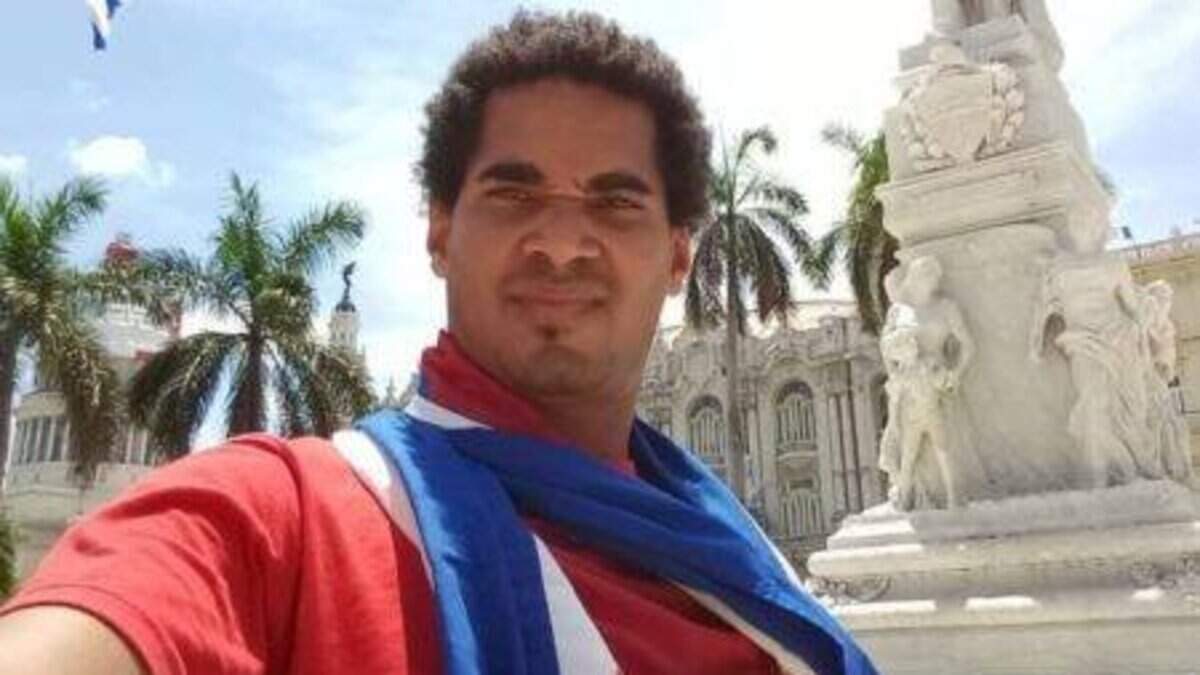
Prominent Cuban dissident-artist Luis Manuel Otero Alcántara is expected to arrive in Miami on Saturday after serving a five-year sentence that turned him into one of the most recognized symbols of the island’s crackdown on independent artists and government critics.
Read more Miami-Dade commissioner’s PAC got $38K in World Cup tix from county tourism bureau
Cuba has recently exiled other prominent dissidents, most recently José Daniel Ferrer, who have been forced to abandon the island for the United States. But unlike Ferrer, who was still serving a prison sentence when he was sent to Miami late last year, Otero Alcántara, 38, had served his sentence but had been held almost incommunicado for more than a week in an undisclosed location by state security agents and pressured to leave Cuba.
Last week relatives and activists said the artist had been moved from a maximum security prison in Guanajay, in the province of Artemisa, to an unknown location. Several organizations, including Freedom House, Artists at Risk Connection, Civil Rights Defenders, PEN International and PEN Cuban Writers in Exile Centre, called on Cuban authorities to immediately release him.
Anamely Ramos, an activist and academic close to the visual artist who lives in Chicago, told the Miami Herald she and others had requested a humanitarian parole on his behalf weeks before his expected release. On Friday, an official at the U.S. Embassy in Havana said his parole had been approved, and the embassy was facilitating his exit.
Earlier on Friday, Ramos announced the approval after what she said was a long and difficult process, but she cautioned that he was still not free.
“Luis Manuel remains missing and in the hands of state security; until that changes, we cannot say how or when he will arrive in Miami, because it is not in our hands,” she said.
On Thursday last week, Ramos said she was able to talk to Otero Alcántara on a phone with an unknown number linked to the state security agency and talked on speaker. In a post on Facebook, she said Otero Alcántara told her he didn’t know where he was.
“Luis Manuel’s parole process is still under way,” she said. “He will remain in that unknown location until the matter is resolved. Luis’s friends are doing everything within our power. The Cuban regime wants him out.”
Otero Alcántara has been imprisoned since July 2021, when he was detained after he said on a social media platform he was going to join the historic anti-government protests of July 11 — the largest demonstrations Cuba had seen in decades. He was convicted the following year on charges of contempt, insult to national symbols and public disorder, in a case widely criticized by international human rights groups as retaliation for his activism.
Read more Johnny Brown, father of Supreme Court justice Ketanji Brown Jackson, dies at 80
The Cuban government had rejected several petitions for his release from U.S. administrations, the Vatican and other foreign governments.
Amnesty International had designated Otero Alcántara a prisoner of conscience, and his case became a rallying point for U.S. lawmakers and human-rights organizations pressuring Havana over its treatment of dissidents. He was named one of the most influential persons in 2021 by Time Magazine and received the National Endowment for Democracy’s 2026 Democracy Award, the Rafto Human Rights Prize, and the Václav Havel Prize for Creative Dissent.
The visual artist staged several hunger strikes while in prison to protest his detention. More recently, the New York Times published a letter he wrote in prison, revealing his anguish about his uncertain release.
“In my darker or more uncertain moments, I try to remember that my survival and my ongoing work as an artist are symbols of hope and sacrifice for other Cubans,” he wrote. “I think of it as trading my time, as if every day I spend in prison wasn’t a day wasted, but another day trying to make my country freer and more just. Like another of my performance pieces — but one that should have ended long ago.”
Otero Alcántara had irked Cuban authorities long ago, as he became the leader of a generation of young artists protesting the lack of liberties on the island.
In March 2020, he was jailed after using the Cuban flag in a street performance, a case that drew attention to Decree 349, which legalized censorship and required artists to obtain government approval before staging exhibitions or performances. The decree became the target of years of opposition from Otero Alcántara and fellow members of the San Isidro Movement, the artist collective he helped lead.
His profile grew after a November 2020 standoff at the San Isidro Movement’s headquarters, when he and other activists staged a hunger strike that drew a police raid and inspired an unprecedented public protest by artists in Havana. At the time, Otero Alcántara told the Herald that he felt “like a piece of paper” at the mercy of the Cuban government.
Months later, in early 2022, while already imprisoned, he again went on hunger strike — a protest that renewed global attention to his case and to the broader question of political prisoners on the island.
Read more Broward man indicted on murder charges after stabbing 3 people, cops say
This story was originally published July 17, 2026 at 5:35 PM.







Post Comment