As data center backlash grows in Florida, here’s why Miami projects are different
The potential spread of massive water and electricity-consuming data centers into Florida has sparked fierce opposition from thousands of residents and drawn dividing lines between its most powerful politicians.
Read more Federal judge demands evidence showing Alligator Alcatraz is closed for good
But, experts say, the projects popping up in Miami-Dade are unlike those that grab headlines for fouling drinking water and driving up power bills — for now.
The best example yet of Florida’s pushback against the spread of data centers may have been Thursday’s Palm Beach County Commission meeting, where officials gave a firm no to a proposed project called “Project Tango” that would have placed a data center using as much electricity as the city of Tallahassee right next to the Everglades.
Project Tango is now the fifth large data center project stopped by Floridians, including Sentinel Grove in St. Lucie, Silver Fox in Martin County, Deltona in Citrus County and Okee-One in Okeechobee.
Several counties have also issued moratoriums for data centers — Leon County, Nassau County, Pasco County, Sarasota County, Citrus County and Jackson County. In Citrus County, where a small town was slated to play host to Florida’s first hyperscale data center, opponents of the project packed the commission and exceeded its overflow room, the Tampa Bay Times reported. The project was canceled.
The difference between those projects and the 27 data centers that already exist or are being built in Miami-Dade (including three newcomers that have drawn controversy) is the size.
‘Hyperscale’
Data centers have been around the years with little controversy. They are where companies bunch computers together for tasks like hosting data on the cloud. But with the rise of Artificial Intelligence and the immense computing load it needs to run have come “hyperscale” data centers.
These much larger centers have begun sprouting up across the nation and making headlines for sucking up communities’ water, spiking power bills and causing other environmental issues.
By contrast, the three data centers coming to Miami-Dade are much smaller, requiring less energy to keep the computers humming all day and less water to circulate and keep the computers cool.
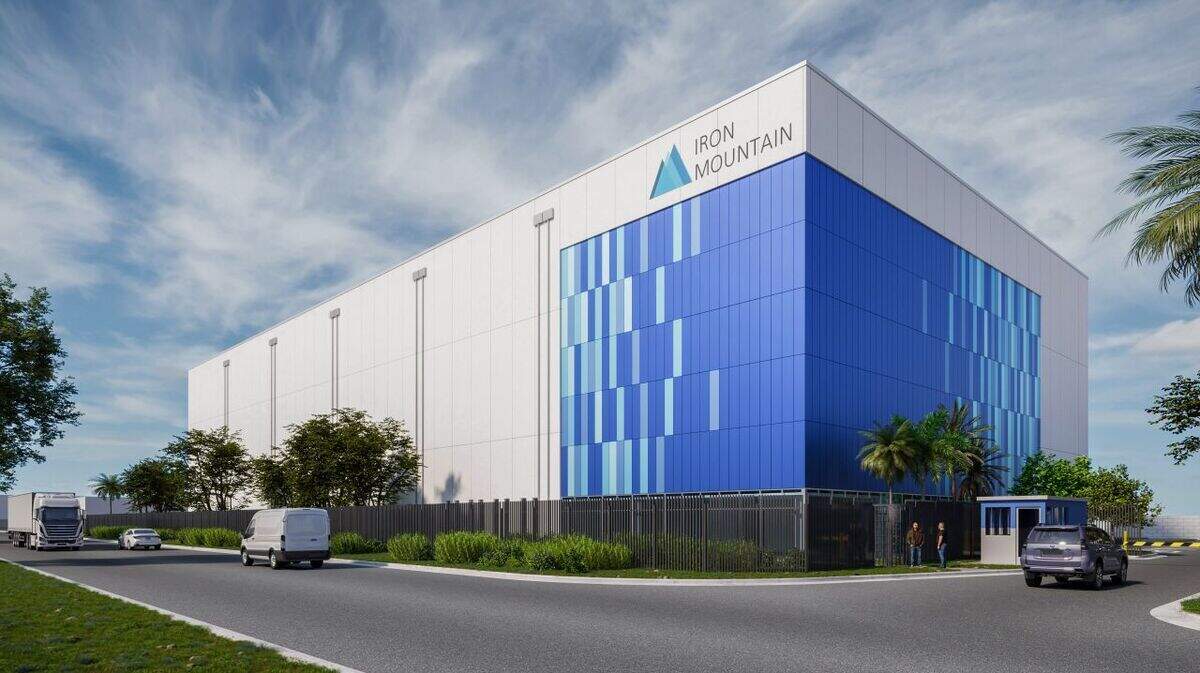
The newest data centers under construction in Miami-Dade are a project by firm Metroblocks on the edge of the Everglades, ReadySetFundGrow’s “Fishbowl,” a one story micro-datacenter in Homestead, and a project by Iron Mountain in Northeast Miami-Dade.
That gives the three imminent data centers in Miami-Dade a tinier footprint than the headline makers elsewhere in the state, said Margaret Cook, vice president of water and community resilience at the Houston Advanced Research Center.
On the high end, she estimated that the three data centers combined would use less than 0.2% of Miami’s total drinkable water. On the lowest end, the centers would use 0.05% of the water.
“If you weren’t going to be worried about three new apartment buildings or, let’s say, 30 new office buildings, then small data centers probably wouldn’t be a worry,” Cook said.
Large data centers also use a lot of electricity, which can destabilize the power grid and lead to outages, said Rachel Mural, a senior research associate at the Harvard Kennedy School. Across the nation, some communities have had more blackouts after large data centers move in, and higher power bills as utilities have to build more infrastructure to support them.
“For the average consumer… you want to know that, when you turn on your light, you’re going to get electricity,” Mural said. But she doesn’t think that will be a big issue in the neighborhoods near the planned Miami-Dade projects. Similarly to water use concerns, these smaller projects would likely use less electricity and cause fewer impacts on neighbors, she said.
However, Mural warned, individual small data centers might not interrupt the flow of electricity much, but a cluster of them could.
“Because of how data centers use power, they might be increasing or decreasing their usage over really, really short time frames, like milliseconds,” said Mural. “That really does introduce challenges for grid operators when you have all these data centers doing this at the same time, and these can actually lead to power interruptions. It can degrade the actual grid hardware… so on a local level, those are very real concerns.”
A lack of transparency
But finding out the specific details of how one of these centers will affect a neighborhood is not easy.
Read more This Miami health system could go out-of-network with United. What it means for you
Iron Mountain, a new data center under construction in the predominantly Black neighborhood of Westview, took residents by surprise. Many of their questions about the potential local impacts of the project remain unanswered.
READ MORE: ‘Hiding in plain sight’: An AI-ready data center is coming to a Miami neighborhood
Christine Reichert, a senior attorney for environmental nonprofit Earthjustice, has been aiding residents across the state in their campaigns against hyperscale data centers in their backyard. Time and time again, she said, she sees developers that fail to release important information about the projects.
“They’re not saying clearly what they’re going to use for their cooling systems. Sometimes they’re not even disclosing how much power their facility is going to require,” she said. “And without that information, the community is not able to assess how that particular data center is going to impact them.”
In the case of Project Tango, she said, developers originally asked permission to build a server farm there instead and then changed to an AI-ready data center. She worries that locals could lose the opportunity to weigh in on a potential data center without broader transparency.
In the case of Iron Mountain, no residential properties were informed of the imminent data center because the property was already zoned for industrial use, and in Miami-Dade data centers are considered “telecommunications hubs” that require no new permissions to build.
“It’s really essential that the local governments have the information they need before they approve any of these projects,” Reichert said.
READ MORE: More AI data centers are coming to South Florida. Could one open near you?
State flashpoint
AI data centers have been a political flashpoint in Florida, pitting AI-cautionary Gov. Ron DeSantis against leading Republican contender for the Governor’s race Byron Donalds — and the White House. Donalds has said that Florida should vie for data center investment, albeit with guardrails to protect the environment.
Another Republican gubernatorial candidate, former House Speaker Paul Renner, vowed to call a special session to halt approval of hyperscale data centers.
DeSantis pushed for a strict law this year that would have reined in data centers and made their operations much more transparent, but he ended up signing into law a version that was watered down by legislators. Florida Politics reported that the White House approved of the amendment to weaken the bill.
What remained in the bill was a provision that data centers pick up the tab for their own electricity bill, not ratepayers. The move was publicly supported by politically influential utility Florida Power and Light, whose president, Scott Bores, called it “another great example of Florida getting things right.”
In a statement reacting to the bill, Bores said that having more large-scale power users like data centers boosts utility profits, which he suggested could eventually help lower rates for everyday Floridians.
The new law also now requires any presumptive large-scale data center to receive a public hearing from its local water management district before the district can issue a water use permit.
“In addition, any application must provide a water conservation plan,” South Florida Water Management District spokesman Jason Schultz wrote in an email.
The law also added a requirement that heavy water users (over 100,000 gallons a day) must use reclaimed water, or water that has been used and cleaned, to offset their use of fresh, drinkable water. However, the wording says that companies only have to follow this if it’s “environmentally, economically, and technically feasible,” without setting up any specific definition of feasible.
Notably, the state law only applies to data centers of a certain size. All three of the upcoming projects in Miami-Dade are small enough that the law doesn’t apply.
Read more Federal judge demands evidence showing Alligator Alcatraz is closed for good









Post Comment