Shark diving tourism off Florida coast could nose dive if feeding ban passes
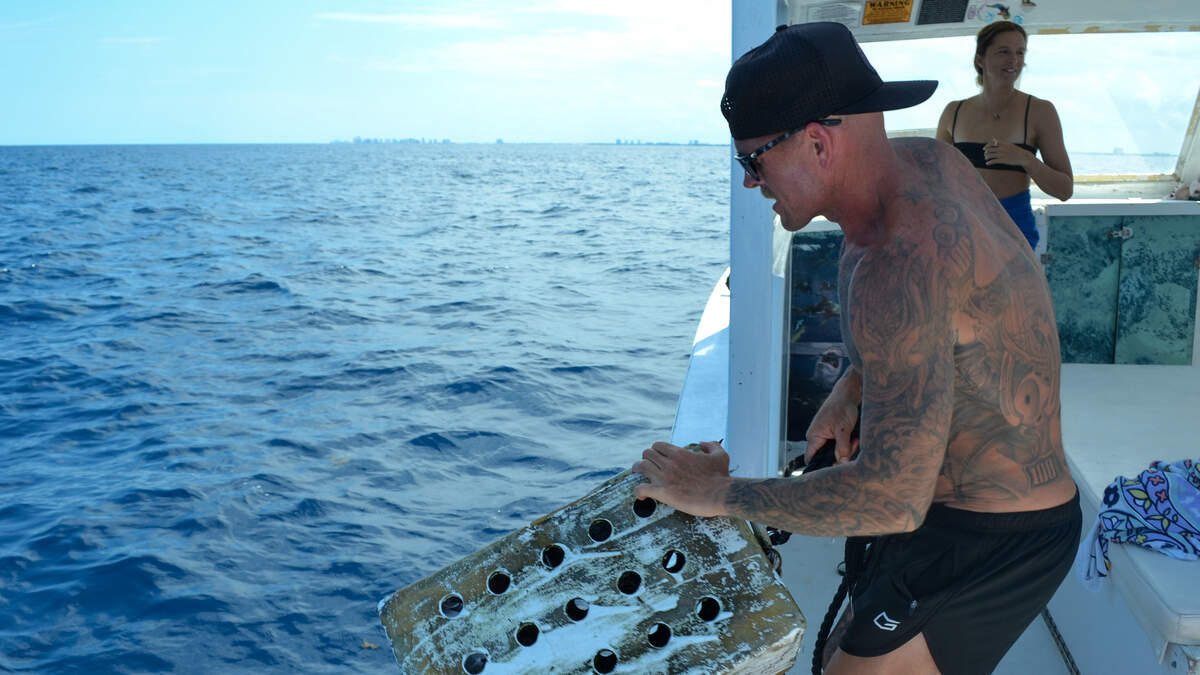
With a splash, the bloody fish chunks in Johnny Matthews’ white, rusty crate sink into the royal blue waters offshore of Jupiter.
Read more A Miami connection will be on the feet of a soccer star during Argentina match
It’s not long before several light gray figures materialize from the depths, their triangular fins slicing through the surface. Matthews gives the signal and his charter boat load of tourists equipped with snorkel gear and fins jump into the ocean, ready to get up close and personal with what they paid to see: sharks.
But the days of chumming to attract the marine animals could be coming to an end off Florida’s coast.
Matthews works for Florida Shark Diving, one of several shark charter companies in southeast Florida that promise up-close encounters with some of the state’s apex predators. A new bill, he said, could put him and other shark diving businesses out of work entirely.
“We’re going seven miles offshore and putting bait in the water. What is the difference?” Matthews said, adding that fishermen do the same thing to harvest sharks or attract fish. “One is where they’re harvesting something, and one is showing people something, educating them.”
Current federal law, passed in 2001, says anyone wishing to introduce food or other substances into the water to attract sharks must go beyond state waters, deemed as the first three nautical miles offshore in the Atlantic Ocean and nine nautical miles in the Gulf.
The Florida Safe Seas Act, introduced by Rep. Daniel Webster (R-Fla.) last June, seeks to extend that rule to the waters beyond — also called federal waters — essentially banning shark feeding for any purpose other than actually catching sharks.
It passed the U.S. House of Representatives in June and will now head to the Senate for a vote. If passed, it would include exceptions for government-funded research programs.
Shark education, Matthews said, is necessary to show tourists that sharks aren’t the man-eating killers we see in movies.
But without an ability to feed sharks by dropping chum, a combination of cut-up fish and bait, he fears these learning opportunities could soon become a thing of the past.
Safety and depredation
While dive charters worry they could lose their livelihood, representatives say the bill, which has bipartisan support from Rep. Darren Soto (D-Fla.), isn’t meant to target companies like Matthews’ and put them out of business; it’s to keep swimmers safe.
“The Florida Safe Seas Act does not prohibit shark diving, shark conservation or education,” said Adam Pakledinaz, a spokesperson for Rep. Daniel Webster. “It simply prohibits the feeding of sharks in federal waters, just as the state of Florida has done in state waters for more than two decades.”
Shannon Knowles, communications director for Florida Fish and Wildlife Commission, said the bill is a matter of human safety.
Florida also prohibits feeding wildlife like alligators, manatees or bears, based on research showing it can alter natural feeding behavior.
This bill, she said, would be an extension of those rules in order to protect both the animal and people observing it. Federal law already prohibits shark feeding in federal waters in Hawaii and several U.S. Pacific territories.
“H.R. 3831 would allow divers to continue to observe sharks in their natural environment, but they could not feed them when diving or when divers are in the water,” Knowles said in a written statement to the Miami Herald.
Read more A former ‘RHOM’ star as been engaged for years. There’s a big update
Other advocates hope it will go one step further than safety and address the state’s ever-growing depredation issue — a sore topic in the fishing community.
Depredation occurs when a shark steals an angler’s catch off their line, and Florida’s fishers are tired of it.
Mike Leonard of the American Sportfishing Association, one of the bill’s main supporters, said in some coastal areas in Florida, it is almost impossible for an angler to pull their catch out of the water before a shark swims up and takes it.
While multiple factors play into the depredation issue, including a higher number of anglers on the water and an increase in the shark population, as more sharks are protected from harvesting, Leonard said dive charters throwing food off their boats to attract sharks doesn’t help the problem, either.
“It kind of creates that Pavlov’s dog scenario,” he said. “The sharks begin to associate boats with free food.”
‘Picking sides’
Dean Grubbs, associate director of research at Florida State University’s Coastal and Marine Laboratory, said the representatives are misframing the bill, not to keep the state’s seas safer, but to pick sides amid an ongoing battle between divers and anglers.
“There’s always been this sort of battle between the fishing industry — particularly recreational fishing — and the shark dive industry,” he said. “It seems that this bill is just picking sides and doing what the fishing industry wants. I don’t think it’ll have any of the desired effect.”
The real impact, Grubbs said, will be to the pocketbooks of shark diving businesses along the coasts and the surrounding communities.
While about a dozen businesses offer in-water shark diving experiences off Palm Beach County, shark ecotourism operations extend all the way to the Florida Keys with groups spending hundreds of dollars for a chance to see — or swim — with the animals.
, an international advocacy group, conducted a 2017 study on the economic impact of shark diving in Florida, citing more than 200 responding shark-diving companies. It said people spend over $100 million on shark-related diving and the industry provided 3,800 full-time jobs. But with the study being almost a decade old, it’s hard to determine the true fiscal impact of the industry.
Regardless, divers and employees are still concerned.
Jordan Lempke, another employee of Florida Shark Diving, said the industry provides more than just thousands of dollars in revenue for the area — between the excursion prices, hotels and Ubers taken by customers — but work, for her and her fellow divers.
“It’s not only our livelihoods that we’re worried about, it’s the shark’s future, and I feel like we really do so much for education and research and all of that work could be out the window,” she said. “It’s kind of a double whammy.”
Lempke has swum with sharks all over the world, including in the Bahamas and Hawaii. She said law or no law, tourists will always seek that kind of experience.
Whether they come to Florida to do so is up to the U.S. Senate.
“The demand to see sharks is not going to go away,” she said. “It’s simply going to shift to other countries, like the Bahamas. We’re going to lose a major tourism income stream in the U.S.”
Read more On the prowl for invasive pythons, researchers are interrupting snake orgies









Post Comment