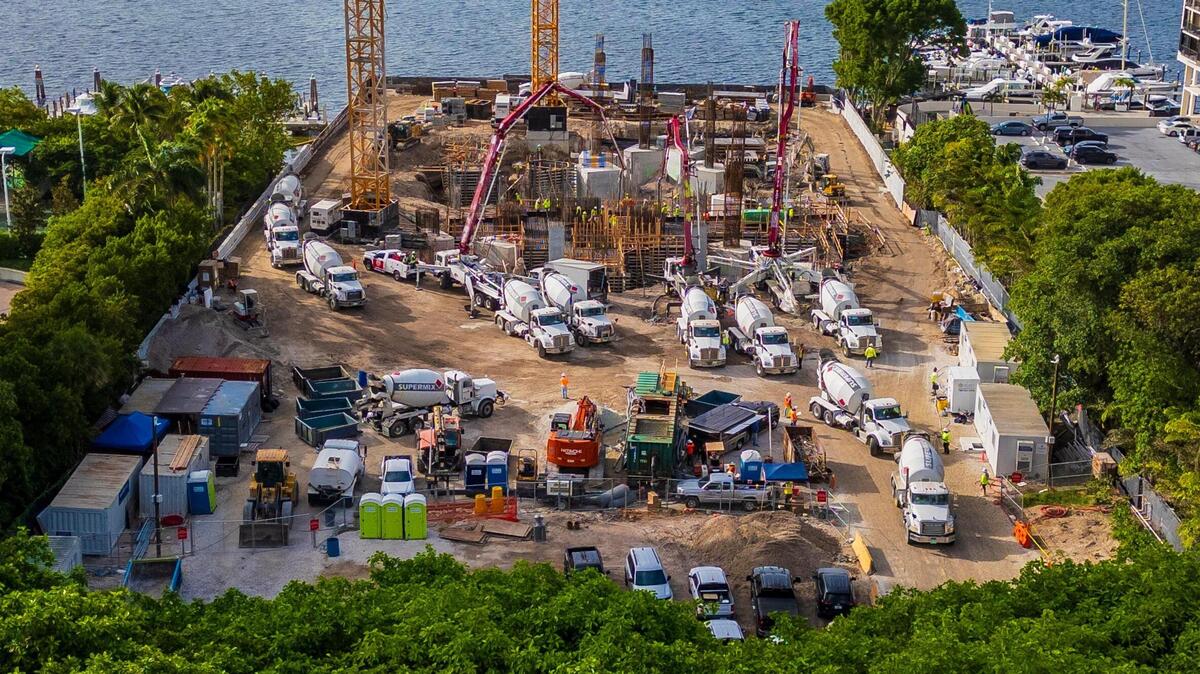
Miami construction projects keep turning up ancient bones. What happens to them?
Decades ago, the looters, builders and early archaeologists who cavalierly dug up the ancient remains of indigenous people from burial mounds and prehistoric cemeteries scattered throughout Miami-Dade County thought little of it: Bones and skulls were cast out, lost, brought home as souvenirs, or shipped off for display and ostensible study to museums like the Smithsonian in Washington, D.C.
Read more Miami’s forgotten ancient past is hiding beneath a Joe & the Juice. Yes, really
That, for the most part, doesn’t happen anymore.
But as redevelopment in and around downtown Miami and Brickell proceeds at a fast pace, new and substantial indigenous burial and cemetery sites are coming to light. The fraught subject of the proper disposition of those human remains has taken on a new sensitivity — both for the prehistoric people’s Native American successors in Florida, and for the archaeologists and developers encountering them.
“In downtown Miami, you will be hard-pressed to find an acre that doesn’t have a rich archaeological history, that doesn’t have some evidence of humans, including burials,” said Tina Osceola, historic preservation officer and executive director of operations for the Seminole Tribe of Florida. “They were not buried to be excavated.”
FULL STORY: Miami’s forgotten ancient past is hiding beneath a Joe & the Juice. Yes, really
The discovery of indigenous human remains, typically the result of archaeological investigations mandated by Miami-Dade County and city of Miami regulations before construction can happen in certain designated zones, triggers a complex process under state law.
To some independent Native American activists, indigenous burial sites are sacred and should not be excavated or touched in any way.
But the state’s process, overseen by the state historic preservation office and a panel of representatives of Florida’s officially recognized Native American tribes, including the Seminole and Miccosukee, seeks to balance respect for the dead and tribal traditions with the pragmatic realities of private property and development.
The preferred option is to leave remains untouched and in place, said veteran South Florida archaeologist Bob Carr, who has handled numerous significant excavations in the region. But that’s often not possible, especially if planned construction would destroy the remains.
The next-best option is moving the remains somewhere on the same property or, if that’s not feasible, to a site as close as possible to the original location, Carr and Osceola said. No samples are taken or DNA studies conducted, Carr noted.
“It’s a balance for the tribe. We’re very respectful of private property. We work very hard to maintain communication,” Osceola said, referring to discussions with property owners and their archaeological teams over decisions on where to rebury remains. “We want them returned to an area as close as possible. They need to be safe and secure. We want some semblance of integrity for them.”
READ MORE: How the Miami Circle, a 2,000-year-old site in Brickell, was found and saved
Where precisely the newly uncovered dead ultimately come to rest is strictly confidential under state law to prevent vandalism or grave-robbing, a matter of real concern. That means no markers or memorialization on maps.
But it’s acceptable to place historic markers and allow viewing at sites such as burial mounds or places of indigenous habitation where no substantial remains are known to lie, Osceola said.
Read more Mother searches for missing son the U.S. deported to Venezuela shortly before earthquakes
Who should decide what happens to ancient human remains?
In some recent instances, though, changing guidance from federal and state preservation officials, in part in response to the wishes of the Florida tribes, has led to questions over how much the public deserves to know about newly confirmed indigenous burial sites in Miami.
Last year, when the city of Miami released Carr’s report on the latest finds in a newly excavated Late Archaic site in Brickell that included a cemetery, it initially blacked out all references to burials at the request of the state historic resources division, although there is no exemption in Florida’s public records law for that. The city released the full report after the Miami Herald, which published a story on the discoveries, challenged the redactions.
Osceola and the Seminoles have also been working on a comprehensive effort and a campaign called “No More Stolen Ancestors” to repatriate the remains of people indigenous to the Southeastern United States that were taken to museums and other institutions for reburial at their places of origin, along with any funerary objects that had been buried with them.
“You have centuries of grave robbing,” Osceola said. “These collections are all over the world. We are dedicated to bringing them back home.”
Though a federal law requiring return, the Native American Graves Protection and Repatriation Act, has been in effect since 1990, institutions and government have been slow to comply and enforce it, Osceola and Seminole tribe archaeologist and director of environmental protection Paul Backhouse say.
The Seminoles say some institutions have refused to comply, sometimes arguing that remains they hold are unrelated to the tribe — distinctions that Backhouse and Osceola say are outdated, often arbitrary and belied by growing evidence of common ancestries among Native American peoples. Some institutions don’t have the resources to undertake the process of identifying and relocating the remains, they noted.
Some archaeologists continue to object to repatriation, arguing that study of indigenous human remains is appropriate. But the tide of opinion among experts is changing.
“The people who are their descendants see them as relatives, not as relics,” said Florida State University historian Andrew Frank, author of “Before the Pioneers,” a book on the indigenous and pre-modern history of Miami. “The decision of what to do with those materials should be up to those who have emotional connections to them, not just intellectual connections. People should be allowed to rest in peace.”
The Seminoles helped successfully push policy changes at the Smithsonian Institution and its National Museum of Natural History that have made it easier for tribes to reclaim the remains of thousands of individuals and cultural or sacred objects. Substantial skeletal remains excavated in the 1930s from Tequesta Indian sites in Surfside by a Smithsonian-sponsored archaeologist are known to have been taken to Washington.
“It has allowed the tribe to really right the wrongs that are centuries old,” Backhouse said. “A lot of ancestors who are sitting on these shelves predate 1492. The common person drives by a cemetery and doesn’t think, ‘Let’s dig that up.’ That’s not the case when it comes to indigenous people.
“It’s so inspiring to see the Seminole Tribe stand up and do that work. It’s hard work. It matters.”
Read more Grand jury charges Florida Keys man with murder in beating death of his wife






Post Comment