What’s next for South Floridian Haitians with TPS after Supreme Court ruling?
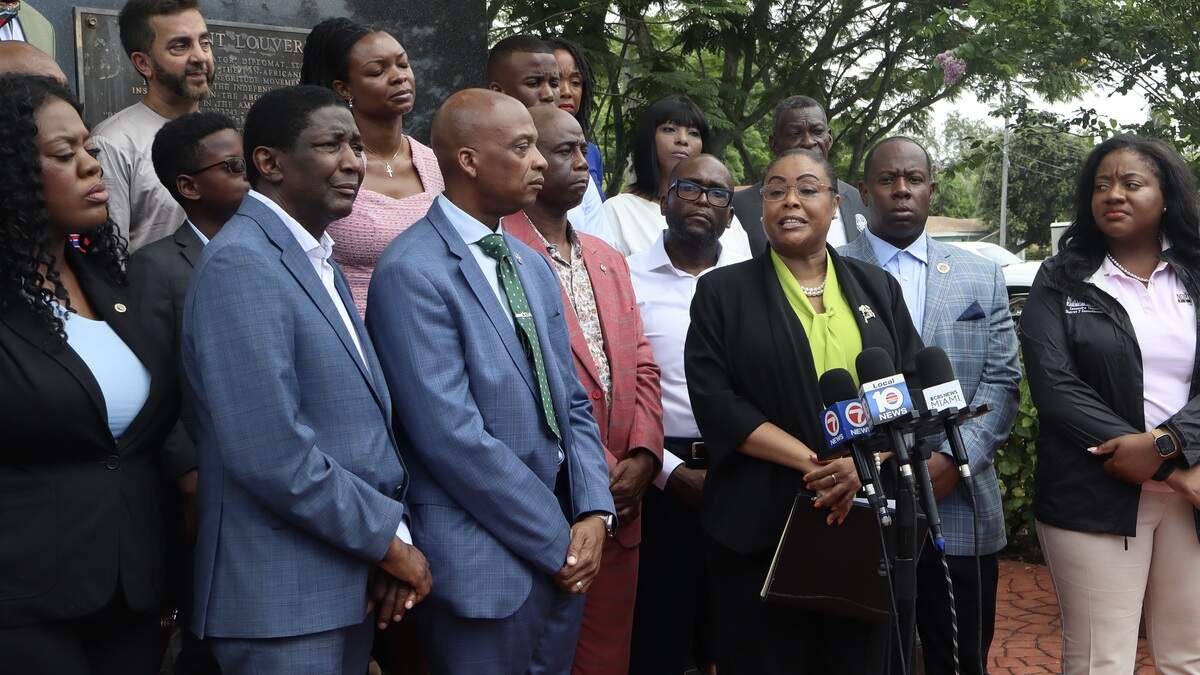
Less than 24 hours after the U.S. Supreme Court allowed the Trump administration to move forward with ending Temporary Protected Status for Haiti, Haitian immigrants, advocates and elected officials gathered Friday in Little Haiti warning the decision will strip families of legal protections, work authorization and a safe place to live.
Read more Colombia fans back in Miami after gate crashing. Has stadium security changed?
The Family Action Network Movement, a longtime social justice group, organized the press conference in front of a statue of Haitian independence leader Toussaint Louverture on North Miami Avenue, where speakers called on Congress to pass long-term protections for Haitians with TPS, a federal program that grants deportation protections and work permits to people from countries in turmoil.
The ruling, issued Thursday in a consolidated case involving TPS protections for Haiti and Syria, clears the way for the administration to end deportation protections and work permits for more than 350,000 Haitians and thousands of Syrians living in the United States. Haitians in South Florida are reeling with uncertainty about what the future will look like for them without the protections and vulnerable to being forced to return to a country with gang violence, widespread hunger and political instability.
Miami-Dade Mayor Daniella Levine Cava said the consequences of ending TPS would be felt across the county, which she said is home to the largest Haitian community in the country. She estimated that the ruling could affect 160,000 people in Miami-Dade.
Business owners, health care workers, teachers and people in other professions who have paid taxes and lived for years in South Florida are among those at risk.
“We all will suffer as they suffer,” Levine Cava said.
The mayor said sending Haitian TPS holders back to Haiti would be irresponsible because of the country’s worsening security crisis, including rampant kidnappings and extreme gang violence. She said the next immediate step is pressuring the U.S. Senate to support an extension of TPS. Democratic Senators introduced legislation last week to designate Haiti for TPS after House Democrats with Republican support succeed in March in passing the legislation. The legislation offers three years of legal protections to Haitians. If passed though it could still be vetoed by President Donald Trump.
“There’s still a chance that the Senate could vote to support the extension of TPS,” Levine Cava said.
Haiti was first designated for TPS in 2010 after a devastating earthquake. The Biden administration expanded the protections following the assassination of President Jovenel Moïse and another devastating earthquake. The humanitarian program allows people from countries facing unsafe conditions, including war, natural disasters or extraordinary crises, to live and work legally in the United States for a temporary period.
Farah Larrieux, a Haitian TPS recipient since 2010, said the ruling has left many immigrants afraid of being forced back to a country where they could be harmed or targeted.
“If they send me back to Haiti, it’s a death sentence,” Larrieux said. “This is more than just a TPS issue. This is a human rights issue.”
Larrieux, who came to the U.S. in 2005, said the issue is broader than deportation protections. Many immigrants, she said, are not undocumented by choice, but because they are stuck in a broken immigration system with few realistic paths to permanent residency.
TPS holders are often reduced to political talking points, even though recipients undergo background checks and include workers, parents, business owners and neighbors whose lives are rooted in the United States, she said.
Larrieux also argued that the United States bears responsibility for some of the conditions that have made Haiti unsafe, pointing to decades of U.S. involvement in Haitian politics and the flow of weapons from the United States into Haiti.
Read more She broke up with her boyfriend and survived being stabbed 34 times: Miami cops
“They know the problem,” Larrieux said. “What has the federal government done to tackle the gun trafficking that comes from the United States?”
For Larrieux, that makes the push to deport Haitian TPS holders especially painful. She said the Haitian diaspora could help support relatives, advocate for better U.S. policy toward Haiti and play a role in rebuilding the country, but losing legal status would weaken that voice.
“We, the diaspora, can play a big role,” she said.
Larrieux said many TPS holders are now trying to figure out what comes next. She plans to apply for asylum, but said she fears that may not be enough to protect her under the current administration.
“I can still be targeted,” she said. “Today it’s the Haitians. Tomorrow it will be the Americans.”
Steve Forester from the nonprofit Institute for Justice and Democracy in Haiti pushed back against the argument that TPS for Haiti should end because the program has lasted too long. TPS has ended for eighteen designations, including nine before Trump took office, he said.
“The idea that TPS is never temporary, it’s just a talking point,” Forester said.
Forester said the federal government should have analyzed current country conditions in Haiti before ending the protections and should have consulted with agencies such as the State Department.
“One of the failings of yesterday’s decision is that, despite the fact that Congress in the statute requires consultation with appropriate agencies, including the State Department, there was no consultation,” Forester said.
The Supreme Court’s conservative majority said federal law limits the ability of courts to review executive branch decisions over TPS, including procedural challenges. The court did say the statute allows for constitutional claims but that the argument that the termination was racially motivated, and a violation of the Equal Protection Claim, was unlikely to succeed.
The decision drew a dissent from the court’s three liberal justices, who said TPS holders should not be forced to return to dangerous conditions while their legal challenges continue.
At Friday’s press conference, speakers urged the new Senate bill. Separately, Rep. Debbie Wasserman Schultz on Friday announced a bill that would amend the TPS statute to allow for judges to review claims broader than just constitutional ones.
Read more What the Supreme Court TPS ruling means for South Florida Haitians










Post Comment