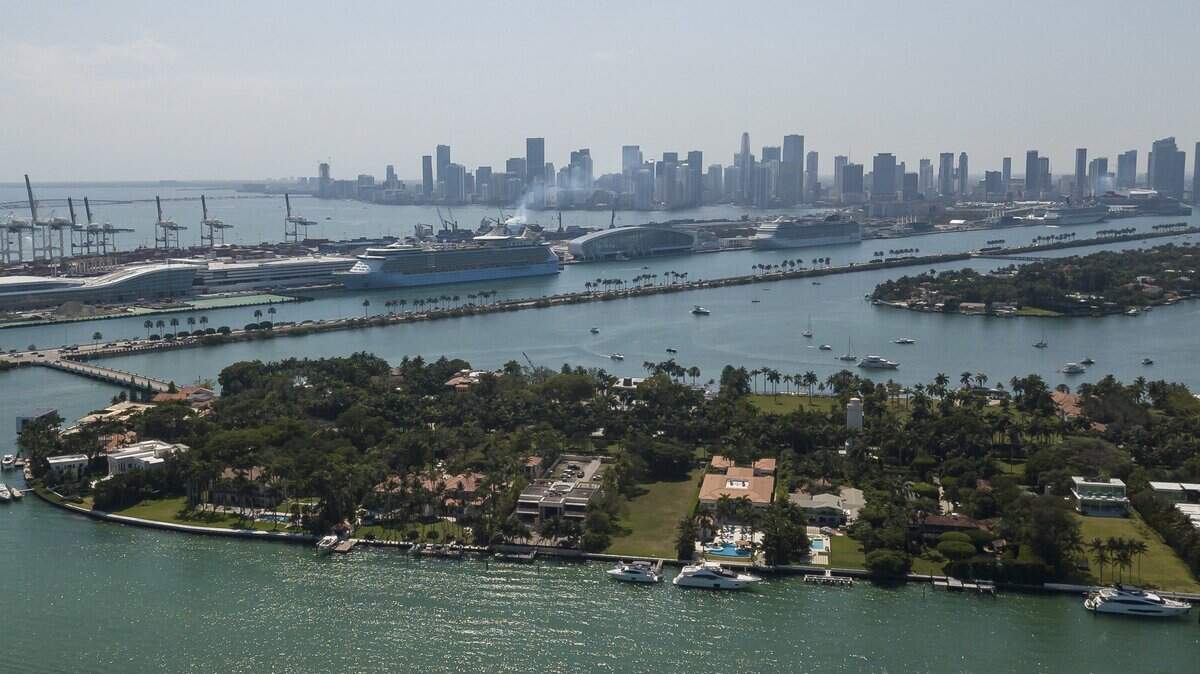
Miami-Dade commission votes to seize PortMiami’s fuel yard in court fight
Miami-Dade County will try to seize the privately owned fuel yard that keeps PortMiami running and hope a jury will decide the 10-acre property on luxe Fisher Island is worth far less than the $400 million acquisition deal on the table from the condo developers that now own the land.
Read more Public schools must excuse students for religious instruction, Florida AG says
In an 11-1 vote, the County Commission approved Mayor Daniella Levine Cava’s request to launch an eminent domain proceeding against the fuel yard. That will have Miami-Dade declare itself the owner of the property, put down a deposit for a portion of the land’s alleged value, then go to court to finalize a forced sale. In that trial, a jury would decide how much Miami-Dade must pay for a property that the would-be developers purchased last year for about $180 million.
“I’m not going to let you buy property for $180 million, then flip it [within] months for $400 million,” Commissioner Oliver Gilbert, backing Levine Cava’s legal strategy, told reporters after the vote. “That’s just insane.”
Only one commissioner, Raquel Regalado, voted against Gilbert’s legislation. (Commissioner René Garcia did not attend the meeting.) Regalado said Miami-Dade was rushing into a risky legal fight. “This is a decision that will impact this county for the next 50 years, and it should not be made lightly,” she said. “Every time we see a crisis here, we run into a burning building without getting all the facts.”
The vote lets Levine Cava move forward with her plan to resolve what’s become one of the largest flaps she has faced since taking office in November 2020.
“The current and future position of our port is precarious,” Jason Liberty, chief executive officer and chair of Royal Caribbean, told commissioners while flanked by other industry executives. He urged commissioners to approve Gilbert’s legislation.
Two years ago, the mayor’s administration failed to try and purchase the fuel yard when its owner put it up for sale on the open market. That quickly emerged as a fumble when the new owners — a group that includes prominent Miami developers Russell Galbut and the Related Group — announced plans to close the yard and build a luxury condo complex there.
While the owners inherited an agreement that requires fuel sales continue through May 2027, the development plans would leave PortMiami with no way to keep ships fueled after that. That sent the Levine Cava administration trying to negotiate a purchase from the new owners under the supervision of a mediator. After nine months, a confidential deal emerged — reportedly at a cost of $400 million, with the county using fuel sales and port fees to pay off the expense over 20 years.
Because PortMiami’s revenues and expenses are segregated from Miami-Dade’s core budget, no tax dollars would be involved in the deal.
And while top aides were on the negotiating team, Levine Cava declared the administration’s price tag as too high. She ousted two aides leading the negotiations — Chief Operating Officer Jimmy Morales and Port Director Hydi Webb — and announced plans for a court fight to try for a lower cost to the port.
On Tuesday, county leaders pointed to a legal provision they say will be a big help in the fight. In the 1970s, according to Deputy Mayor Roy Coley, the county secured a covenant on four acres of the land requiring that it remain a fuel facility as part of a zoning change requested by the facility’s owners at the time. He said only the County Commission, which has zoning authority over Fisher Island, has power to change the covenant.
Read more Will Miami-Dade pen a taxpayer-funded deal with financially strapped Brightline?
The 1978 covenant states the property “shall be restricted” to shipping and storage of petroleum and other fuel types, according to a copy of the document provided by Levine Cava’s office.
In remarks to reporters after the vote, Levine Cava said that while the negotiating team had kept her informed on the talks, she hadn’t learned about the covenant until the last minute.
“I was kept apprised all along, but there were some details I wasn’t apprised of,” Levine Cava said. “Certainly like the covenant.”
In a statement, the developers, HRP Fisher Island, waved off the importance of the restriction on that portion of the fuel yard, saying that land isn’t needed to build a condo complex expected to generate $2.5 billion in sales. “Covenants of this nature are routinely terminated during the land use entitlement process,” the statement said. “During the public sale, the land was marketed by leading national broker CBRE as a development parcel, not an industrial fuel terminal.”
With both sides publicly posturing for the coming legal fight, the stakes are high. Should Miami-Dade fail to secure the fuel yard that has been operating on Fisher Island since the 1920s, the port will need to scramble for alternatives — including the possibility of a fuel barge anchoring off PortMiami to keep cruise ships running, or the county scrapping current expansion plans at the port to clear land for a fuel facility.
A central question in the conflict is how much a jury would require Miami-Dade to pay for the fuel yard. In a memo, Levine Cava said the county obtained three appraisals for the land.
The lowest assumed it could only be maintained as a fuel yard and valued the land at $25 million. A second appraisal came in around $180 million, and the third assumed residential development could go there and valued the land at $430 million. Coley said the administration will settle on a final value for the land based on the appraisals. The legislation that passed Tuesday allows the administration to make a final offer for the land up to 15% above the county’s appraised value for the fuel yard.
The administration offered no defense for not trying to buy the fuel yard when it went up for sale, beyond saying that port administrators assumed whoever bought it would continue selling fuel to PortMiami. Multiple commissioners said they were unhappy with the administration letting the fuel yard be bought by developers but that they didn’t see an alternative to fighting to buy it now.
“Unfortunately, there have been missteps along the way, and we probably didn’t do what we should have done,” said Commissioner Vicki Lopez, whose district includes Fisher Island and PortMiami. “But that was then. We are here now. We have to be responsible, and we have to make a responsible choice for the public good.”
Read more Edwin Lopez sworn in as Miami police chief. Here’s what he says about immigration











Post Comment