David Jolly introduces running mate to Miami, sits down with the Miami Herald
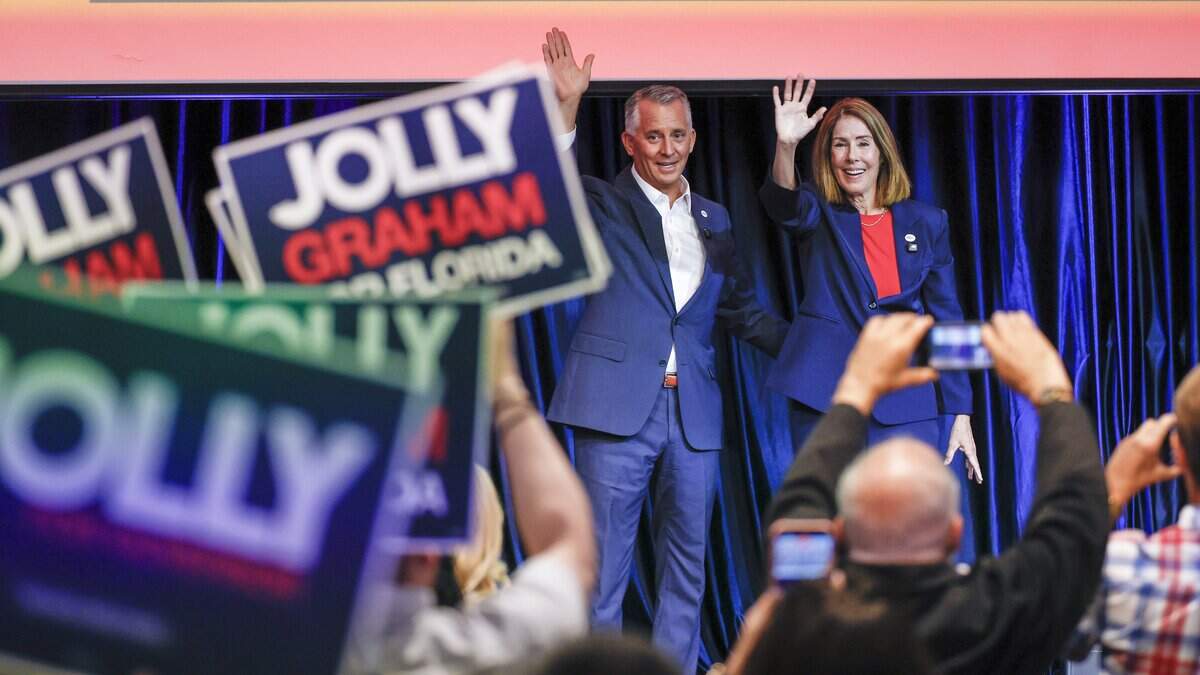
Inside Florida International University’s Graham Center, named for late state Sen. Ernest R. “Cap” Graham, his granddaughter Gwen Graham was greeted Thursday evening by cheers from a crowd of roughly 250 supporters as Democratic gubernatorial candidate David Jolly introduced her as his running mate.
Read more Affordable housing replacing public housing as developers address Miami shortage
The appearance came one day after Jolly, a former Republican congressman who represented part of the Tampa Bay area before switching parties, announced that Graham was joining his ticket, making him the first major gubernatorial candidate to name a lieutenant governor pick and creating the appearance of a campaign looking past the Aug. 18 Democratic primary and toward November.
Graham — daughter of former Florida governor and U.S. senator Bob Graham — ran for governor in 2018 but lost in the primary to Tallahassee Mayor Andrew Gillum, the more progressive candidate. Graham’s addition places two well-known center-left figures atop the ticket.
The audience included supporters like Miami-Dade Mayor Daniella Levine Cava and state Rep. Kevin Chambliss, as well as intrigued voters who came to hear Jolly and Graham make their case.
In the crowd was 71-year-old Kendall resident Judy Byrum, who attended with her sister, niece and longtime friend Diana Simonoff, 72. They said they wanted to see whether Jolly was a candidate who would work on behalf of Florida residents.
“As far as I’m concerned, this is a job interview,” said Simonoff.
Simonoff recently moved in with Byrum after struggling to afford rent on a Social Security income. Both women said they want elected officials to do more to address the rising cost of living and help longtime residents remain in South Florida.
“I want more focus on human needs,” said Simonoff. “This is my family’s home, and I wish that I could afford to have a better life here.”
Ahead of the event at FIU, the Miami Herald sat down with Jolly to discuss his campaign, his alliance with Graham and his view of one of the biggest decisions voters will make this fall: whether to significantly cut property taxes.
This Q&A has been edited for brevity and clarity.
What steps are you taking to ensure your campaign hears and reflects the diversity of voters in this state, particularly with two white people leading the ticket?
Jolly: I think that the disparate impact in communities of color, when it comes to the economy, access to healthcare and education and housing still exists today. It’s not been cured.
I’m afraid my Republican friends in leadership think it has. I acknowledge the disparity in inequities today. [GOP frontrunner] Byron Donalds doesn’t, and I’m building policies to address that. I also know that to do that we need diverse voices and leadership in our campaign with different lives and expertise that I bring.
I’m the son of a minister from rural Florida. I lived in Miami for a while, I lived in Pensacola, I understand the state very well, but that’s my lived experience.
When I set about to build a team, I started a year ago. We built a state university system advisory team. I went to Florida Agricultural and Mechanical University leadership, and I asked somebody on the FAMU Foundation Board to help me look at the future of the state university system.
When we started to build economic development teams, I went to two county commissioners — both people of color, one in Escambia and one in Pinellas — and I said, “Help me imagine an economic plan that doesn’t rely on trickle-down economics for your community.” When we built a faith community plan, I went to an African-American minister of a historically African-American church and said, “Help me make sure that all voices are lifted up.”
We have invested in many of the Hispanic communities and asked them to help lead — not just support us, but help lead. It’s similar when it comes to the LGBTQ+ community as well.
Different lived experiences make the policies better, but they also provide a vision for our youth.
Something I subscribe to is: You can’t be what you can’t see.
Our transition chair is an African-American attorney in Tallahassee. Our policy chair is a state senator from Palm Beach County. We are building a very diverse team.
The lieutenant governor position is one of those positions. All of those positions strengthen my leadership, but this is a campaign that acknowledges that equality of opportunity has not been achieved, that people’s fundamental rights are under attack, and that we’re building policies to address that.
What made Gwen Graham stand out to you as a potential running mate?
Jolly: I wanted to find a governing partner capable of leading the state, not just as lieutenant governor, but as governor. Gwen brings remarkable experience in politics and public service.
Read more Friends pledge millions to free ex-Rep. David Rivera. Judge will rule soon
She also brings a fundamental goodness to leadership and to the state. In the past, gubernatorial candidates have always had the first priority on identifying someone ready to lead the state as governor. I wanted to demonstrate a certain sobriety and seriousness to this decision, and I wanted to do it early in the race — not wait until August or September.
What is your response to the criticism that this pick hearkens to an era of Florida politics that is long gone? How does choosing Gwen Graham help push Florida and Democrats into the future?
Jolly: I think this race is bigger than a single party. And I don’t accept that everything has to be done through the lens of electoral math, but we have to win, and so what does the addition of Gwen do?
It demonstrates to Florida Democrats that we are a ticket amplifying the Democratic values, that the economy should work for everyone, the government can do its part to improve our lives, and everyone’s rights should be protected. Those values are rooted in the traditions from FDR to JFK to Barack Obama, and yes, to her father, Bob Graham. But they are bigger than our party as well.
If you’re an independent or Republican today who knows that we need to do something to address housing, health care and education, we’re the ticket. It recognizes the economy needs to work for everyone — absolutely everyone — that there’s a role for government.
Some Republicans think the property tax amendment is going to drive out conservative voters that might have otherwise not gone out to vote for Byron Donalds. Are you concerned the amendment being on the ballot will hurt your chances?
Jolly: Republicans are promising something that the language doesn’t actually explain, and even Republican critics are now speaking up, from state Sen. Jeff Brandes to conservative tax think tanks and The Wall Street Journal. They’ve rushed this through, and they haven’t shown us how the math works.
We do need property tax relief, and if they can answer those hard questions, make the math work, and show us how services are supported, then sure, we’ll work with the current administration to execute what voters approve.
Right now, we don’t know what language the courts will finally approve, and so I’ve been prudent on this for a year, saying there are more questions than answers.
We have proposed several tax relief packages: a $250,000 homestead exemption for first-time homebuyers and targeted additional homestead tax exemptions.
But I think what this also reveals is we may be a state now that needs to move to local control of homestead exemptions.
What do I mean by that? It’s obvious in South Florida. In Miami-Dade, property values are half a million, a million, a million and a half dollars to get into a home. That’s very different than communities in Escambia, Levy or Leon, where costs may be $200,000, $250,000 or $500,000.
If the state is going to be in charge of a universal exemption, it intuitively doesn’t make the same sense in Miami-Dade as it does in Leon or Escambia.
Maybe what this debate has exposed is a conversation we should have as a state. There’s a 10-year tax commission that convenes next year as part of the state’s constitutional requirements.
Should we move homestead exemptions from a state decision to a local one? Should Miami-Dade determine whether you need a $500,000 or $1 million homestead exemption? Should it go to first-time homebuyers, and so forth?
That is a unique decision for a Miami-Dade economy that is different from Escambia and other counties.
So, more questions than answers.
Donalds’ Republican opponents have made data centers and being backed by AI a primary point of criticism. Do you plan to focus on this in the general? What is your position on data center expansion in Florida?
Jolly: We need an immediate moratorium. There are three things that we are unprepared for: the environmental impact, the labor disruption and the privacy needs.
And I give Ron DeSantis credit on this as well. I know this is a little different than the data centers themselves, but until we know that our youth are protected from AI, until we know that artificial intelligence is not in a position to convince a young person to take their own life, there’s a lot we’re unprepared for.
Read more ‘We need somebody who’s focused on us:’ Dotie Joseph makes her play for governor
Miami Herald staff writer Claire Heddles contributed to this report.








Post Comment