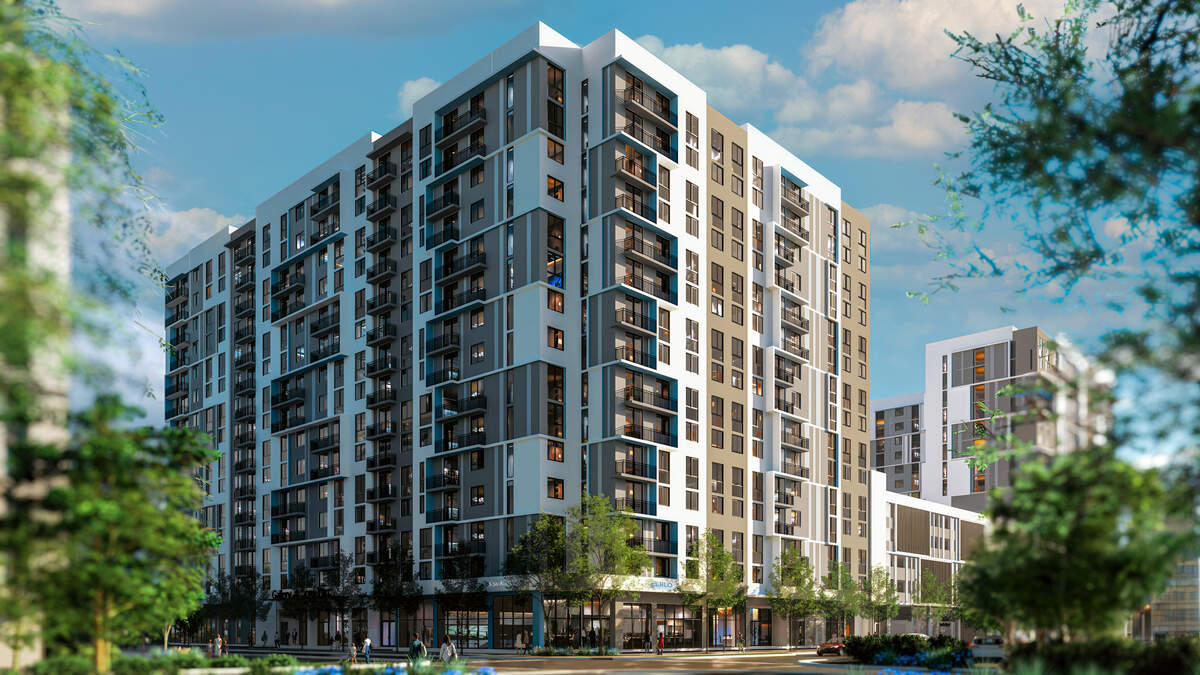
Affordable housing replacing public housing as developers address Miami shortage
Miami-Dade has a shortage of affordable housing — and the land to build it on.
Bounded by Biscayne Bay and the Atlantic Ocean to the east and the Everglades to the west, the county doesn’t have much space for the estimated 90,000 new units needed to address the shortage.
Read more Friends pledge millions to free ex-Rep. David Rivera. Judge will rule soon
But to deal with the squeeze, some developers are turning to sites where affordable housing already exists. They’re replacing aging county-owned public housing with new, denser affordable and workforce housing developments.
These redevelopment efforts reflect a broader national shift from traditional government-run public housing to affordable and workforce housing built through public-private partnerships, said Alberto Milo, Jr., the president of Related Urban Development Group. Related Urban is the workforce and affordable housing arm of the real estate development firm Related Group and is a leading developer of affordable housing in Miami-Dade.
Related Urban has built new affordable housing on numerous county-owned public housing sites and is planning to break ground on two new redevelopments this month. The firm is also behind the ongoing redevelopment of Liberty Square, one of Miami’s oldest and largest public housing sites.
What is public housing?
The pre-World War II Liberty Square public housing complex dates back to an era when federal funding for housing was funneled toward municipal governments to build low-income housing developments run by local housing authorities. These housing communities were largely underfunded, poorly maintained and often exacerbated issues of racial and economic segregation in American cities.
This former public housing model has been widely criticized, and housing policy has since shifted toward public-private partnerships, where developers like Related Urban partner with municipal governments and use state, federal and local subsidies and incentives to build affordable housing, often in mixed-income developments.
In Miami-Dade, public housing is owned and operated by the county, while affordable and workforce housing are privately owned and operated, with developers receiving government incentives and subsidies to keep rents at affordable levels for different income tiers. Affordable housing is usually for people making up to 80% of the area’s median income, and workforce housing is usually for people making up to 120%.
Miami-Dade Public Housing and Community Development manages around 6,500 units of public housing for low-income households. Rent in these units is restricted to 30% of a household’s income and is generally available to households making up to 80% of the local median income. The county’s median income benchmark used to calculate eligibility for housing programs is around $87,000.
Unlike public housing, rent for affordable and workforce units is not tailored to an individual’s income. For instance, all units in the 80% tier would have the same rent, regardless of the tenant’s exact income within that tier.
Very low or extremely low-income households, which make less than 50% or less than 30% of the median income, often receive priority for public housing units.
Like many public housing sites, Liberty Square had fallen into disrepair over the years, and in 2015, Related Urban put forth a proposal to demolish the old housing rows and build nearly 1,500 new public, affordable and workforce units. Related Urban completed the fourth of nine planned phases in the redevelopment in April 2025 and broke ground on the next two phases earlier this year.
Related Urban recently completed Brisas Del Sol, an affordable housing community for seniors in Little Havana. Miami Mayor Eileen Higgins said the conditions in the county-owned senior housing facilities Brisas Del Sol replaced were “deplorable.”
Read more ‘We need somebody who’s focused on us:’ Dotie Joseph makes her play for governor
Overtown public housing site to be redeveloped
Rainbow Village, an aging 1970s-era complex of two-story yellow apartment buildings, is another Miami-Dade public housing site getting a makeover.
Coconut Grove-based affordable housing developer Housing Trust Group is building Rhapsody at Rainbow Village, which will bring more than 1,500 new units of mixed-income affordable housing to the Overtown site. The first 310-unit phase of the project is under construction at 2000 NW Third Ave. It is expected to be completed early next year and will have units that are affordable for people making between 30% and 80% of the area’s median income, said HTG’s senior vice president for development Elon Metoyer.
Rhapsody is replacing a complex of 136 apartments that were in poor shape. These units were vacated ahead of the redevelopment, and residents have been moved to other county public housing sites. They will be offered units in the new building once it’s completed, Metoyer said.
HTG made use of the federal Rental Assistance Demonstration program, which helps local housing authorities turn public housing into privately-run affordable housing. This program mandates that the residents of the existing public housing be given a place to live during the redevelopment and a unit in the new building, with restrictions on how much their rent can increase.
Denser developments
One major benefit these redevelopments bring is that they can dramatically increase the number of units on a site.
Rhapsody will replace 136 units with more than 1,500. And the two redevelopments Related Urban is preparing to break ground on will roughly triple the number of units across the two formerly county-owned sites.
The Residences at Claude Pepper will replace the 166-unit Mildred & Claude Pepper Towers, a senior housing facility in Brownsville built in 1970. The new building will have 428 units.
Gallery at SoMi Parc is the second phase of the SoMi Parc Master Plan, a multiphase redevelopment project replacing South Miami Gardens, a county-owned public housing site in South Miami. The first building, which was completed in 2024, has 172 apartments, and the next will have 350.
Gallery at SoMi Parc, 5949 SW 68th St., was scheduled to break ground on Friday, and the Residences at Claude Pepper, 750 NW 18th Ter., will begin construction later this month.
So far, Milo said Related Urban has completed 38 affordable housing developments in partnership with the county, several of which have been redevelopments of public housing sites. The firm has about 10,000 new units of affordable and workforce housing in its pipeline to be built, said Milo.
He said he’s “optimistic” his firm will be able to “chip away” at the county’s housing shortage.
Read more Companies pursuing a Miami-Dade incinerator throw up their hands (for now)









Post Comment