Videos, texts show South Florida pastor’s role in Haiti president’s killing, feds say
The seven-minute video, sent in early May 2021, offered a step-by-step guide for carrying out modern warfare in a country where everything seemed to be unraveling.
Read more Videos, texts show South Florida pastor’s role in Haiti president’s killing, feds say
The blueprint included the recruitment of mercenaries and exploiting the grievances of disaffected citizens, from religious fanatics and extremists to soccer fans.
“It does not matter if these violent rebels are comprised of football fans,” the French-speaking narrator said before moving on to the next steps, including an attack.
“The motto: synergy above all, strike together, march separately,” the narrator said. “The attacker thus creates heterogeneous terrorist groups.”
This week, as federal prosecutors in Miami continued making their case against Christian Emmanuel Sanon, the Haitian-American pastor and South Florida resident accused of conspiring to kidnap or kill Haiti president Jovenel Moïse, they suggested to jurors that the video had served as a guide for the operation that culminated in Moïse’s July 7, 2021, assassination.
“What was the sixth step listed in this video?” Jason Wu, one of three assistant U.S. attorneys prosecuting the case, asked Kaitlin Dayton, an intelligence analyst for the FBI.
“Allow themselves to be celebrated as saviors,” she replied.
The video had been sent to Sanon on May 3, 2021, by Roland Jean-Pierre, one of several individuals involved in the plot who claimed to work for the U.S. government. Dayton testified that Jean-Pierre, who traveled to Port-au-Prince with Sanon and another co-conspirator in late May, was not a State Department employee, despite claims to the contrary that persisted even on the morning that Moïse was killed.
Dayton walked jurors through a summary of what she said was “a vast amount” of exchanges involving Sanon and four co-conspirators convicted earlier this year of conspiring to kill or kidnap Moïse and providing support, including recruiting former Colombian soldiers and arming them.
Among those already found guilty by a jury earlier this was Arcángel Pretel Ortiz, a Colombian national who worked as an informant for both the FBI and Homeland Security Investigations. Pretel shopped for fake lapel pins, advised one of the co-conspirators to purchase camouflage vests and assigned military-style ranks and code names inspired by avenging angels to the mercenaries.
The messages showed that the network of people involved in the discussions about the removal of Moïse went beyond Sanon and the four South Florida men, currently awaiting sentencing.
There were individuals accused of fraudulently obtaining COVID-19 pandemic relief loans that prosecutors say helped finance the plot. There were Haitian police officers who provided intelligence, and others who were not charged in either Haiti or the U.S. but whose names appeared on a shortlist of prospective members of a government that Sanon was to head after Moïse was gone.
The conversations also included references to prominent Haitian pastors and politicians, as well as Jimmy “Barbecue” Chérizier, leader of the G-9 federation of gangs. Prosecutors presented no evidence showing that Chérizier, a former cop, communicated directly with the men or that some of the others whose names were also dropped in chats were involved.
At one point Pretel, who ran the company Counter Terrorist Federal Academy with his business partner Antonio “Tony” Intriago, claimed that the group in Haiti was training members of the G-9 gang. Pretel and Intriago hired the Colombians and sent them to Haiti.
Dayton testified that Sanon was part of group chats in which the G-9 training was discussed and others in Pretel, Intriago, James Solages and Walter Veintemilla all discussed using gangs to remove Moïse, often referred to as “a thief” and the “rat.” They also discussed, per the steps of the instructional video, putting people on the streets to fan a popular uprising.
Financial troubles
Just as in the previous trial, the text exchanges showed a group increasingly under financial strain while members exaggerated, and at times outright lied, about their numbers on the ground in Haiti and having powerful backing, including from U.S. government agencies.
Read more Off-duty ICE agent from Texas charged with assault in California. Police say homeowner shot him
Sanon had wracked up a $46,689 bill at Maxime Boutique hotel in Port-au-Prince for the former soldiers initially assigned to protect him in Haiti. On July 4, the hotel owner’s daughter sent Sanon an email effectively kicking him and the Colombians out, telling him the hotel would be closing.
In one of the videos shared by the men and played for the jury, an animated Sanon was sitting at the end of a table, speaking in Haitian Creole and saying God had entrusted him with the mission.
Sanon’s defense
Sanon’s defense attorneys have sought to distance him from the assassination of Moïse, arguing that as July 7 approached, he was increasingly isolated from Pretel and the others. They are expected to expand on this Thursday when they get a chance to finally cross-examine Dayton.
Prosecutors have used the texts to show that Sanon remained involved in preparations for the presidential overthrow, and Wu repeatedly noted that he was referred to as “President” in correspondence and text exchanges.
Despite the earlier convictions, there has always been a lingering question: Did Sanon, 67, genuinely believe he had a shot at becoming Haiti’s president? Or was he a willing participant in an elaborate deception scheme employing fake military and government lapel pins, camouflage clothing meant to resemble American military uniforms and filled with claims of official u.S. support?
At one point, members of the group plotting the assassination claimed that Sanon planned to meet with the U.S. ambassador in Haiti and that the Dominican Republic was involved. Dayton said she found no evidence substantiating either assertions.
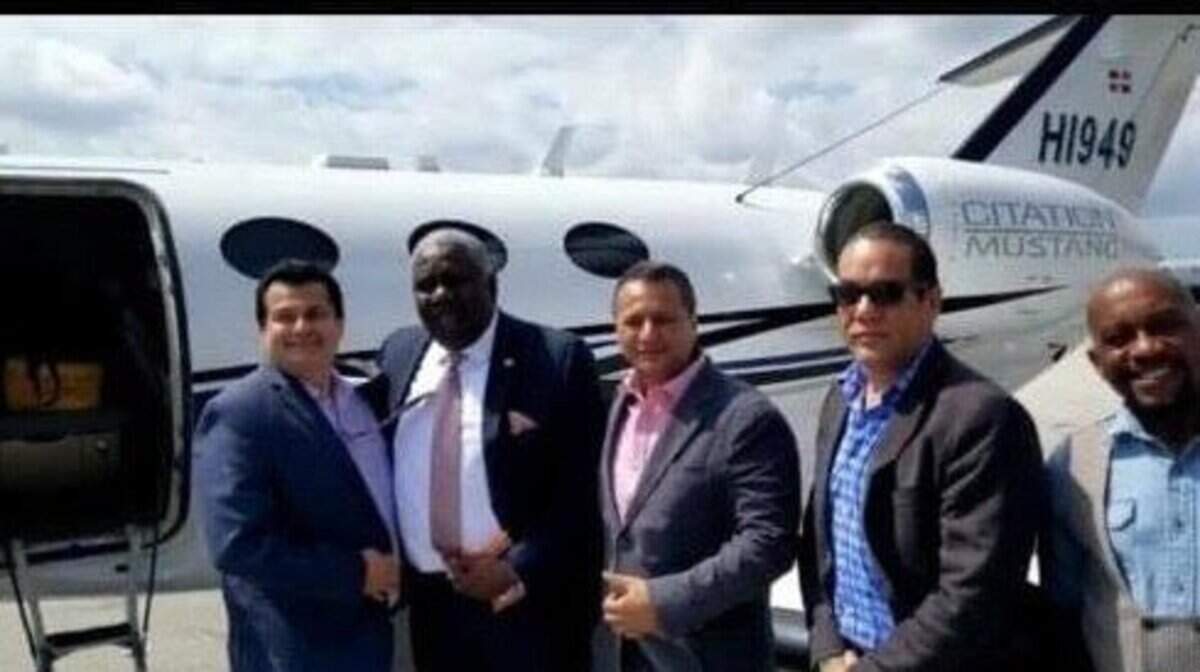
In late May, Sanon traveled to Haiti on a private jet accompanied by Jean-Pierre and Intriago. Before the flight took off, they posed for photos and Pretel placed a pin on his lapel while referring to them as “brothers.”
Before the trip, Intriago had instructed Sanon to call FBI agent George Núñez and inform him the group was headed to Haiti on a private jet, and planned to hold a meeting with the U.S. ambassador. Sanon did a Google search for the number. Sanon’s call log showed that at 10:23 a.m. on May 21, 2021, he made a call to the FBI’s general number. The call lasted 4 minutes and 11 seconds, Dayton testified.
The insertion of the FBI in the plot is among the most striking claims. After the flight took off, Pretely dropped a voice note in a chat.
“Kumbe is in the air right now,” he said in the message played for jurors. “Kumbe” is one of the various nicknames for Sanon, prosecutors said.
In the same message, Pretel claimed the trip had been coordinated with the FBI. Sanon, he said, had called Núñez, and the agent had asked for coordinates in Port-au-Prince and was providing support. Núñez was Pretel’s handler and had met with Sanon and others in Doral months earlier, but had failed to immediately report the meeting, sources told the Miami Herald ahead of the first trial.
“George then says ‘Your life is covered like a diplomatic representation for the Haiti situation,’ ” Pretel claimed in broken English. “So we have a presence for the FBI in the airport..but it’s not official support. Only for the presence on the ground.”
Wu asked Dayton about Pretel’s assertion that an FBI agent had described the flight as a diplomatic mission.
Read more Fact Check: Marshall and Hamilton debate in race for Kansas seat in U.S. Senate
“What does the FBI have to do with diplomacy or foreign relations?” he asked.
“Nothing,” she replied.







Post Comment