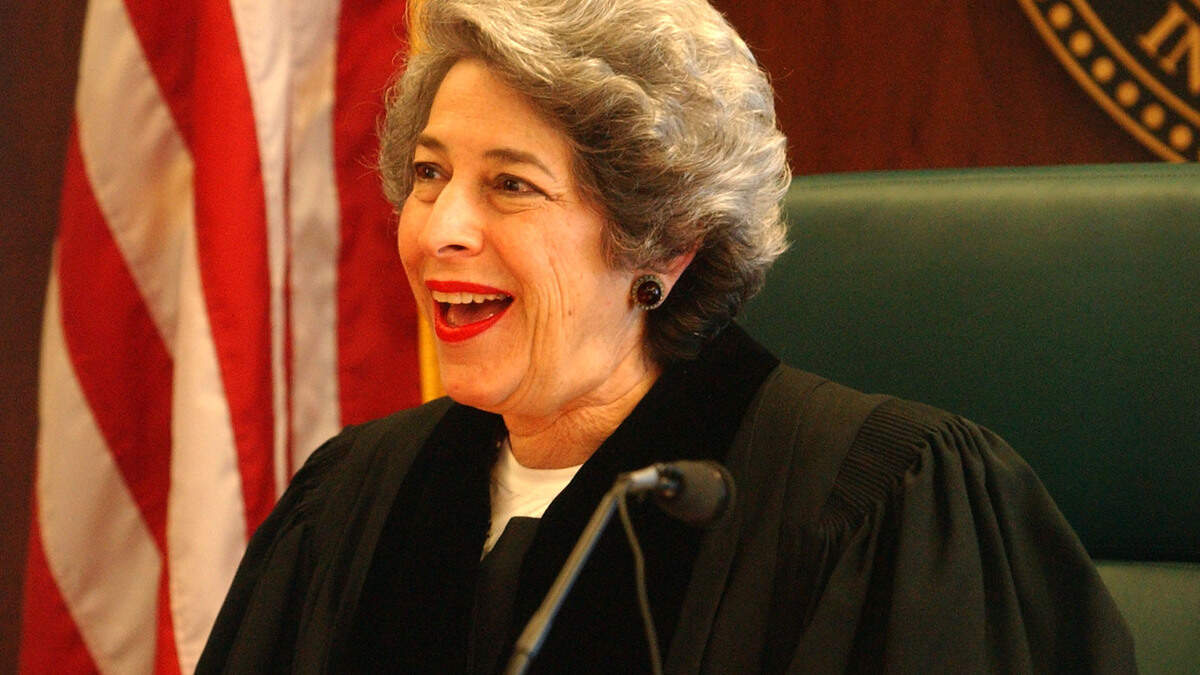
‘She was tenacious.’ Miami family judge Judith Kreeger dies at 85
Judith Kreeger overcame gender barriers, work challenges and a surprise career. But she rose to become a senior judge in the Miami-Dade court system despite opportunities that were denied to women in the 1960s when she pursued a legal profession.
Read more State moved to close ALF after man’s deadly fall. Jackson still sent people there
Kreeger, a founder, president or founding board member of community nonprofits that advocated for children and women such as Miami Cares for Kids, the Florida Foster Care Review Project and Women of Tomorrow, died Tuesday at 85, nearly two years after her husband, Julian Kreeger, a Miami classical music impresario and lawyer, died at 84.
The couple were known in South Florida for their dinner parties at their homes in Miami Beach and Coconut Grove that gathered musicians, fellow attorneys and judges, senators, bankers, philanthropists and journalists.
“Mom’s professional accomplishments are extraordinary, yet what most people remember was her warmth and grace,” said son David Kreeger. “When she left her chambers, she was simply Mom or Judy, always present for whomever she was with, never once leaving the impression that she had more important things to do, places to be, or people to see.”
Professional accomplishments
Kreeger served as a judge in Miami-Dade’s 11th Judicial Circuit Family Division from 1993 through 2019. She held a senior judge title in the latter years.
When she ran for the seat in 1992 against two opponents, with her outspoken 16-year-old son Daniel at her side on the campaign trail, the pair hit churches in Opa-locka, bar association events and candidate meetings. The election was delayed by Hurricane Andrew.
The Miami Herald Editorial Board recommended Kreeger, calling her “an outstanding candidate.” She had been an attorney since 1966 — about 20 of those years alongside her husband in their joint Miami firm Kreeger & Kreeger. She concentrated on real estate and estate planning so she would have weekday evenings and weekends to help raise their three sons, Abram, David and Daniel.
“Commanding respect in the courtroom, setting a no-nonsense tone, while still protecting justice’s humane side is not an easy assignment,” the Herald board opined. “Yet it’s one for which Ms. Kreeger’s nature seems quite suited.”
Her youngest son, Daniel, who has worked in government relations, climate change and healthcare, said of his mother: “Everything that I do has to be mission driven and that’s a value that came from her. It’s the only place it could have come from. The combination of making the world around her a better place and the grace with which she carried herself in a world that told her she shouldn’t be doing what she was doing because she was a woman is something that I hope leaves an impression on others — and it certainly has left one on me.”
Kreeger, a founding mentor and board member of the mentoring Women of Tomorrow & Scholarship Program that was founded in 1997 by then-NBC 6 anchor Jennifer Valoppi, was one of four U.S. judges appointed by the U.S. State Department to serve on the International Hague Network of Judges. The network focused on international child custody issues.
“Judge Kreeger knew firsthand what it meant to be the only professional woman in a room full of men, and she never hesitated to pass on the lessons learned to help a new generation. She will be forever missed by all of us whose lives she touched at Women of Tomorrow,” Valoppi said.
Kreeger was appointed by the Florida Supreme Court to chair its technology committee and committee on a unified family court system.
“It was a major directive to define and implement a modern family court in the state,” Kreeger, a Jurist of the Year award winner from the Florida Academy of Matrimonial Lawyers, told the Miami Herald in 2001. She was on the committee for six years.
As the founder and chair of the Florida Bar’s Media Law Conference, she successfully pushed to bring cameras into the courtroom in Florida for the first time during the 1970s.
“Judy was a true pioneer in the law,” said Scott Bernstein, an administrative judge of the Unified Family Division in the 11th Judicial Court. “She created the first case management system in the Miami courts, because she recognized how crucial it was for family cases to be resolved quickly. This was her invention, and she implemented it to great success. She was also an expert in international child kidnapping cases. She was appointed by the United States State Department as one of only four judges in the nation to assist with these emotionally complex international cases.”
Miami’s foster care system
State Attorney Katherine Fernandez Rundle said she met Kreeger when she was selected for a grand jury investigating the management of the Miami-Dade County child welfare system. Kreeger served as the grand jury’s foreman in 1989.
The jury “blasted the state’s child welfare system as grossly inadequate,” the Herald reported at the time.
On Tuesday, shortly after Kreeger’s death, Fernandez Rundle remembered Kreeger’s leadership as she resolved conflicts.
“She had an ability to lead, and she did,” Fernandez Rundle said. “She was incredibly tenacious.”
Read more South Florida Jamaicans bid farewell to beloved consul general as he lands in New York
As a result of that grand jury’s plea, and their shared experience, Kreeger and Fernandez Rundle teamed on an event organized by Kreeger’s Miami Cares for Kids charitable group in 1990. They set up a clothing shopping spree for hundreds of local foster parents who were struggling to raise their children on tight state stipends. The former Burdines Clearance Center opened its doors after hours for that spree. The clothing cost? Everything was free.
Kreeger and Fernandez Rundle picked through hundreds of dresses, shoes, T-shirts and designer jeans. The state attorney recalled how Kreeger went to stores, hosted an event at her house and gathered donations that were distributed to kids in the foster care system.
“She led a great life. She was a great humanitarian, a great lawyer, mother, wife. She cared deeply and … worked hard for the community,” Fernandez Rundle said.
Taking charge and minding details
Kreeger was fluent in Spanish — “with a pronounced gringa accent,” her son David said, chuckling. She once kicked out a translator from her courtroom during a hearing due to inaccurate translation. Then she did the translating herself for the rest of the hearing.
And those dinner parties. Husband Julian gave out CDs of grand piano recitals from his stock of thousands to guests as party favors. Judy kept her guests’ appetites satisfied.
“Judy was a great hostess. She owned a full set of fish knives! Her living room and dining room were special places. We had lots of fun together, shared a love of dark chocolate. I will always miss Judy,” said Gisela Cardonne Ely, a Miami-Dade senior judge.
Confounding skeptics
Born Judith Lefkowitz in New York on April 16, 1941, she moved with her family from Far Rockaway to Miami Shores when she was 13. She graduated from Miami Edison High School in 1959; graduated from Randolph Macon Women’s College as a Spanish major in 1963; and enrolled at the University of Miami School of Law, where she met and later married Julian Kreeger, her husband of 58 years.
“She overcame gender barriers that started before she even finished law school,” her first-born, Abram Kreeger, said. Her own parents withdrew financial support while she was in her last year of law school. Her future husband’s mother, a recent widow, financially supported her during her final year of law school.
“Dad’s mother believed Mom should have the opportunity to finish what she started — a view Mom’s own parents didn’t share at the time — regardless of whether Mom ended up marrying Dad,” David Kreeger said. He likened his mother to trailblazing singer-songwriter Dolly Parton, who also died Tuesday.
“In many ways, Dolly Parton’s story reminded me of Mom’s,” her middle son wrote on a Facebook post. “Two women of a generation where women were told no far more often than yes. And two women who refused to accept that answer.”
Kreeger was one of only three women in her UM law school class of 1966 and finished seventh in her class.
Overcoming significant hurdles
But she was a Jewish woman in the 1960s when cultural restrictions on gender and religion conspired to deny people like Kreeger the opportunities they had earned. It took Kreeger 30 tries before a judge gave her a chance as a legal clerk at the U.S. District Court for the Southern District of Florida. She couldn’t get an interview at a law firm in Miami, her family remembers.
“Working with my father, not just at home, but in the workplace at a time when few couples did so, was a remarkable model to the rest of our family,” Abram Kreeger said. “Her ability to lead discussions in rooms where women were not present taught us that woman could and should have the same opportunities as men. Yet, the culmination of her career, ironically, came back to family, with law itself. She constantly helped settle family disputes in her court, and also worked closely with judges from around the globe to improve family laws.”
Former Miami Herald managing editor Liza Gross, a regular at the Kreegers’ parties, and now senior advisor to the Collaborative Journalism Resource Hub in New Jersey, shared an annual celebration with her friend during Jewish High Holidays services at Temple Israel of Greater Miami embracing the concept of Tikkum Olam, “repairing the world,” she said.
“Tikkum Olam emphasizes the value of social action and kindness. Invariably, as we walked back to the car after every service, Judy would reflect on this value as her chosen guide to the way she conducted her journey on this earth,” Gross said. “Her commitment to repairing the world showed in all her actions and all the spheres of her life, from her loving devotion to her family and friend to her indefatigable efforts in her professional life to safeguard the welfare of families and children.”
Survivors and services
Kreeger’s survivors include her brother Paul Lefkowitz; sons Abram, David and Daniel; and three grandchildren.
Services will be held at 10:30 a.m. Sunday, Aug. 30, at Riverside Gordon Memorial Chapel at 5900 SW 77th Ave. in Miami-Dade County.
Read more ‘She was tenacious.’ Miami family judge Judith Kreeger dies at 85
Miami Herald staff writer Grethel Aguila contributed to this report.











Post Comment