Sebastian Inlet adds ‘living shoreline’ to stop erosion
The banks of the Indian River Lagoon along Coconut Point at Sebastian Inlet State Park are coming back to life with a new ‘living shoreline.’
Read more Dramatic dolphin rescue: Photos show what it took to save Florida mammal
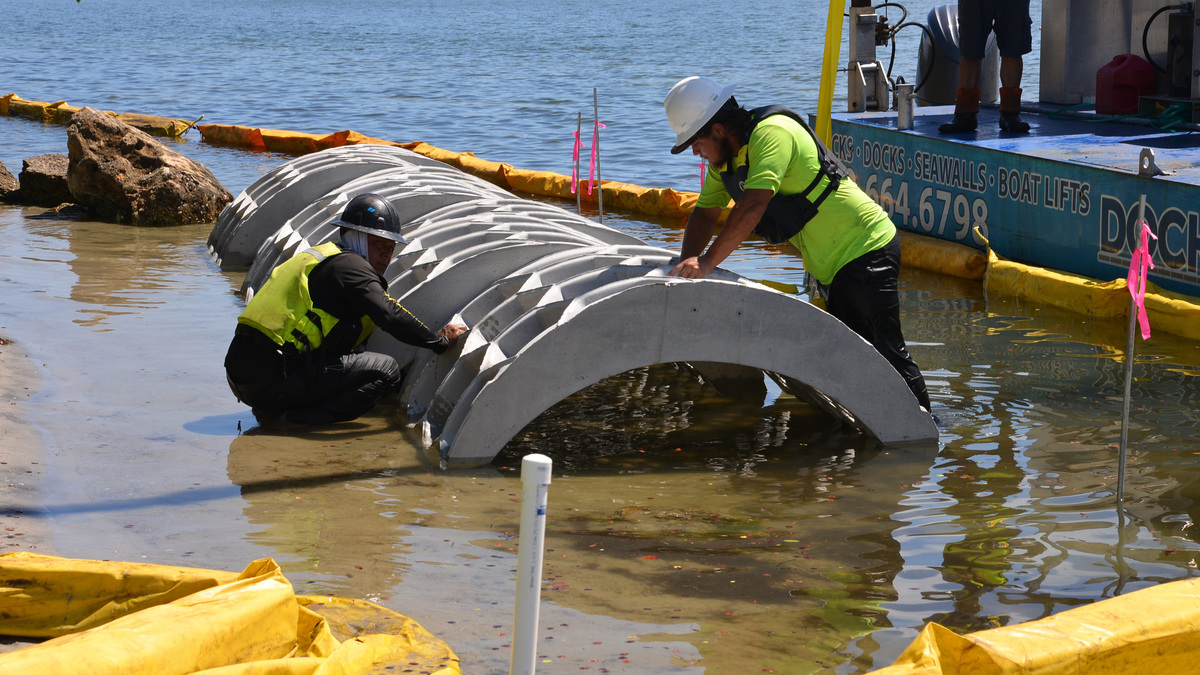
Sebastian Inlet District this month is installing a new $95,000 artificial reef and plantings, funded through Florida Department of Environmental Protection’s Resilient Florida Program, to install 15 reef arches from Reef Arches, LLC and 45 red mangroves along about 100 feet of shoreline on the south side of Coconut Point at Sebastian Inlet State Park.
The new “living shoreline” was installed Sept. 10 along about 200 feet of eroded shoreline at the park.
The pilot project aims to reduce erosion and improve habitat. Project partners include the Sebastian Inlet District, Sebastian Inlet State Park, Ocean Research Conservation Association, and Reef Arches LLC.
The project included the installation of 22 reef arch structures and about 90 mangroves along the shoreline. Reef arches are prefabricated, honeycomb-shaped modular units used to protect shoreline.
They’re an alternative to seawalls to absorb wave energy, filter pollutants and adapt to sea-level rise.
The Vero Beach-based nonprofit Ocean Research and Conservation Association (ORCA), partnered with the Sebastian Inlet District to fund seven of the reef arches and about half of the mangroves, and is using volunteer citizen scientists to help monitor the project for at least three years.
“We’re seeing accelerated erosion of natural shorelines in the Indian River Lagoon, which leads to habitat loss as well as water quality deterioration among other things,” Natalie Stephens, an ORCA research associate, said in a press release. “We utilize our citizen scientists to really look at what is happening over time and how a project is improving the shoreline.”
Read more Sarasota home sales rise as inventory tightens across region
The project is partially funded through a $95,000 state cost-share grant, with in-kind matches provided by the inlet district, Reef Arches and MANG , a foundation raising awareness about the critical role that mangroves play in supporting healthy coastal ecosystems and the communities that depend on them.
Guarding the Indian River Lagoon’s banks in Brevard got off to a “rocky” start, especially during the Space Race. Decades later, homeowners and government at all levels continue to rely on rocks, walls and other “hard” ways of protecting shorelines. That’s despite mounting evidence that “living shorelines” have a better track record along the lagoon banks.
The concept is gradually gaining ground as biologists can point to more examples of how nature’s ways are cheaper, longer-lasting and better for the environment.
In 2024, Brevard County launched a $4.2 million project to guard A. Max Brewer Memorial Parkway in Titusville with huge concrete pyramid-shaped wave breaks, baby clams, seagrass plantings and fill sand.
Regarding the Coconut Point project, according to Sebastian Inlet District documents:
- The district’s grant match portion is $7,918 and will be used for permitting and construction certification.
- The remaining $87,084 is from an in-kind combined match from Reef Arches, LLC. and the nonprofit MANG.
- As the local sponsor on the grant, the district will request $95,002 in total reimbursement from the state upon completion of the project.
- The project is similar to living shorelines that have gone in at Castaways Point Park and the nonprofit Marine Resources Council’s Ted Moorhead Lagoon House in Palm Bay.
- Learn about Florida Living Shorelines at: floridalivingshorelines.com
Waymer covers environment and government. Contact him at (321) 261-5903 or [email protected].
This article originally appeared on Florida Today: Sebastian Inlet adds ‘living shoreline’ to stop erosion
Read more Volatile yen draws intervention watch, other currencies subdued
Reporting by Jim Waymer, Florida Today / Florida Today
USA TODAY Network via Reuters Connect
Copyright Reuters or USA Today Network via Reuters Connect
This story was originally published September 21, 2026 at 5:07 AM.










Post Comment