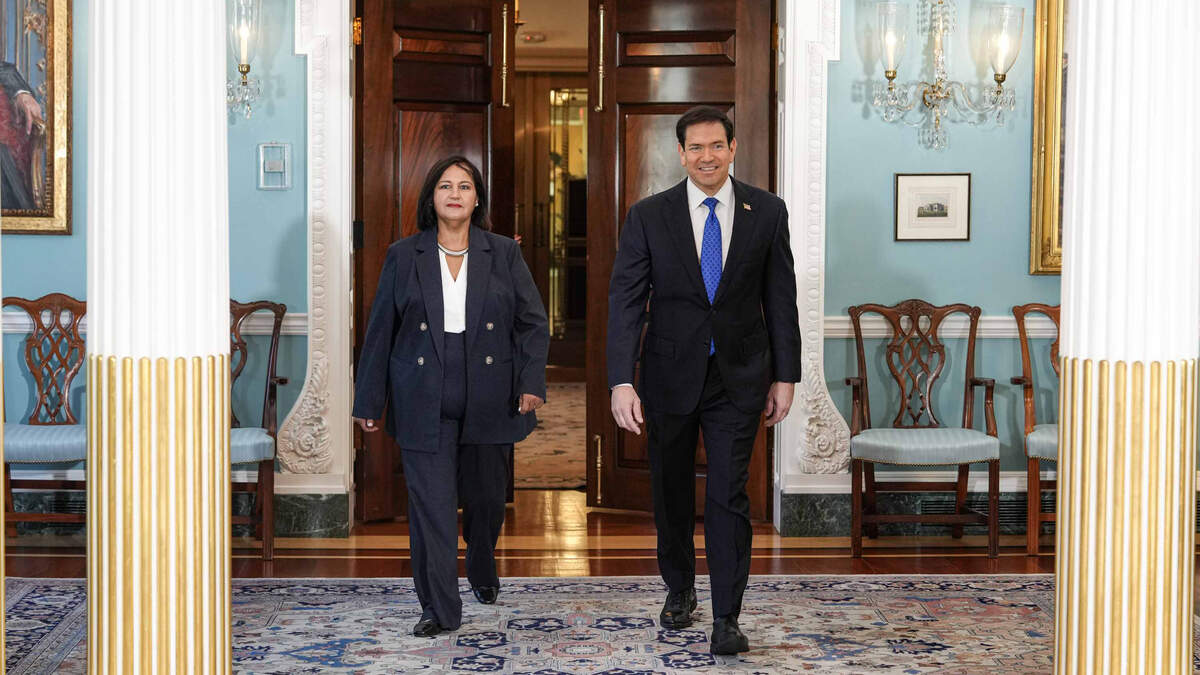
Rubio backs Venezuela transition talks but offers no timeline for elections
Secretary of State Marco Rubio on Friday reaffirmed Washington’s support for negotiations aimed at restoring democracy in Venezuela, calling the process the country’s best opportunity in more than a generation to overcome decades of political turmoil, while stressing that free elections must be accompanied by the rebuilding of democratic institutions.
Read more Florida ‘ghost’ candidate scandal haunts FPL in merger talks with Dominion
Rubio made the remarks in Washington after meeting with Venezuelan opposition leader Dinorah Figuera, who heads a delegation participating in U.S.-backed negotiations with the government of interim President Delcy Rodríguez. The talks have opened a new chapter in Venezuela’s political crisis following the U.S. military operation that captured Nicolás Maduro in Caracas on Jan. 3.
The secretary of state said the negotiations must involve all sectors of Venezuelan society and ultimately produce not only free elections but also institutions capable of sustaining democracy over the long term.
“This is the best opportunity Venezuela has had in more than a generation” to restore democracy, Rubio said in Spanish, describing the damage inflicted on the country during more than two decades of political upheaval.
Rubio also announced that another round of talks is expected on Oct. 14, signaling that Washington intends to maintain its involvement in the negotiations.
The meeting comes amid divisions within Venezuela’s opposition over the U.S.-backed dialogue, which does not directly include opposition leader María Corina Machado, despite her central role in the movement seeking a democratic transition.
Elections and institutions
Rubio said Venezuela had endured 20 to 25 years of profound trauma affecting every level of society and argued that restoring democracy would require more than organizing a presidential election.
“What we want, more than anything, is for Venezuela to have not simply a democracy, but a democracy that can govern,” Rubio said, emphasizing the need for stability, prosperity and freedom.
He said the United States wants free and democratic elections as soon as possible but also a functioning republic supported by institutions capable of preserving democratic government for future generations.
Rubio urged opposition groups and other sectors of Venezuelan society to participate in the negotiations, saying the process had already achieved progress despite the difficulties involved.
He also emphasized the strength of Washington’s commitment.
“This effort has our support at the highest levels of the U.S. government,” Rubio said. “We are going to do everything possible for this process to achieve what we all want.”
Figuera thanked Rubio and the Trump administration for supporting what she described as an opportunity for Venezuela that emerged after Maduro’s capture.
She said the opposition delegation was committed to rebuilding the country’s public institutions, particularly the Supreme Court of Justice and the National Electoral Council, two institutions whose lack of independence has been central to longstanding disputes over Venezuela’s electoral system.
“We are committed to the reinstitutionalization of public powers,” Figuera said in Spanish, citing the need to establish political and civil guarantees and create conditions for national reconciliation.
“Is it an easy process? It isn’t. But it is a possible process,” she added.
Figuera said the negotiations are following a roadmap developed with U.S. support and expressed confidence that institutional reconstruction, combined with economic recovery, can help Venezuela move toward democracy.
Read more ‘It’s been so many years,’ says mom of teacher allegedly killed by assistant principal
She specifically welcomed progress in oil investment, describing economic development and institutional rebuilding as two essential pillars of the country’s future.
No election date
Despite the emphasis on democratic elections, Figuera did not provide a timetable for holding them.
Asked whether elections would take place in the near future, she said the negotiating process would establish the necessary conditions.
“We are going to guarantee the path and the roadmap so that elections can take place,” she said.
The absence of a specific date underscores one of the principal disagreements surrounding the negotiations: how quickly Venezuela should move toward presidential elections while its institutions are being restructured.
The Democratic Unitary Platform, Venezuela’s largest opposition coalition, has called for a more dynamic relationship with Washington to accelerate political change.
Roberto Enríquez, the coalition’s interim executive secretary, told the Spanish news agency EFE that establishing a presidential election timetable as soon as possible would strengthen the U.S. plan for Venezuela, which envisions stabilization, recovery and democratic transition.
Enríquez argued that lasting economic recovery would be difficult without a legitimate government and that credible elections would help establish confidence among international investors.
Although the unitary platform party does not participate directly in the negotiations, two of its member parties, Primero Justicia and Voluntad Popular, are represented in Figuera’s delegation.
The coalition continues to support Machado, who won its presidential primary in 2023 but is not directly involved in the current talks.
According to Enríquez, the negotiations have already included discussions about restructuring the Supreme Court and restoring access to blocked internet domains, including those belonging to independent media outlets.
The opposition also wants changes to the National Electoral Council, the restoration of political parties whose leadership was taken over through court decisions and guarantees for free and fair elections.
For Rubio, the challenge extends beyond reaching an agreement on when Venezuelans can vote. The objective, he said, is to ensure that the eventual transition produces a democratic government capable of surviving beyond a single election and providing the stability Venezuelans have long sought.
This article was supplemented with reporting from el Nuevo Herald’s wire services.
Read more ‘It’s been so many years,’ says mom of teacher allegedly killed by assistant principal






Post Comment