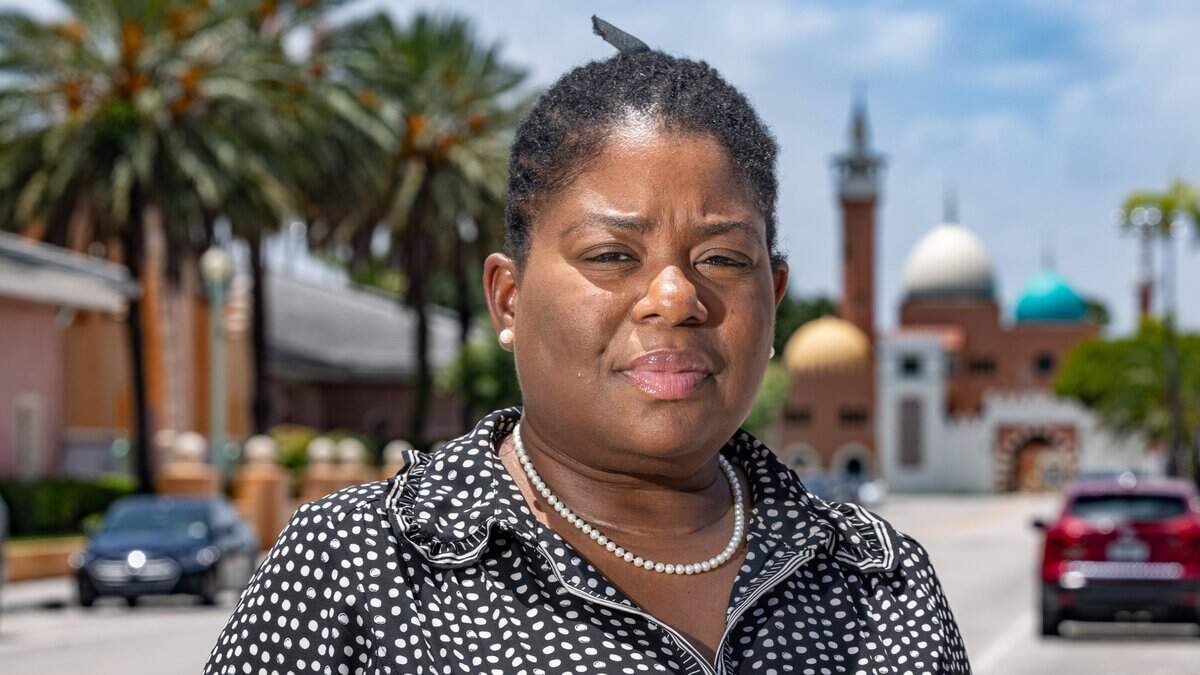
Residents of Frederica Wilson’s district want her successor to ‘be rebellious’
As one of the dwindling number of majority-Black congressional districts left in the South after a sweeping Republican-led redistricting effort this year, Florida’s Congressional District 24 is in a pivotal political moment. The district, established in 1992, well after the Voting Rights Act, to help ensure Black voting power, is in the process of a major transition of leadership as Congresswoman Frederica Wilson winds down her final term.
Read more Hollywood pair claimed baby was fake, but she was real and they killed her: cops
A crowded field of 10 candidates are vying to represent the district. Campaign signs are plastered across the district, town halls have been hosted, endorsements bestowed, Sunday sermons preached.
The Miami Herald wanted to speak to voters, residents and business owners about what they want to see in their next congressional representative. We found seven community stakeholders who spoke to us at length about their hopes for Wilson’s successor.
Time and again, the Herald was told that district residents don’t want to be represented in Washington, D.C., by someone they only know from a sign. Instead, people said they want a candidate that they can see walking the streets, showing up in person and prioritizing small businesses over corporate interests. Other priority issues included affordability, accessibility, housing, infrastructure and Temporary Protected Status.
Here’s what else Florida’s 24th District stakeholders had to say:
Sometimes I feel like we’re being pushed out.
Donnell Thompson, 60
Barber in Miami Gardens
Donnell Thompson remembers when Miami Gardens was referred to as Carol City and when the stretch of 27th Avenue outside his barbershop was just two lanes running north and south.
While he’s called Miami Gardens home for 20 years, he’s worried about displacement of residents and small businesses in favor of corporate interests and that if his barbershop closed, another locally-owned one wouldn’t be able to open there.
“Sometimes I feel like we’re being pushed out,” he said. “I think the big companies are coming in trying to push us out.”
Thompson is undecided on who he’ll support, but said he’s chatted with one candidate, Oliver Gilbert, while exercising at a nearby trail outside of North Dade Regional Library.
“He thinks bringing in a big company, big business is gonna bring more job opportunities for the community, which is cool, but don’t forget about the smaller people,” he said. “Don’t forget about the people that might get pushed out of the way while bringing in the bigger people. It’s enough room for everybody.”
He said while he has some disagreements with him about economic development, he values that Gilbert is easily accessible around Miami Gardens: “He’s out in the community. You can bounce into Oliver at Burger King. You can always see him. Everybody else you don’t see.”
Thompson said he ultimately wants someone who is present in the community and will keep the promises made to constituents. “Do what you say you’re going to do,” he said. “Fight for what you say you’re going to fight for. That’s what I like. I like honesty and just be a person of your word.”
Politicians for this area have always had the interest of their biggest donors.
Valencia Gunder, 42
Liberty City community leader/nonprofit founder
Inside the Carrie P. Meek Senior Center at Charles Hadley Park in Liberty City, longtime resident and nonprofit leader Valencia Gunder talks to senior residents during an event held by her nonprofit The Smile Trust.
Born and raised in Liberty City, Gunder has worked to aid Black communities with housing, provide hurricane relief, and assist low-income communities. While she is a no-party-affiliation voter, Gunder said she wants to see the next congressional representative address affordability, access to fresh food, healthcare, housing and mental health services.
She’d also like someone to address infrastructure and transportation concerns and not court corporate interests ahead of resident issues. “Politicians for this area have always had the interest of their biggest donors, which usually are developers and things like that, but they depend on the people for the vote,” she said.
“I also would like to see more resources going into community solutions that we need and want, not just what people think we need, but actually what people want to see in their communities,” she said.
Gunder said Wilson has been her congresswoman for much of her lifetime and pointed to her accessibility as a strength but said she recognizes the present challenges she and other members of Congress have in getting bills passed under the Trump administration – and said the next congressional representative will likely also deal with that struggle. Still, she wants someone who will speak out against the current administration.
“I got to understand that folks are dealing with this unprecedented, uncharted territory right now when it comes to policy and politics, especially in D.C.,” she said. “I also think that that’s when it’s an opportunity for you to at least be rebellious enough to speak out against it.”
Being one of the biggest Black congressional districts in America, we need a solid plan for District 24.
Isaiah Thomas, 36
Bookstore owner in Liberty City
Seated on a sofa below a large-scale painting of late Liberty City activist Danny Agnew, Roots Bookstore co-owner Isaiah Thomas described himself as a “Miami nomad” who has lived in Opa-locka, Overtown, and some places in between.
Thomas, an elementary school assistant principal, said living throughout Miami-Dade has shaped him and his desire to see more than Miami Gardens define the race to succeed Wilson and noted that cities like Opa-locka and neighborhoods like Liberty City deserve attention, too, when it comes to infrastructure and attracting local businesses.
“These corporations, these real estate conglomerates, they know how important Opa-locka is,” he said. “You could call it a transit hub. You have an airport, you have the railroad. It’s an important city, and it just doesn’t receive its fair shake.”
Thomas said affordability and education are top of mind for him going to the race. He pointed to the fact that his friends cannot afford to buy back into their communities and concerns about charter schools on the rise. But he also wants someone who won’t give into corporate interests at the expense of residents and local business owners and pushes back against Trump’s policies.
“Stand boldly against a lot of his policies and things he’s doing, especially when it comes to our community, TPS, and different things,” Thomas said. “And don’t let these corporations control you. Your constituents, the people, we the people, put you in this position. Don’t allow these corporations to come and control you with policies and with money to turn your back on your community because it’s easy to do it.”
And like others, he wants to see his congressional representative be more present in the district. While he’s undecided, he said showing up makes a difference, noting Gilbert and Meek came to the bookstore’s book fair on Juneteenth. “Just by them showing up and being present, understanding the importance of that event, they gained some props for me just for being here,” he said.
But he raised a more direct concern of not knowing what candidates’ plans are: “They’re campaigning, but being one of the biggest Black congressional districts in America, we need a solid plan for District 24.”
We need a congressional representative who’s going to put our people first.
Santra Denis, 41
Nonprofit founder
Santra Denis spent much of a sweltering July day at the Little Haiti Cultural Center at a rally she organized calling on Congress to enact a law that would extend Temporary Protected Status for Haitian immigrants.
Denis, president and founder of Avanse Ansanm, a nonprofit focused on building political and economic power among Haitian millennials, said she wants a candidate focused on immigration concerns in an area that has one of the largest populations of Haitian immigrants.
Read more Wrong-way DUI driver who killed 23-year-old paramedic on Turnpike gets 20 years
“They raise kids who are American citizens, and so it’s not only that they’re undocumented that they can’t vote, but they also have influence on people who may have the opportunity to shape what happens in this district,” she said.
Denis’ role as executive director for the Miami Workers Center puts her in Little Haiti and Liberty City often and gives her a front seat to the housing and affordability issues affecting residents who live in the district.
“If you’re already paying so much in housing, childcare is almost unattainable for folks,” she said. “Those are the things that we continue to hear. Wages are suppressed here. We really need some reform around living wage here in this state.”
Denis said she understands much of the work of a congressional representative will be in D.C., but still would like for them to be accessible to residents when they’re at home in South Florida and hold town hall meetings that educate residents about what is happening and how it’s affecting them.
Ultimately, she wants someone who prioritizes the needs of residents. “We need a congressional representative who’s going to put our people first, and not the billionaires, and not the tourists, but Miami first,” she said.
Fresh faces, fresh ideas, and new energy are important because we see what’s happening in these areas.
Tiffannie Ramos, 42
Liberty City resident
Liberty City resident Tiffannie Ramos grew up in the area and said she wants to vote for someone focused on affordable housing and the concerns of longtime residents who have been pushed out or cannot return to their neighborhood because it is too expensive to buy into it.
“As someone who grew up in this area, the most important thing is realizing how many of the area residents and those that have grown up do not have the ability to stay in their neighborhoods,” she said.
Ramos said she’d like to see small business owners receive funding to beautify their business and more recognition for how essential they are to the community. “These are the everyday mom-and-pops that are providing for their families,” she said. “They should have the same resources as those of larger corporations.”
“I’ve seen an influx of 7-Elevens and other organizations, but in the small restaurants and coffee shops and things that are building up in the areas, they don’t have the same accessibility to the funds that come through,” she said.
Like others, she’s undecided on the candidate she wants to serve her but said it comes down to accessibility and wants them to keep the community in mind when they legislate.
“What I find a lot in politics is that they become superstars and kind of forget about their communities,” she said. “We don’t need the pomp and circumstance. That seat has been occupied for so long… Fresh faces, fresh ideas, and new energy are important because we see what’s happening in these areas. I just don’t want us to be forgotten.”
All I see are signs of people I’ve never seen before.
Jovany Appolon, 31
Clothing store owner in unincorporated Dade
Jovany Appolon grew up just miles away from the latest location of his 1GR Urbanwear in Gladeview, a clothing store he co-founded with his uncle. While he no longer lives in the 24th District, because his business is in the district he’s been keeping his eye on the congressional district race as he hopes for leadership that is accessible and supports other entrepreneurs from the neighborhood he grew up in.
“I want a leader that’s able to get out of your office. Walk this corridor,” he said. “Don’t be scared, speak to the people.”
He said the most he’s heard from 10 candidates has been via the hundreds of political signs attached to public fences around the district.
“I see the signs. That’s the closest they get to the community, the signs or maybe a press appearance, or they go to a park and pretend that they care about the people,” he said. “All I see are signs of people I’ve never seen before.”
When it comes to representing this community in the halls of Congress, Appolon said he wants “support for small businesses” to be a top priority. He coaches other up-and-coming small business owners and said there needs to be more accessible financial education, including classes on starting an LLC and opening a business bank account.
“They’ve got to make this money accessible,” he said, adding that even small amounts of government-backed business support funds have unreasonable hurdles. “Yeah, they have local community agencies and stuff like that, but it’s so complicated to get it.”
My friends who are writers and artists, they cannot live where they work at all.
Sandy Dorsainvil, 49
Homeowner in unincorporated Dade
Dorsainvil was at the TPS rally in Little Haiti soaking in the concerns for Haitian immigrants and describes herself as a community redevelopment specialist and cultural curator. She has had an imprint all over the county, from being a manager of the Little Haiti Cultural Center to curating its premier monthly event, Sounds of Little Haiti.
While she is an American-born citizen, Dorsainvil said she has relatives and friends who are deeply impacted by the latest Supreme Court ruling on TPS. “I need my new congressional person to be sympathetic towards them and to also have an active plan of how they’re going to aid them,” she said. “I don’t want to say transition because that just assumes that they’re going to all have to leave, and I don’t want to believe that, but just help them adjust to whatever new policies are going to come through or at least impact the policies in some way.”
The quest for cheaper housing brought her family from New York to Miami-Dade County when she was younger, and now, some 30 years later, it remains an issue she wants her next congressional representative to address.
“My friends who are writers and artists, they cannot live where they work at all,” she said. “They can’t afford the rent. They can’t. Some of them are thinking about moving out of their condominiums because the association fees are so out of control.”
Dorsainvil said her daughter and son-in-law, both educators, had to move to Homestead – more than an hour’s drive – to be able to afford a home for them and their two children. “They are two college graduates, double income, and still could not afford to purchase a home nearby,” she said, adding she’d like to see her next representative focus on workforce housing for working professionals such as teachers and firefighters.
Like others interviewed, she is undecided and wants to hear what candidates’ plans are.
“They keep talking about what they’ve done in the past, but I haven’t heard any real conversations about a plan or legislation that they plan to bring forward,” she said. “Maybe when it gets closer, we’ll start to get to the meat of it. But for me, I need someone who’s going to take care of my family and my people.”
Miami Herald staff writers Ana Claudia Chacin and Churchill Ndonwie contributed to this report.
Read more Hollywood pair claimed baby was fake, but she was real and they killed her: cops







Post Comment