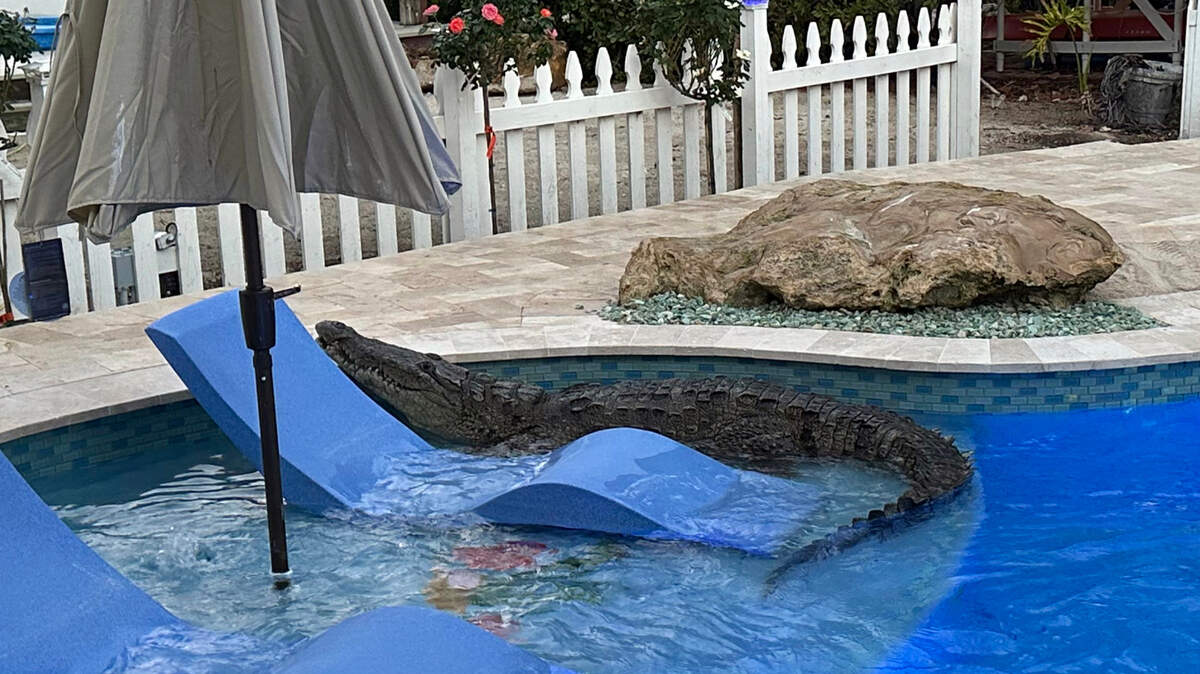
Paradise with predators? How South Florida can live with alligators next door
South Florida can be paradise to people — but gators and crocs love living here, too. And sometimes our paths cross.
Read more Florida gets a reality check with new business-friendly rankings
So, can we all exist together in our separate but converging worlds? That depends.
As development goes deeper into the Everglades and humans build artificial waterways — stormwater retention ponds, residential lakes, canals — alligators can move into the neighborhood. That can lead to conflict.
This year so far, Central Florida has seen three alligator attacks, and one of them killed a woman while she was swimming with friends.
In 2018, a woman was killed by an alligator in Davie while walking her dogs at Silver Lakes Rotary Nature Park. Some neighbors said they had seen alligators in the park, and lost pets that wandered too close to the water.
Last year, 13 alligator attacks were recorded in Florida, two of them deadly.
But Frank Mazzotti, a professor in wildlife ecology at the University of Florida and one of the “croc docs” who specializes in alligator research, doesn’t see alligators as Miami invaders. Mazzotti says gators are the original residents and are being pushed out by concrete.
In the first seven months of 2026, officials have received 64 calls for alligator removals in Miami-Dade County and 221 in Broward County. Of those, 15 gators were removed from Miami-Dade, 72 from Broward.
“We tend to look at all of this in terms of the alligators — something that the alligators are doing, the alligators are at fault, but we have just gone right out and built right in the middle of where they used to live,” Mazzotti said.
He also said that manmade waterways push alligators into urban settings like neighborhood streets and pool areas.
“We’ve not only moved into places where alligators used to live. We’ve kind of invited them back by creating habitat for them,” Mazzotti said.
Todd Hardwick, a wildlife trapper with Pesky Critters and one of the people the Florida Fish and Wildlife Conservation Commission calls to remove alligators, says urban wildlife, such as Muscovy ducks and the carp in the canals, offer a tasty and abundant menu for alligators.
“I’ve been calling our canal system the alligator turnpike for years,” Hardwick said. “It’s the perfect way for an alligator to easily find his way into the urban area with very little effort.”
Trapping the gators and crocs
Hardwick, who has a lot of stories about his gator trapping experiences, remembers a call from a woman about to head to work. She heard her car tire hissing. So she called AAA to fix the tire, but the auto service advised her that the hissing noise was coming from … the alligator underneath her car.
“When alligators are taking shortcuts at night from a canal to a lake or to another canal,” Hardwick said, “they’ll often hide underneath a car or in an open garage or a carport as the sun starts to come up, and sometimes they’re not discovered right away.”
But some of Hardwick’s gator stories don’t even involve gators.
A call about an alligator in a swimming pool turned out to be a palm tree frond that had sunk to the bottom. Another time, he was told about a gator in the road. It was a truck tire tread.
“I get snookered by imaginary gators,” he said.
Removing the alligators
When there really is a problematic gator that needs to be removed from an urban environment, there’s a protocol to follow.
The Florida Fish and Wildlife Conservation Commission, the law enforcement agency responsible for South Florida waterways, doesn’t remove alligators less than four feet long. If an aggressive alligator is longer than four feet, and has been exhibiting aggressive behavior, permits will likely be issued by the Statewide Nuisance Alligator Program (SNAP) for the animal to be removed by a licensed trapper, said the public information officer with the FWC, George Reynaud.
After removal, Hardwick says “there’s no happy ending.” At least for the gator.
Alligators cannot be relocated, according to Mazzotti, because their internal compasses can lead them back to their capture site, and they pose threats in other areas along their journey.
Most of the alligators captured will be euthanized, harvested and sold. In rare circumstances, they are placed in permanent captivity, like zoos.
Read more A Miami child-supplement maker had no permit and used vodka as sanitizer
“Very few make it to permanent captivity because there are more than 8,000 nuisance gators a year being captured, and only a handful of those does a zoo and exhibit want,” Hardwick said.
Reynaud encourages anyone concerned about a large alligator exhibiting aggressive behavior to call the Statewide Nuisance Alligator Program hotline: 866-FWC-Gator (866-392-4286).
What you shouldn’t do near a South Florida alligator
Am I concerned or am I worried about alligators being aggressive? Absolutely not. But am I worried about people being stupid? All the time.
Frank Mazzotti
Wildlife professor
Alligators, by nature, are not aggressive creatures. They have a natural fear of humans, and prefer not to interact with us.
“If you live next to a canal or a pond, you’re way more likely to drown than you are to be attacked by an alligator,” Mazzotti said. “When you get in your car and drive to a natural area to look at alligators, you’re in way more danger of getting in a car accident and dying than you are of having a negative interaction with an alligator.
“The common misconception is that these alligators are predators that see them as a prey item,” Hardwick said. “While on the rare occasion that does happen, it’s not nearly as likely as they think it could be.”
But the story can change if a person approaches, entices or feeds an alligator.
“All it takes is one person to want to go out there and start feeding them, enticing them, or anything like that, to create a hazard for somebody else,” said the FWC’s Reynaud.
“When people feed alligators, alligators not only lose their fear of humans, but they begin to associate people with food,” Mazzotti said. “They think people mean food.”
In Florida, feeding an alligator is a second-degree misdemeanor, which is punishable by up to 60 days in jail, a $500 fine, or both.
The punishment is worse if you try to catch an alligator.
“There’s been times when an officer has seen somebody fishing, and they’ve caught a small alligator, maybe a foot to two feet in length, and they just think it’s cool to keep it,” Reynaud said. “And that’s another criminal violation that we also do enforce.”
Catching an alligator can result in a third-degree felony.
According to Mazzotti, people should not “undertake risky behavior, especially when you know an alligator is present.” That includes swimming or fishing in waters that could contain alligators, or even walking your dog along the shoreline.
“That’s like waving a barbecue rib in front of a starving person,” Mazzotti said.
“Am I concerned or am I worried about alligators being aggressive? Absolutely not,” Mazzotti said. “But am I worried about people being stupid? All the time.”
How the big reptiles and humans can coexist in Florida
According to Mazzotti, as human-alligator interactions continue to increase, education is of “paramount importance.”
Reynaud says that the FWC attempts to educate through signs, social media and community events.
“Our biggest thing is always to educate people that alligators are a natural part of Florida’s ecosystem, and help maintain a healthy way to coexist, knowing that they’ve lived in the state for longer than we have,” Reynaud said. “They have the right to be here, and we want to make sure people know how to coexist in a way that is safe.”
According to Hardwick, he “represents both sides” — the wild alligator and the public.
“I don’t want to discourage people from calling in a gator that they feel is a legitimate danger or threat to anyone or their pets,” the Pesky Critters trapper said. “But certainly, let’s calm down and be thoughtful about the smaller gators that are behaving themselves that we don’t need to call in.”
Read more Florida gets a reality check with new business-friendly rankings
This story was originally published July 29, 2026 at 7:45 AM.











Post Comment