Miami won $20M from feds for soccer stadium bridge. It’s causing a political rift
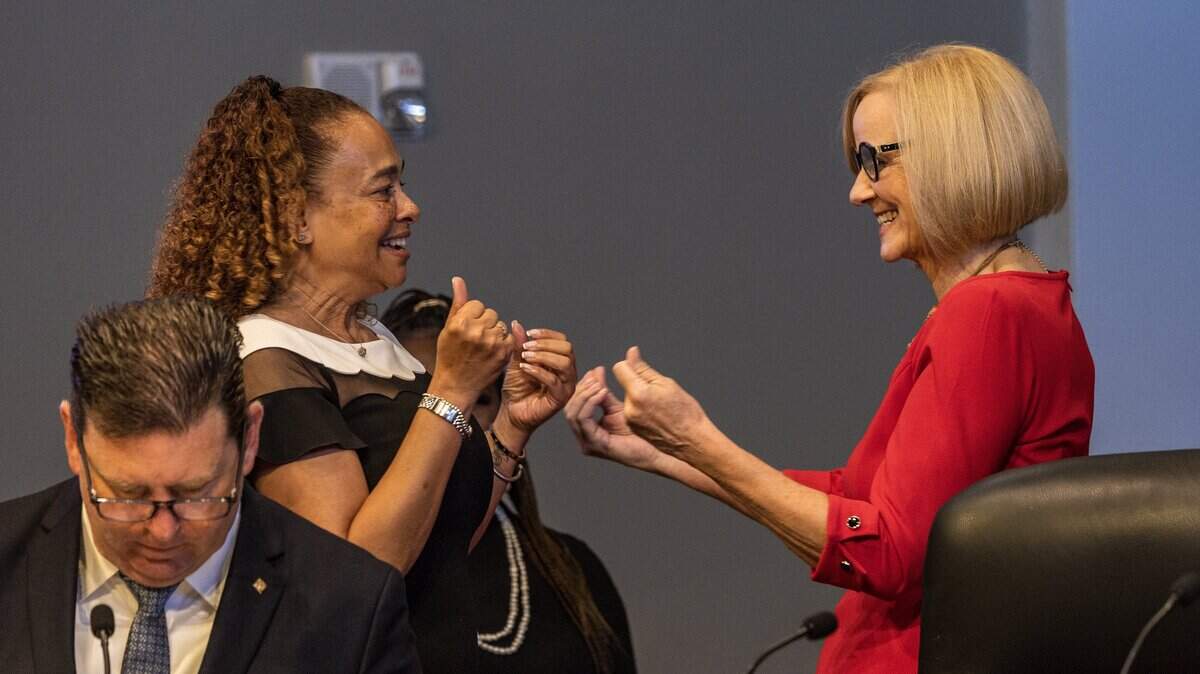
Eileen Higgins spent her first few months as Miami mayor quietly championing a $20 million federal grant application that would fund a pedestrian bridge connecting Miami International Airport to Miami Freedom Park, home of the soccer stadium that houses David Beckham’s MLS team.
Read more Miami mayor names herself commission chair, removes King. What it signals
After at least two trips to Washington, D.C., this year where she advocated for the project, the mayor finally received some good news. She announced this month that the city was one of 127 recipients of a U.S. Department of Transportation grant awarded to transportation infrastructure projects “with significant local or regional impact.”
“This project is about planning for the Miami we are becoming,” Higgins said in a July 10 press release. “… This $20 million federal investment helps us improve safety, expand access to transit, and build a more connected Miami.”
But not everyone in the city was celebrating.
That’s because Miami had submitted competing applications for the same USDOT grant. The other application, for a project championed by Commissioner Christine King, was not awarded funding.
King’s project — formerly known as the Underdeck and now renamed the Rev. Edward T. Graham Heritage Trail — was designed to reconnect Overtown, a once-prosperous Black neighborhood that was devastated decades ago by the construction of Interstates 95 and 395.
The Graham Heritage Trail would create 33 acres of open space beneath I-395 that would include a 1-mile central promenade and connections to transit networks, “transform[ing] a dark, desolate, uninviting under-the-highway eyesore into a stunning, world-class community gathering place,” according to the application.
The city in 2024 received a $60 million grant for that project under a Biden-era program meant to rebuild communities divided by transportation infrastructure. But last summer, following the passage of the Big Beautiful Bill, the Trump administration killed the remaining funds in that program, and the money went away.
For King, the USDOT grant looked like an opportunity to reclaim funds for the Graham Heritage Trail project.
“Seeking this grant was important because it was going to help address a decades-long quality-of-life issue for residents in Overtown,” King said in an interview with the Miami Herald. “Everyone is aware of how the community was almost decimated when the expressway went through the middle of Overtown. Now, there is an effort to reimagine, revitalize the space.”
The city asked for $25 million for the project; it received $0. Asked if she felt that the city applying for the pedestrian bridge grant jeopardized the chances of the Graham Heritage Trail receiving funding, King said: “It certainly made it more difficult.”
In a statement to the Herald after her interview, King put it more bluntly.
“Perhaps if the Mayor did not require staff to submit a competing application, and instead used her office to advocate for the residents of Overtown, the outcome could have been very different,” King said. “My priority remains clear as we move forward: elevating the quality of life for Overtown residents by addressing decades of disenfranchisement.”
The growing rift between Higgins and King escalated further Monday morning, when the mayor announced that she was designating herself as chairwoman of the five-member City Commission, effectively removing King from the role. King had held the position since 2021, and Higgins reappointed her in December shortly after being sworn in.
‘We obviously didn’t see eye to eye’
While she’s known for her transit advocacy, the mayor has publicly said little about the city’s recent push for the pedestrian bridge project.
But speaking to the Herald, Higgins described a concerted effort by the city, in collaboration with Miami Freedom Park, to secure the grant this year. The city previously awarded a 99-year lease to billionaires Jorge and Jose Mas, as well as Beckham, to develop the site. Higgins said Miami Freedom Park’s involvement in the application process included help with grant writing.
Miami Freedom Park President Devon McCorkle thanked Higgins in a press release last week, along with “everyone whose partnership and commitment helped make this important project possible.”
The grant application was finalized in late February, weeks before Nu Stadium’s April 4 grand opening, which was made possible thanks to a special permit issued by the city less than 24 hours before kickoff, as the stadium was scrambling to get a temporary occupancy certificate.
The 26,700-seat stadium has brought an influx of fans to Miami’s residential Grapeland Heights neighborhood, which Higgins said “could be inundated with traffic if we don’t have a safe way to encourage people to use transit.”
The mayor noted that the Miami Freedom Park site is also the home of the up-and-coming city administration building, which will also house the future City Hall. Higgins said the 1,450-foot pedestrian bridge, called the Safe Access Pedestrian Connector Project, will provide residents much-needed pedestrian access to government services from the airport’s transit hub, which includes a Metrorail stop.
“This connectivity to transit matters,” Higgins said.
During trips to Washington, D.C., in March and May, Higgins said she met with USDOT officials and advocated for both the pedestrian bridge and the Graham Heritage Trail project. But during those meetings, Higgins said, it became apparent that there wasn’t an appetite among federal officials to fund the Graham Heritage Trail project.
“We didn’t have competing grants,” Higgins said. “We had a grant that aligned with the president’s priorities, and we had a grant that we really want but wasn’t in alignment, nor written in a way that aligned, with the president’s priorities.
“And I am saddened and disappointed that we’re not allowed to really advance equity projects in this administration,” Higgins continued. “But that’s the world we live in, and it doesn’t mean I’m not going to draw down federal funds when we have infrastructure projects that we can align with him on.”
King sees it differently. She told the Herald one project “literally addresses a quality-of-life issue,” whereas the other is “for entertainment purposes.”
“I don’t think that the residents of Overtown would care how efficiently they can get to a sporting event,” King said, “versus quality of life for them.”
King said Higgins approached her at a ribbon-cutting ceremony in early February to inform King of her plans to apply for the federal grant. Higgins said she had suggested to King to hold back on the Graham Heritage Trail application for now and come back in a year to allow for “a complete rewrite of the grant.”
But both Higgins and King proceeded with their separate applications anyway.
“We obviously didn’t see eye to eye on what was more important,” King said.
The grant applications include “letters of support” from politicians and community leaders making the case for the projects.
Read more Sunday’s only lottery draw winner came from a South Florida gas station
King’s application included letters from herself and two colleagues on the City Commission: Commissioners Damian Pardo and Ralph Rosado.
Higgins’ application, on the other hand, had letters from Miami-Dade County Mayor Daniella Levine Cava, as well as several members of Florida’s congressional delegation, including U.S. Sens. Rick Scott and Ashley Moody, whose written testimonials, the application notes, “were sent directly to U.S. Transportation Secretary, the Honorable Sean Duffy.”
The situation was news to Pardo, who for years has been a supporter of the Graham Heritage Trail project. About three months ago, Pardo joined King on a trip to Washington, D.C., to advocate for the grant.
“You have to really champion something for it to get funded,” Pardo said. “That’s the reason we decided to go up there [to D.C.] and, you know, make the big effort.”
But Pardo described an “awkward” meeting during that trip when he found out there was competition for the grant from within his own government.
“Maybe I didn’t ask the right question, maybe I didn’t get the email. But I did not realize that there was a competing grant,” Pardo said. “ … The way they reacted made it seem like, ‘Make sure to apply again next year.’”
Growing rift between Miami Democrats
The competing grant applications spotlight a rift forming between the city’s Democratic elected officials.
While the positions of mayor and city commissioner are technically nonpartisan, Higgins’ December election to City Hall was heralded as a victory for progressives. Backed by the Democratic National Committee, Higgins defeated Trump-endorsed Emilio González, making her the city’s first Democrat mayor in decades.
Coming off the heels of a red-versus-blue election, one might assume Higgins would find easy allies in her fellow Democrats, Pardo and King. But that hasn’t necessarily been the case during the mayor’s first few months in office.
Higgins, for example, spent months wrangling three City Commission votes to send her $450 million public safety bond to the November ballot. When the commission finally called the vote in early July, Higgins succeeded thanks to support from across the aisle: Commissioners Ralph Rosado, Rolando Escalona and Miguel Angel Gabela — all Republicans — backed her bond measure. Pardo and King voted against it.
Tensions escalated moments before the bond vote was called. Higgins, who presided over that particular commission meeting instead of King, the designated chairwoman, tried to quell cross-talk happening on the dais.
“Colleagues, colleagues, colleagues,” Higgins said. “We have three people talking at once, and this is a professional meeting.”
“We answered professionally. I’m not sure what you’re —,” King began to respond.
“Commissioner King,” the mayor interjected, gesturing with her hand and briefly pointing her finger.
“Listen, one, don’t point your finger at me, ‘cause I’m not your child,” King responded. “Don’t point your finger at me.”
City ‘sat on its hands’
Miami officials were left reeling last summer when the Trump administration yanked the $60 million grant for what was then known as the Underdeck project.
The grant had been issued by the Biden Administration as part of the Reconnecting Communities and Neighborhoods Program meant to rebuild communities divided by transportation infrastructure. But last summer, the Trump administration killed the remaining funds in that program.
Higgins, however, said much of the blame for losing the funding actually lies with the city officials at the time. According to her, the city “sat on its hands” and did not complete the paperwork in time to finalize the agreement, which she said the city should have done prior to President Trump’s January 2025 inauguration.
“That responsibility rests on the prior administration and the commissioners who were serving at that time,” Higgins said. “Other cities in America got their awards at the same time, that March 2024 tranche, and moved more quickly to get their grant agreements signed.”
It’s not clear, however, whether the city had much control over execution of the $60 million grant by that point. A May 2024 letter from former City Manager Art Noriega shows that the city transferred the grant to the Florida Department of Transportation as the “recipient and administering agency” due to FDOT’s “increased resources and experience in administering federal grants of this size.”
Noriega wrote that the city would still be involved in public engagement and design, but that FDOT and the U.S. Transportation Department would negotiate and draft the grant agreement. FDOT did not respond to a recent request for comment on the matter.
King strongly disagreed with Higgins’ characterization of events.
“It is convenient, and exactly what one would expect a politician to do, blame the previous administration to justify her own careless conduct,” King said in a statement. “However, the facts contradict the narrative that the Mayor would like everyone to believe. The City, the previous Republican Mayor, his administration, and Commissioners acted prudently by transferring the grant to FDOT, who is an equity partner on the project and holds legal title to the Rev. Edward T. Graham Heritage Trail.”
Levine Cava, who submitted a letter of support for the pedestrian bridge project, told the Herald she wasn’t aware that it was competing against the Graham Heritage Trail for grant funding. But she emphasized the importance of the bridge to link the new sports venue with the county’s transit system in a safe way.
“We need safe transportation to the stadium,” Levine Cava said. “People need to get across the street if they want to take transit.”
She also praised the Underdeck as a good project that never should have lost federal dollars under Trump.
Read more New string of heat advisories began Monday in Miami. When will it end this time?
“It would be glorious” to get built, Levine Cava said.
Miami Herald staff writer Douglas Hanks contributed to this report.








Post Comment