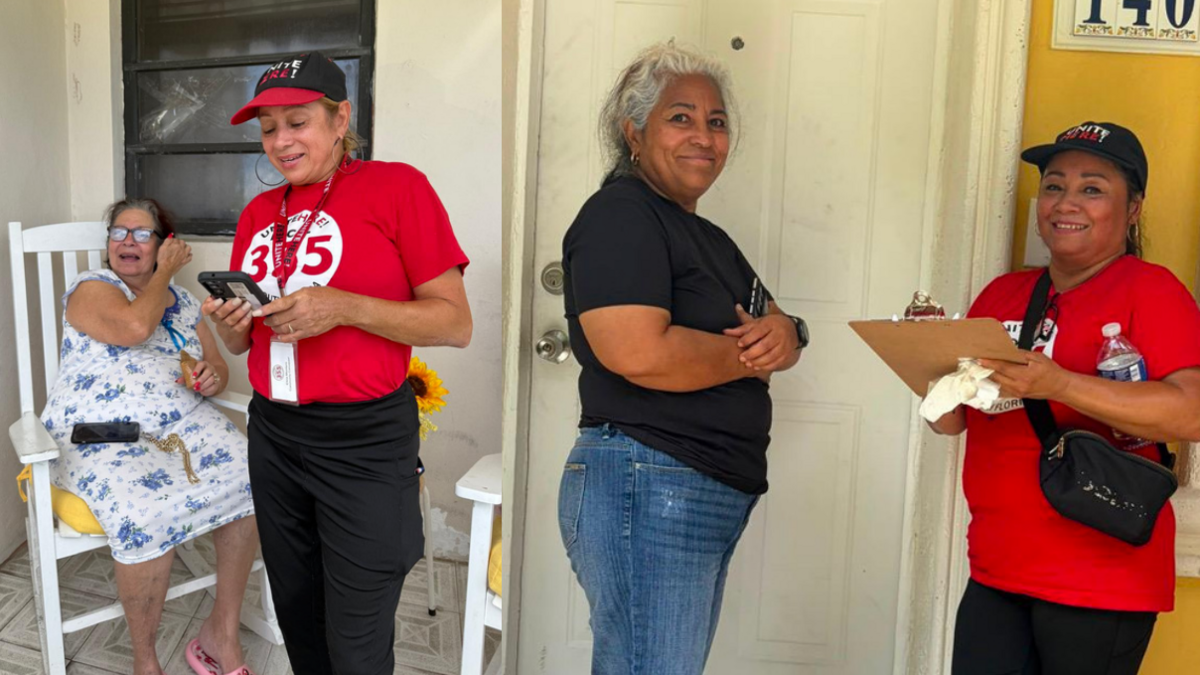
Miami unions knocked on 32,000 doors. This is what Hispanic voters told them
Hispanic voters in Miami are frustrated by the high cost of living, including food and transportation, and feel that the American dream is slipping away, according to a new survey by two South Florida labor unions.
Read more Miami unions knocked on 32,000 doors. This is what Hispanic voters told them
After knocking on more than 30,000 doors this spring, the unions also found widespread dissatisfaction with immigration enforcement.
Unite Here Local 355 and SIEU 32BJ, representing workers from hospitality to maintenance, launched teams throughout Miami between March 21 and June 27. Canvassers completed over 2,381 surveys from Latino working-class voters and residents are considering leaving Miami due to high debt, declining economic conditions and the Trump administration’s crackdown on immigration.
Elvia Montero, a Dominican immigrant who canvassed for Unite Here, said she still thinks about the elderly residents who told her they were still working two jobs because their Supplemental Nutrition Assistance Program or Social Security benefit checks were not enough for them to get by.
“The American dream has turned into a nightmare for many people in our community. People are suffering and not receiving any kind of support,” she said.
Seventy-seven percent of respondents said economic conditions were getting worse, compared with 18% who said they were staying the same. Only 5% said they were improving.
Though the unions conducted the survey during a midterm election season, they did not ask voters which candidate they thought would solve their issue.
They did, however, ask who the voters thought was responsible for the cost-of-living crisis.
When provided the menu options of politicians, corporations, and multimillionaires, 59% chose all the above. However, 29% said politicians were to blame.
Disappointed with immigration enforcement
People who participated placed the high cost of food at the top of the list of daily expenses causing the most difficulty in their lives.
Eighty-five percent rated food costs as a 5 out of 5 in difficulty. Housing was given the same rating by 78%, and medical expenses by 67%.
Another 88% cited the high gas and transportation expenses as one of their biggest concerns.
Martha Cabrera, a Cuban immigrant who canvassed for Unite Here, said she learned that “Latino voters of Miami feel very disappointed, very let down by the current conditions here in Miami.”
Read more Omar Thornton, known for physicality, ‘fits perfectly’ in Hurricanes defense
“We heard from many people really upset and frustrated,” she said. “How is it possible that there are people moving to Miami with millions of dollars, and our community is barely surviving, even though they’re benefiting from our labor?”
Sixty-seven percent of respondents said they would support increasing taxes on millionaires, while16% opposed such a measure.
But across Miami neighborhoods, surveyors found that the Trump administration’s immigration crackdown was top of mind for working-class Latinos, with 78% of respondents saying it was their top priority.
When asked to choose the best word to describe how they feel about immigration, 58% chose the word “disappointed,” and 19% chose “angry.”
Wendi Walsh, the general vice president of Unite Here, said on top of the “crushing weight” of the economy, families are living in “fear and disillusionment under the current system of immigration enforcement.”
“Our members, their families, their neighbors are feeling targeted, vulnerable, and completely ignored by the political establishment; they’ve watched their neighbors here in South Florida lose their status, both to work and to live here in the country, with the termination of humanitarian parole and [Temporary Protected Status] for many of our residents,” she said.
The Trump administration eliminated Temporary Protected Status for hundreds of thousands of Haitians and Venezuelans, stripping away their protection from being deported and their ability to work legally in the United States.
In May, the labor unions added questions to the survey to gauge how Latino voters felt about Republican U.S. Rep. Maria Salazar’s Dignity Act, which aimed to provide a legal pathway for immigrants who have lived in the United States for years without a criminal record.
Salazar’s bill, which has not advanced for a vote in the House, would mandate that undocumented immigrant workers pay a $1,000 annual fee for seven years to remain legally authorized to work in the U.S.
Latino voters in Miami who participated in the survey disagreed with the bargain. Eighty-one percent said they did not support that component of the bill.
Salazar’s office did not immediately respond to requests for comment.
The report concluded that for the working-class Latino community, the issues of affordability and immigration crackdown have reached a tipping point. They recommended expanding legal pathways to permanent residency and citizenship, including TPS and raising the minimum wage.
Read more Candor on key Hafley/McDaniel difference. And how Dolphin coach should be judged










Post Comment