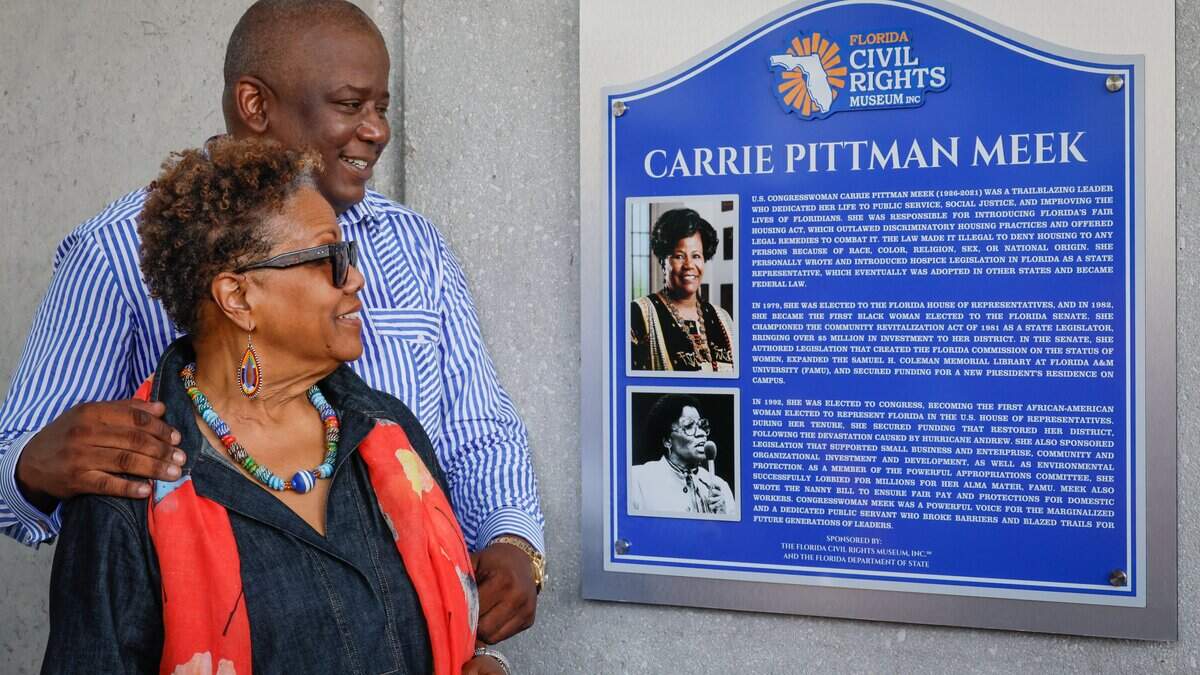
‘Memory needs a place to live.’ Marker honors history maker in Miami
In 1961, Carrie Meek became the first Black educator at Miami Dade College, then called North Dade Junior College, working her way through the ranks to associate dean and eventually becoming a state legislator and congresswoman.
Read more ‘Memory needs a place to live.’ Marker honors history maker in Miami
So, it was only fitting that a historical marker honoring Meek’s statewide and South Florida contributions be affixed to the very Liberty City campus where she brought $2.3 million in funding to build the school’s entrepreneurial center, which now bears her name.
The Meek family stood before a crowd of 75 people inside the Miami Dade College Carrie P. Meek Entrepreneurial Educational Center and said the marker is a symbol of Meek’s work and investment into youth and community.
“Young people inspired her,” son and former Congressman Kendrick Meek Sr. said of his late mother. “She understood what struggle looked like. She was a once-in-a-lifetime figure that came to do battle on behalf of good.”
The marker is the first in Miami-Dade County from the Florida Civil Rights Museum as part of its heritage trail honoring Black pioneers throughout Florida. “These markers are important because memory needs a place to live,” Florida Civil Rights Museum Co-executive Director Delaitre J. Hollinger said during Saturday’s event.
“Long after all of us have left this place, a child will walk past this marker, a teacher will stop here with students,” he continued. “Someone who never had the privilege of meeting Carrie Meek will read her name and discover what she did, and perhaps that person will decide I can do something, too.”
For Meek Sr., the honor speaks squarely to the legacy that his mother built and the communities that she cultivated. Meek said he recalls the late nights that his mother would spend working at Miami Dade College when he was a boy, a sign of her resilience and commitment to education.
“The work that she did was monolithic in the area of education and housing and even assisting our community as we found new immigrants coming to this community and becoming citizens,” he said. “Carrie Meek was one of the people that laid out the doormat for the very mission that Miami Dade College set out to accomplish and brought a sense of community.”
Miami Dade College President Madeline Pumariega recalled how Meek was supportive of her mother when she came from Cuba and wanted to return to work as a teacher. At the time, Pumariega’s mother was working in a factory in Hialeah after coming to the U.S. and Meek was a director of a program doing outreach services for people who wanted to study English and then become teachers.
Read more No. 13 Alabama leans into ground game, tops East Carolina 48-10
Pumariega’s mother went through the program and would go on to graduate from St. Thomas University before becoming a teacher for Miami-Dade County Public Schools. “It’s really a full-circle moment,” she said. “It reminds us how transformative education can be, and they both believed in that.”
Meek died in 2021 at 95 after a political career that spanned nearly 25 years. Born in Tallahassee to sharecroppers, Meek was raised during the Jim Crow era and would go on to break racial barriers.
A graduate of Florida A&M University, Meek taught at Bethune-Cookman University and Florida A&M. She was recruited by what is now Miami Dade College to become the first Black professor there. It was among a series of firsts for Meek, whose political career began in 1979 when she won a special election to fill Gwen Cherry’s Florida House seat following her death.
Meek would hold that seat until 1982 when she ran for the Florida Senate, becoming the first Black woman since Reconstruction to be elected to the body.
In 1992, Meek would become one of the first Black legislators to represent Florida in Congress since Reconstruction after the Florida Legislature redrew districts. She would hold that seat until 2003, when she retired. Her son, Meek Sr., succeeded her. Her grandson, Kendrick Meek Jr., ran for the office last month, but came in third with 17% of the vote.
During her legislative career, Meek spoke out against the discrimination of Afro-Cubans by Cuba’s communist government and advocated for U.S. residence for Haitian immigrants, who made up a sizable portion of her north Miami-Dade district. She was also an advocate for affordable housing and access to healthcare and education.
In 1991, she founded the Carrie Meek Foundation, a nonprofit focused on education, health, affordable housing and economic mobility and is spearheaded by her daughter Lucia Davis-Raiford, who said the marker is a testament to her mother’s legacy.
“This is what legacy looks like and feels like,” she said. “We have a responsibility, and we take it seriously. Carrie gave us the greatest gift: the gift of hardwork, dedication and commitment to your people.”
Read more Five Below wins over shoppers with major strategy shift










Post Comment